
North Korea’s Kim Jong Un Re-elected as Chief of Workers’ Party
Unanimous party vote reinforces Kim Jong Un’s authority as North Korea confronts economic hardship and rising international tensions.

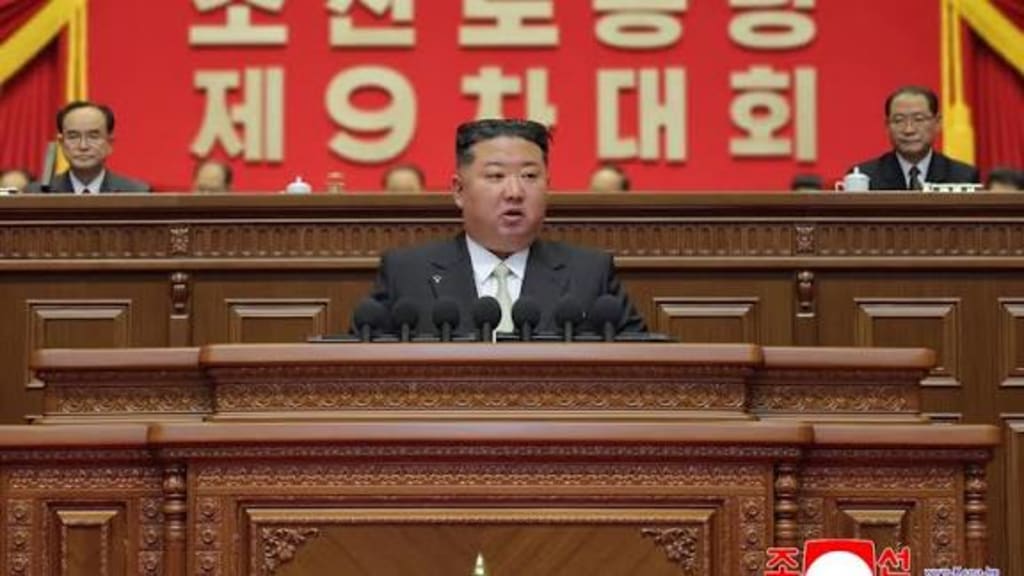
North Korean leader Kim Jong Un has been re-elected as chairman of the ruling Workers’ Party of Korea, consolidating his grip on power and reinforcing the continuity of the country’s political system amid growing economic strain and international isolation.
The decision was announced at the conclusion of a high-level party congress held in Pyongyang, where senior officials praised Kim’s leadership and reaffirmed their commitment to his long-term strategic vision. State media described the vote as unanimous, presenting it as an expression of “absolute loyalty” to Kim and his policies on defense, development, and national unity.
The re-election marks another chapter in Kim’s rule, which began in 2011 following the death of his father, Kim Jong Il. Over more than a decade in power, Kim has reshaped the country’s political hierarchy while prioritizing nuclear and missile development alongside limited economic reforms.
Symbol of Political Stability
The Workers’ Party remains the central pillar of governance in North Korea, and Kim’s reappointment as its chief sends a strong signal of internal stability at a time when the nation faces mounting challenges. Officials attending the congress highlighted the importance of ideological unity and discipline, emphasizing that loyalty to the party and its leader remains the foundation of national strength.
In a speech broadcast by state television, Kim called for “greater resolve and self-reliance” as the country confronts what he described as “hostile external forces” and economic pressures. He also urged party cadres to focus on improving food production, strengthening defense capabilities, and maintaining social order.
“The success of our revolution depends on the unity between the party and the people,” Kim was quoted as saying.
Economic and Social Pressures
Kim’s re-election comes as North Korea continues to struggle with food shortages, declining trade, and the lingering effects of border closures imposed during the COVID-19 pandemic. International sanctions tied to its nuclear and missile programs have further restricted access to global markets and foreign investment.
Observers note that the leadership’s emphasis on stability and continuity reflects concern about domestic morale. Recent state media messaging has focused heavily on self-sufficiency, agricultural productivity, and industrial output, signaling that economic management will be a key priority during Kim’s next term as party chief.
Analysts say the re-election also serves to reinforce the image of Kim as an indispensable figure at a time when the country must navigate both internal hardship and external diplomatic pressure.
Military Focus Remains Central
While economic issues dominated parts of the congress agenda, defense policy remained at the core of Kim’s leadership message. The Workers’ Party reaffirmed its commitment to strengthening nuclear deterrence and advancing missile technology, which it views as essential to national security.
Over the past year, North Korea has conducted multiple missile tests and expanded its military exercises. Officials portrayed these actions as defensive measures against what they describe as hostile policies from the United States and its regional allies.
Kim’s re-election ensures that this strategic direction will continue without interruption. Experts believe that Pyongyang is unlikely to scale back its weapons programs in the near future, even as it seeks limited engagement with foreign partners for humanitarian and economic relief.
International Reaction
Foreign governments responded cautiously to the announcement. South Korean officials said they were monitoring developments closely and reiterated their call for dialogue and denuclearization. The United States issued a statement urging North Korea to return to negotiations and refrain from further provocative actions.
China and Russia, two of Pyongyang’s key diplomatic partners, emphasized stability and regional peace, avoiding direct criticism of Kim’s leadership.
Consolidation of Power
Kim’s re-election highlights the tightly controlled nature of North Korea’s political system, where leadership transitions are managed internally without public competition. The congress also confirmed appointments to key positions within the party’s central committee, ensuring that trusted allies remain in influential roles.
Political scientists note that such events are less about debate and more about reinforcing unity around Kim’s authority. “These congresses are designed to project confidence and continuity,” said one regional analyst. “They remind both domestic and international audiences that Kim’s leadership is secure.”
Looking Ahead
As Kim Jong Un begins another term as head of the Workers’ Party, North Korea faces a complex future shaped by economic uncertainty, diplomatic isolation, and persistent security tensions. His re-election suggests that the country will continue along its current path, prioritizing political control and military strength while cautiously managing domestic challenges.
For Pyongyang, the message is clear: stability under Kim’s leadership remains the guiding principle, even as pressures at home and abroad continue to mount.
About the Creator
Fiaz Ahmed
I am Fiaz Ahmed. I am a passionate writer. I love covering trending topics and breaking news. With a sharp eye for what’s happening around the world, and crafts timely and engaging stories that keep readers informed and updated.
Keep reading
More stories from Fiaz Ahmed and writers in The Swamp and other communities.
France Will Become the First Nation to Use Airbus’s New Ship-Launched Drone and Jump From Laggard to Pioneer
France is set to become the first country to operationally deploy Airbus’s new ship-launched drone system, marking a major shift in its naval and aerial surveillance capabilities. The move places France at the forefront of European maritime drone innovation and signals a dramatic transformation from a nation once criticized for lagging behind in unmanned systems to one now positioning itself as a pioneer. The drone, developed by Airbus, is designed to be launched directly from naval vessels without the need for runways or large flight decks. It can conduct long-endurance reconnaissance missions, gather intelligence, and provide real-time data to commanders at sea. French defense officials confirmed that the system will be integrated into the fleet over the coming months following a series of successful trials in the Mediterranean and Atlantic waters. A Breakthrough in Naval Drone Operations Unlike traditional shipborne helicopters or larger unmanned aircraft, the new drone is compact and designed for rapid deployment from frigates and patrol vessels. It uses a catapult-style launch system and can be recovered vertically or via net capture, allowing it to operate from smaller warships with limited space. This capability significantly expands the surveillance reach of the French Navy. A single vessel can now monitor vast areas of ocean, track suspicious vessels, and support search-and-rescue missions without relying on manned aircraft. “This technology gives us eyes far beyond the horizon,” said a senior French naval officer involved in the testing program. “It changes how we think about maritime security and operational awareness.” From Delay to Leadership For years, France was considered behind countries such as the United States and Israel in the field of military drones. Political hesitation, regulatory hurdles, and budget constraints slowed the adoption of unmanned systems within the French armed forces. That narrative is now shifting. By becoming the first nation to deploy Airbus’s ship-launched drone, France has leapfrogged several competitors and established itself as a testing ground for next-generation naval aviation technology. Defense analysts say the move reflects lessons learned from modern conflicts, where drones have proven essential for intelligence gathering, targeting, and battlefield coordination. “Navies are realizing that unmanned systems are no longer optional,” said one European security expert. “France’s decision puts it at the front of a new operational model.” Strategic and Geopolitical Impact The deployment is expected to strengthen France’s role in NATO maritime operations and European Union security missions. The drone will support patrols in the Mediterranean, the Atlantic approaches, and overseas territories where France maintains a permanent naval presence. It will also be used to monitor illegal trafficking, piracy, and unauthorized fishing, as well as to provide situational awareness during humanitarian and disaster-response missions. Beyond its practical uses, the decision carries symbolic weight. It demonstrates Europe’s growing independence in defense technology at a time when many nations are seeking alternatives to U.S.-made systems. Industrial and Economic Significance For Airbus, the project represents a major commercial and technological achievement. The company has invested heavily in unmanned aerial systems as part of its strategy to diversify beyond traditional aircraft production. Executives believe France’s adoption will encourage other European navies to follow suit. Several countries are already observing the French trials closely, raising the possibility of future export contracts. “This is not just a military step,” said an Airbus spokesperson. “It is a signal that European innovation can lead in cutting-edge defense technology.” Challenges Ahead Despite its promise, the system still faces challenges. Integration with existing naval command networks must be perfected, and crews require specialized training to operate and maintain the drones safely at sea. There are also ongoing debates about cybersecurity and the vulnerability of unmanned systems to electronic warfare. Environmental conditions pose another test. Saltwater corrosion, high winds, and rough seas demand extremely robust engineering to ensure reliability. A New Chapter for French Naval Power France’s decision to field Airbus’s ship-launched drone marks a turning point in its military modernization. Once cautious about embracing unmanned warfare, the country is now helping shape the future of naval operations in Europe. By combining advanced drone technology with its global naval presence, France is redefining how maritime missions are conducted—faster, safer, and with greater reach than ever before. As one defense official concluded, “This is not just a new aircraft. It is a new way of seeing and protecting the sea.”
By Fiaz Ahmed about 5 hours ago in The Swamp
A Gathering of Evil Bosses
“I’m the queen of chin jutting while I smooth my hair, attacking, insulting, and deflecting to protect my appointer.” “Oh, please, Blondi, my hair is curled, highlighted, and longer than yours. I feature television commercials telling immigrants that we will give them a free plane ride home, and if they voluntarily turn themselves in, they will be allowed to legally apply for re-entry. It runs everywhere, and I look good in it! You can’t compete because of your blond hair. Mine is nicer, and my lips are prettier than yours.”
By Andrea Corwin 5 days ago in The Swamp




Comments
There are no comments for this story
Be the first to respond and start the conversation.