

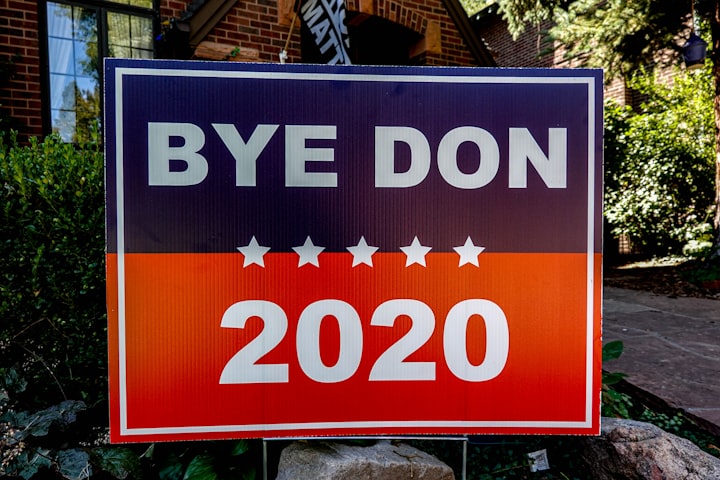
To the Former President Donald Trump,
Oh Mr. Trump, how far you have fallen. If each person’s worth was measured somewhere between the tallest mountain and the deepest crevice; you Mr. Trump, would certainly be plummeting into the unfathomable Mariana Trench.
It is no surprise to me that these final days have concluded into a concrete emulsion of agony and greed. A wallowing of buyers remorse and putrid ignorance. The sharpening of knives and blasting of guns the soundtrack to your removal. I have been so lucky; and also unfortunate, to witness this dismal betrayal of leadership from afar. Though I was born in the States, my decade-long immigration to Canada did little to protect me from the worldly portrait you created for the American people - a jagged and unruly bust of a bull’s ass. Every American across the globe felt embarrassed, saddened, and disheartened at each of your tweets, your public appearances, and the gall of your finite lexicon.
Your behavior is so questionable that a seagull stealing food is more acceptable than you. From the very beginning of your campaign you were able to outwit the nervous and doubtful populous like a used car salesman selling a lemon as a Ferrari. This extended to the time at Charlottesville where you could not bare to bring yourself to condemn the killing of Heather Hayer. Further beyond that reckoning you enabled the incarceration of thousands of refugees for very little legal reasoning - many of which are still housed in deplorable, inhumane circumstances. Many children have been lost; very literally, at your command. In the last year of your presidency, when the people needed comfort and stability, you gave them destitution as the world fights a pandemic. The riots from early 2020 were; really, just the second-hand smoke of the poverty ridden air you blew in our faces. The valley of your failure is wide and insurmountable.
The filter of your grandiose ego-centrism is removed when a retrospective lens is applied. The truth is: Not only are you a terrible person and leader, you are without a doubt the biggest damage the United States has suffered since 9/11. So while I understood from the beginning that your legacy was going to be significant and shady I think no one expected the truth of your presidency to be so dire and grim. The sheer division, unhappiness, confusion, poverty, and anger you stirred is heartbreaking. If; at the end of all ends, you still believe that you provided a positive influence to the American people, then you are far worse than just delusional. Evil would be the only term suitable then. I would be very afraid of a time where you and Hitler or Stalin shared the same space.
I will not lie. There were many times when watching the news that I wished; that I just WISHED, the worst for you. I see now that mentality would make me no better than your followers at the Capitol. It is this extremism that you thrive on, and I wish now to only deprave you of all that you consider sanctimonious - even if the only trophy I take from you is your Mar-a-lago resort.
I do not see that you deserve a proper goodbye, nor do you have enough respect from me that I wish you a prosperous future. I can not give you that. There is too much pain and suffering and the time to move away is as intoxicating as my favorite perfume. Adventure and renewal stirs inside like a giddy reader so profoundly driven by each page of a great book. These final hours are exhilarating! I am anxious to watch President Joe Biden at his inauguration, and I am most happy that you will not be there. I laugh at your petty attempt to scar Biden’s entry with your lack of presence, it is a childish gambit only fitting for a timeout. Who cares? I wonder if you know how little some American’s think of your “fits”.
To quote the movie A Knight’s Tale, “You have been weighed. You have been measured. And you have been found wanting.” And much like Count Adhemar, you too will be remembered for your arrogance and prejudice.
Sincerely,
A Far Away American
About the Creator
Jessie Valk
Just a creative soul searching for an outlet. Is Vocal that outlet? Will this be like a light fixture meeting the spark in the pale wall of a living room?
Keep reading
More stories from writers in The Swamp and other communities.
The Saddest Thing - The Billionaires Who Rule America Aren't Even Enjoying Themselves
This single post says more about our ruling class than a thousand policy papers. The saddest thing about today's system is that the men robbing the rest of us - sabotaging our economic prospects, our pensions, our access to affordable healthcare - are not even happy.
By Scott Christenson🌴7 days ago in The Swamp
If You Write A Book, Don’t Tell Anyone
There are days when I’m grateful Amazon doesn’t tell me specifically who has bought my book and who hasn’t. If they did, I would be heartbroken when I read the list and noticed all the important names in my life were not on my list of customers.
By Ellen Frances6 days ago in Writers



Comments
There are no comments for this story
Be the first to respond and start the conversation.