
The Deadliest Tweet
Trump's impulsive nature and inability to control himself have created a huge problem for America that nobody is talking about.

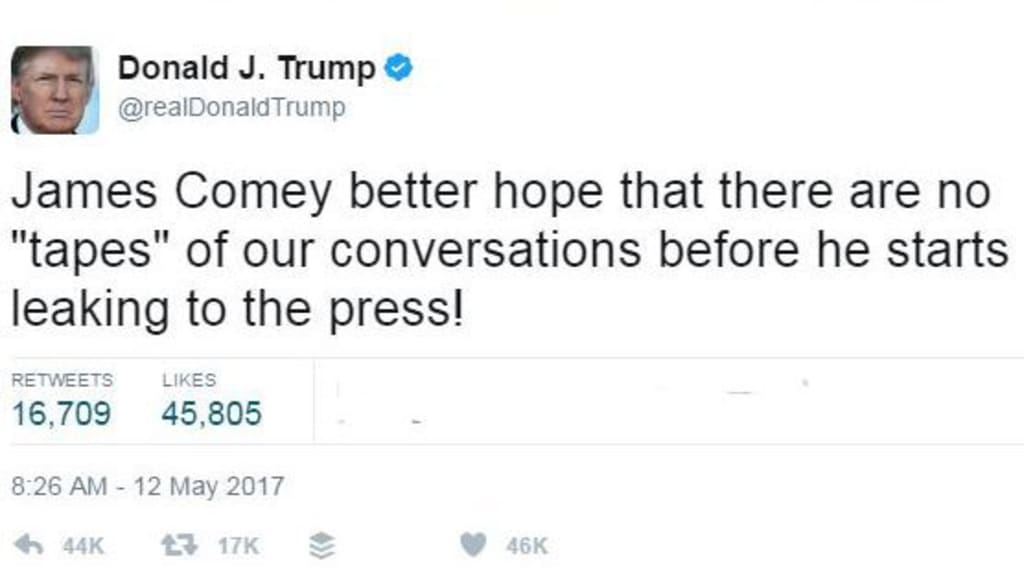
Forget about "the Russian thing" for just a moment. Although the subject matter here is derived from the cloud that revolves around the investigation into Russian meddling in the 2016 election, there is now even bigger cause of concern due to the President's reaction to circumstances he alone is responsible for.
I'm talking about the firing of former FBI director James Comey and the tweet that followed it that referenced possible recordings of Trump and Comey's interactions. Putting aside that Trump seems incapable of learning from history and may not fully understand what happened in 1973 and '74, this single tweet has created more potential problems for America and possibly the entire world than anything the irresponsible and immature Trump has done before.
The video below explains the situation the tweet has created.
Here's the thing, "the Russian thing" led directly to "the tape thing". Of course, the tape thing is Trump's suggestion in a moment of impulse to suggest he taped his conversations with Comey. The tape thing leaves 3 possibilities:- The tapes do exist and they back up Trump's side of the story.
- The tapes do exist and they back up Comey's side of the story.
- The tapes don't exist and Trump was bluffing to try to influence Comey to not talk about their conversations.
Of the three possibilities, the third is by far the most problematic for America and likely the planet, and here's why. Trump has a long history of bluffing, threatening lawsuits to bully silence and generally blowing smoke and bluster to get his way. However, now the whole world–including America's enemies–are watching and listening. North Korea would certainly be emboldened with the knowledge that Trump is a bluffer. Imagine Trump telling North Korea that launching more nuclear tests would be met with overwhelming military force. Easy to imagine, right. Now imagine the North Korean reaction with the evidence that Trump is a bluffer firmly implanted in their minds.
Virtually all of the enemies of America will be eager to test the veracity of Trump's bluster and given that he's full of bluster and overstatement, things could escalate pretty quickly into action that will make 9-11 seem like a picnic. This may seem highly speculative, but given the history of both Trump and Kim, it's easy to speculate lack of control and the lack of self-control that responsible leadership requires.
The other two possible outcomes mentioned would have a political impact, but nowhere near the potential for starting war. More importantly, the chances that Trump is bluffing and that tapes do not exist are by far the most likely of the three possibilities.
About the Creator
Keep reading
More stories from Matt Nappo and writers in The Swamp and other communities.
Another Rockin45 Summer Of Fun
Now in their seventeenth year, theRockin45s, aka America's Favorite Party Band are showing no signs of slowing down. Their 4 hour marathon sets continue to keep audiences dancing and singing and in Summer the band always kicks up a notch.
By Matt Nappo9 years ago in Beat
Why Black History Matters in America?
The United States of America is celebrating their 250th anniversary in 2026. I'm proud to be an American and as someone who was born here, I wouldn't imagine myself living anywhere else. This is a country where opportunities are possible. Where anyone can be successful in anything they desire to do. Equality, community, and togetherness are the backbones of what America is and should be about. However, we have an administration who wants to erase and disregard those who have made positive, meaningful impacts in our country, specifically Black figures, such as Martin Luther King, Jr., Rosa Parks, and Maya Angelou. President Trump and his administration have been constantly complaining and fighting against what they call the "Woke agenda". They use this excuse as a distraction from other issues they refuse to address, such as the high cost of living, climate change, and inflation. That equality is dividing America, when in reality, it's bringing us together. Being woke is not tied to a specific political party. No matter where you stand on the political spectrum, you can still care about other people and their plights. Compassion and empathy for others isn't tied to a political party, either. We were taught as children to treat others the way we want to be treated and not judge others because they're different from us. Caring about others isn't a personal attack on your beliefs. It doesn't make you any less of a person. People who are easily offended over African American figures, past or present, or anything related to it, are grasping at straws. Current and future generations need to know who people like Harriet Tubman and Shirley Chisholm were, especially in the classroom. Black History is part of American History. It should be recognized, not hidden or forgotten. Besides, you can't shield children from everything, just because your feelings are easily hurt.
By Mark Wesley Pritchard 5 days ago in The Swamp
Public Announcement Challenge Winners
For the Public Announcement Challenge, writers were asked to work inside voices built for control. These were notices, warnings, and updates meant to inform rather than confess. The strongest entries committed to that form and didn't break from it. Corporate memos, formal government alerts, and internal policy language were held consistently, allowing emotion, fear, grief, or humor to surface indirectly through pressure rather than declaration. The following poems recognize the voice of authority, and let human feeling slip through despite all its rules and restraint.
By Vocal Curation Teamabout 12 hours ago in Resources



Comments
There are no comments for this story
Be the first to respond and start the conversation.