
The Queen Stuck by Andrew. King Charles Is Pulling Away.
A Royal Rift Reveals Two Very Different Visions of Duty, Loyalty, and the Future of the Monarchy
In the long arc of modern British monarchy, few internal family dramas have tested the institution’s resilience quite like the scandal surrounding Prince Andrew. What began as a personal catastrophe for the Duke of York evolved into a constitutional headache, a reputational crisis, and, ultimately, a revealing study in two very different royal leadership styles. Queen Elizabeth II stood by her son to the end. King Charles III, now firmly on the throne, appears determined to draw a line.
The contrast is not merely personal. It reflects generational change, institutional survival instincts, and differing interpretations of duty.
For Queen Elizabeth II, Andrew was not just a troubled royal—he was her son. Throughout her 70-year reign, the late Queen was guided by a deeply rooted sense of familial loyalty. Even as allegations surrounding Andrew’s association with Jeffrey Epstein escalated into a global scandal, she resisted calls to completely exile him from royal life. While she stripped him of military affiliations and royal patronages in early 2022, a significant and symbolic move, she continued to offer him personal support.
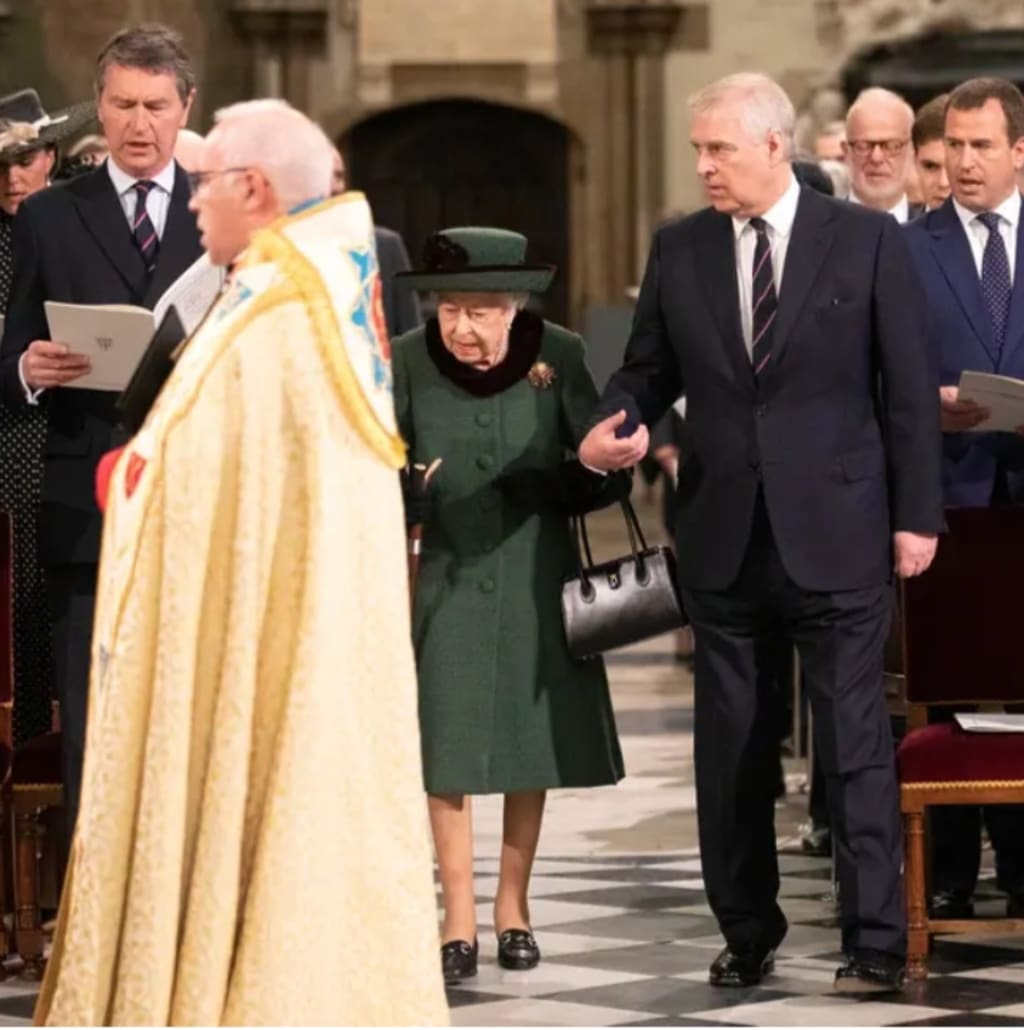
That support was not subtle. Andrew was seen accompanying her to memorial services and public events during her final months. Most notably, he walked beside her at Prince Philip’s memorial service in March 2022—a highly visible gesture that spoke volumes. For critics, it was tone-deaf. For the Queen, it was maternal resolve.
Elizabeth II had always believed in what she famously described as “the family firm.” The monarchy, in her view, was both institution and kinship. Protecting one often meant shielding the other. Even as Andrew’s disastrous 2019 BBC Newsnight interview compounded public outrage and led to his withdrawal from public duties, the Queen did not publicly condemn him. Her approach was measured, restrained, and deeply private.
King Charles III, however, inherited a very different landscape.
Ascending the throne in September 2022, Charles assumed leadership at a moment when public trust in institutions—royal and otherwise—was fragile. Unlike his mother, who ruled from a position of near-unquestioned authority for decades, Charles began his reign under scrutiny. He has long advocated for a “slimmed-down monarchy,” one focused on core working royals and streamlined public service. Andrew does not fit into that vision.
The King’s stance has been markedly cooler. Reports suggest he has been keen to distance the monarchy from Andrew’s controversies. Financial support, once flowing more freely, has reportedly been curtailed or more tightly controlled. Discussions around Andrew’s continued residence at Royal Lodge have underscored the new tone: pragmatic, cost-conscious, and unyielding.
This shift is strategic.
Charles understands that the monarchy survives not on divine right, but on public consent. The Epstein scandal, and Andrew’s settlement of a civil lawsuit in the United States without admitting liability, left a stain that the institution cannot easily absorb. In a media environment driven by social platforms and global outrage cycles, there is little tolerance for perceived leniency toward privilege.
Where Elizabeth may have seen a son in need of quiet protection, Charles sees an existential risk.
The generational divide is striking. Elizabeth II came of age during World War II and ascended the throne in 1952. Her worldview was shaped by endurance, stoicism, and a belief in stability above all. Personal matters were to be handled discreetly; public composure was paramount. Charles, by contrast, has spent decades navigating the relentless scrutiny of tabloid culture. His own marital struggles and the media frenzy surrounding Princess Diana fundamentally altered the monarchy’s relationship with transparency.
He knows what prolonged scandal can do.
There is also a practical dimension. Charles has long emphasized fiscal responsibility within the monarchy. Maintaining a non-working royal in substantial comfort, particularly one embroiled in controversy, invites public criticism—especially amid economic strain across the United Kingdom. Every expenditure becomes political.
Yet the story is not one of cold abandonment. Andrew remains a member of the royal family. He participated in family events surrounding the Queen’s funeral. He has not been formally expelled from royal status, nor has he been stripped of his dukedom. But the symbolism matters. He no longer represents the Crown in any official capacity. There are no patronages to champion, no diplomatic tours, no public roles. His royal identity has been reduced to lineage rather than function.
This recalibration sends a message.
Charles appears intent on reinforcing the principle that public service—not birth alone—justifies royal privilege. The working monarchy model elevates those who actively contribute to its mission. Others, regardless of title, remain on the periphery. In that framework, Andrew’s return to public duties is virtually unthinkable.
The emotional cost of this shift should not be underestimated. Royal observers often speak of “the Crown” as though it exists independently of the individuals who wear it. In reality, the institution’s decisions are deeply personal. Charles is not merely a monarch managing optics; he is a brother navigating a fraught family dynamic.
For Elizabeth II, the calculus was different. In the twilight of her reign, preserving family unity may have felt as urgent as protecting the institution. She had weathered abdication crises, divorces, and public tragedies. Standing by Andrew may have seemed consistent with her lifelong commitment to steadiness in the face of storm.
Charles, however, governs at the beginning of his reign, not the end. He is tasked with ensuring the monarchy’s relevance for decades to come. That requires difficult boundaries.
Public opinion, too, has evolved. Younger generations are more skeptical of inherited privilege. Transparency and accountability carry greater weight than tradition alone. In this climate, association with unresolved scandal is not easily forgiven.
The monarchy has always been a delicate balance between symbolism and reality. Elizabeth II leaned toward symbolic continuity—family standing together, even when fractured behind palace walls. Charles leans toward institutional survival—streamlined, disciplined, and visibly responsive to public sentiment.
History may judge both approaches as understandable in their contexts.
The Queen’s steadfastness reflected a lifetime of unwavering loyalty. The King’s distancing reflects a determination to protect the future of the Crown. Between them lies the uncomfortable truth that monarchy is both family and business—and when the two collide, someone must choose which comes first.
In choosing distance, King Charles III is signaling that the era of unconditional shelter has ended. The Crown, as he sees it, cannot afford the burden.
About the Creator
A Gathering of Evil Bosses
“I’m the queen of chin jutting while I smooth my hair, attacking, insulting, and deflecting to protect my appointer.” “Oh, please, Blondi, my hair is curled, highlighted, and longer than yours. I feature television commercials telling immigrants that we will give them a free plane ride home, and if they voluntarily turn themselves in, they will be allowed to legally apply for re-entry. It runs everywhere, and I look good in it! You can’t compete because of your blond hair. Mine is nicer, and my lips are prettier than yours.”
By Andrea Corwin 4 days ago in The Swamp
Rubio Delivers MAGA’s Foreign Policy Doctrine in Munich
When Marco Rubio stepped onto the international stage at the Munich Security Conference, his speech signaled more than a routine policy address. It was a declaration of what the “Make America Great Again” (MAGA) movement believes U.S. foreign policy should look like in a rapidly changing world.
By Sajida Sikandar7 days ago in The Swamp


Comments
There are no comments for this story
Be the first to respond and start the conversation.