
Trump Feinstein Extra Terrestrial Misdirection
Does Russia control the US or do HETLAU?

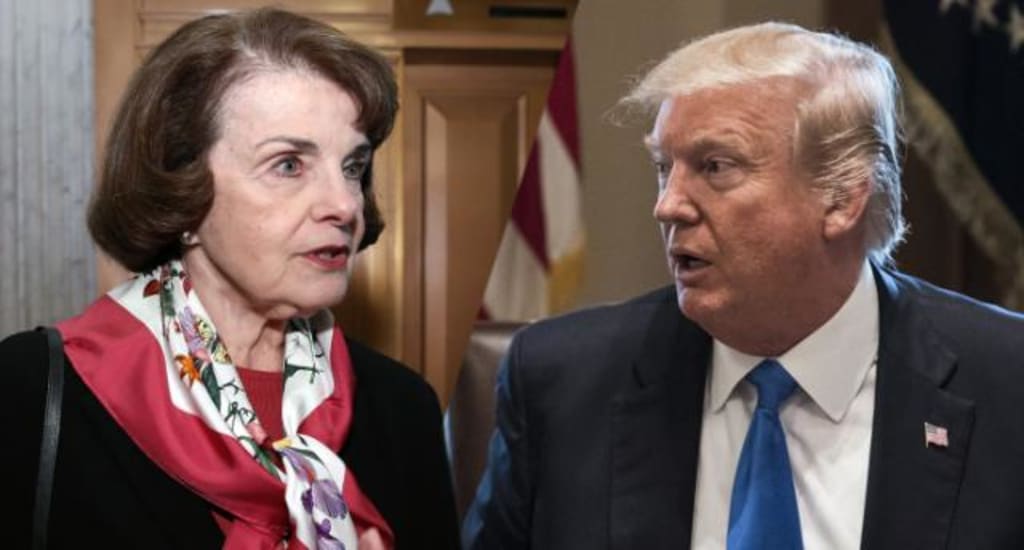
If the possibility of Hetlau is real, then the HET as a group would be the net, individual HET would take turns as the players, each event would be the ball. The Earthlings would be the spectators.We looked at how Trump and Kim Jong Un arguing back and forth calling each other rocket man and dotard were a possible example of misdirection. Most people can't see the misdirection because they have never heard of the concept of Hetlau, they can't believe it is possible, and the concept of war seems too serious an event to play these type of psyops over.The latest spat by Trump and Feinstein (here) is another opportunity to see the possibility of misdirection taking place. There is an infinite number of examples of misdirection taking place each day, though the big name ones are usually easy to start with to try to see it.When you try to show the possibility of Trump and Feinstein performing misdirection most people immediately fall into the political trap. Rather than being able to step back and be objective from an ET Intelligence point of view they allow their Earthling Intelligence to control the situation and blind them from seeing the EvenT. They pick a side based on their personal political viewpoint and want to believe that is the truth as to what is really happening.The key is how you look at it and being objective without being political. If the concept was that Earthlings are the only ones on the planet then the political viewpoint might be worth evaluating. The key is this viewpoint is to be looked at from the possibility of Hetlau and political viewpoints should not be considered.If you are stepping into the actual content of the event then you don't understand what misdirection is really about. All you need to do is find an event and then decide if it is misdirection or subliminal dissemination. There are only two choices once you know what is going on.What is also interesting is when you read the names of the actors around the events:TRUMP = TRuth dUMP - (Is disclosure imminent?)KIM JONG UN = You know I am ETK = KnowledgeIM = I aMJON = JOiNG = 7 (alphanumeric)UN = UNo = 1Join 7 + 1 = 88 = EighT = ET (bracketing)Feinstein = Female EinsteinEinstein = alberT Einstein = ET (bracketing)I am not trying to say with certainty that any of these individuals are actually HET. Since they would never corroborate, it is just speculation. The key is to pay attention to all the information surrounding the events and what you start to notice is repeating patterns that are constantly occurring and a trend starts to develop that allows you to see the whole picture. All you need is for one of them to be HET and the theory is correct. After a while you will start to notice quite a few you think are HET.What this basically does is allow you to understand what disclosure should look like, not what it will probably look like. For instance, if SETI says they find radio signals and this is the extent to which disclosure is providing information, you can tell it's not really true disclosure.
About the Creator
Richard Van Steenberg
HETs live among us
CTVs vectate above us
ET is at war with EA to validate their Inslavement
Sign the ExtraTerrestrialDisclosurePetition.com
Keep reading
More stories from Richard Van Steenberg and writers in The Swamp and other communities.
Government Shutdown Actually Costs Money
This is an on going series of why you can't drain the swamp. What we immediately began to realize when we studied how Government works is it never is what it seems. The idyllic dream of getting everyone out of office so that a new group of responsible people could represent the taxpaying public has just taken another detour. Why work to get paid when you can just shut down and get paid more? Most people when they hear the Government has to shut down immediately think that both sides can't agree and so this inconvenience to the taxpaying public is a result of their incompetence. Quite the contrary. Sure it's an inconvenience to the taxpaying public but that is not all it is. It actually costs "more money" to run the government when its shut down then when its open (article). Did they hear "more money?" Why don't they just run it in a shutdown state all the time?So rather than being incompetent, the elected officials are actually exercising their competency. The problem all has to do with perception. The taxpaying public has the perception that these supposedly honorable people are exhibiting such moral high ground that they will become servants of the people for the greater good of society.Think about that for a second. Why would a well educated, highly intelligent, wealthy, and powerful person submit themselves to becoming a servant? Everything about what they have achieved to this point in their life and the people they chose to surround themselves with says just the opposite. They hire servants and pay them as little as possible. Do you think they are going to become a servant? Have they convinced you it's worth being a servant if you pay them enough? Have they convinced you the greater good is actually being served? Isn't the whole point of wanting to drain the swamp to get people like them out of there? If they were really serving you and had the greater good in mind wouldn't they stay as far away from that place as possible?Apparently, they have a swamp in Washington D.C. that needs draining they would like to sell you.So when the opportunity arises to join an elite group of people who are using group psychology to convince the taxpaying public they are their servants so they can amass the ultimate in wealth and power, why in the world would they suddenly jump ship and become a good Samaritan? Hint: They wouldn't!Rather isn't this the moment, they are in the zone and everything about who they are and what they are about is like a fine-tuned machine out to screw anyone and everyone and make themselves the ultimate beneficiary. The best part of all is all they have to do is take a few acting classes to make it appear they care. Certainly, at this point, they don't know how to do that by themselves anymore. So when everyone is counting on them to keep the government functioning, since it obviously won't function efficiently or effectively anymore, they step it up another notch. Working together to secretly achieve a government shutdown while running around blaming it on each other. This allows the seeming financial chaos to actually orchestrate even more funding for them to distribute to additional points they deem necessary. It's like legal euphoria!It makes you wonder why Hollywood doesn't give them the Oscar. The acting job being performed so well, by so many, for so long, puts to shame any basic movie that is produced out west. These guys and gals are in a league all their own. The best part of all is its always someone else's fault. We're already 20 trillion in debt and there is no end in sight to that. Even if they had a balanced budget and stopped deficit spending immediately, it will still take them more than a century to pay it off. That's three generations! Doesn't it just make you wonder what other nonsense they will think up next?
By Richard Van Steenberg8 years ago in The Swamp
Why Black History Matters in America?
The United States of America is celebrating their 250th anniversary in 2026. I'm proud to be an American and as someone who was born here, I wouldn't imagine myself living anywhere else. This is a country where opportunities are possible. Where anyone can be successful in anything they desire to do. Equality, community, and togetherness are the backbones of what America is and should be about. However, we have an administration who wants to erase and disregard those who have made positive, meaningful impacts in our country, specifically Black figures, such as Martin Luther King, Jr., Rosa Parks, and Maya Angelou. President Trump and his administration have been constantly complaining and fighting against what they call the "Woke agenda". They use this excuse as a distraction from other issues they refuse to address, such as the high cost of living, climate change, and inflation. That equality is dividing America, when in reality, it's bringing us together. Being woke is not tied to a specific political party. No matter where you stand on the political spectrum, you can still care about other people and their plights. Compassion and empathy for others isn't tied to a political party, either. We were taught as children to treat others the way we want to be treated and not judge others because they're different from us. Caring about others isn't a personal attack on your beliefs. It doesn't make you any less of a person. People who are easily offended over African American figures, past or present, or anything related to it, are grasping at straws. Current and future generations need to know who people like Harriet Tubman and Shirley Chisholm were, especially in the classroom. Black History is part of American History. It should be recognized, not hidden or forgotten. Besides, you can't shield children from everything, just because your feelings are easily hurt.
By Mark Wesley Pritchard 3 days ago in The Swamp
Off the Book
It ended like every other stupid idea. Badly, and alone. I’m researching digital confession ethics, he said. A tech ethicist. He gestured at floating data I couldn’t see then pulled out a physical notebook. Actual paper, fountain pen. He held it up like he was showing me scripture.
By Nicky Frankly6 days ago in Fiction




Comments
There are no comments for this story
Be the first to respond and start the conversation.