
Australia Cold Chain Equipment Market 2026: Perishable Logistics Boom, Smart Refrigeration and Infrastructure Expansion
How food safety regulations, pharmaceutical distribution and IoT-enabled refrigeration technologies are accelerating Australia’s cold chain equipment industry

Australia Cold Chain Equipment Market Overview
Australia’s cold chain equipment market is undergoing rapid transformation as demand for temperature-controlled storage and transportation solutions intensifies across food, pharmaceutical and export industries. Cold chain equipment — including refrigerated storage systems, transport refrigeration units, monitoring devices and insulated containers — plays a critical role in preserving product quality and regulatory compliance throughout the supply chain. As Australia’s consumption of fresh and frozen products grows alongside pharmaceutical logistics expansion, investments in advanced cold chain infrastructure continue to rise.
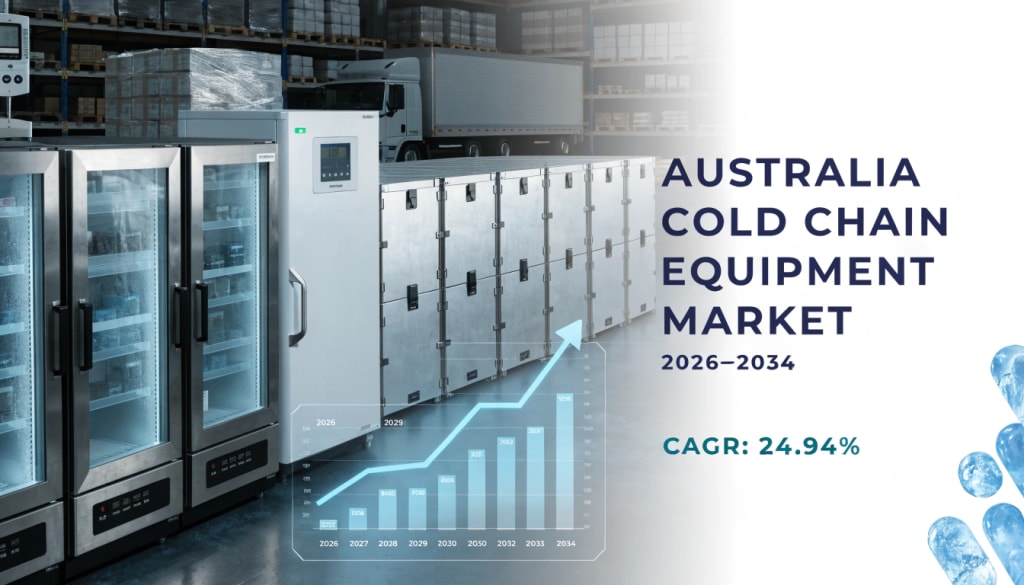
According to IMARC Group, the Australia cold chain equipment market size reached USD 694.9 million in 2025 and is projected to grow to USD 5,155.0 million by 2034, exhibiting a compound annual growth rate (CAGR) of 24.94% during 2026–2034. Growth is supported by rising perishable product demand, strict food safety regulations and rapid adoption of IoT-enabled refrigeration systems.
Key Market Drivers
Growing Demand for Perishable Food and Pharmaceuticals
Rising consumption of fresh produce, seafood, dairy and frozen products is increasing reliance on temperature-controlled storage and transport equipment. Similarly, expanding pharmaceutical distribution networks require precise temperature management to ensure product integrity.
Stringent Food Safety and Quality Regulations
Australia’s regulatory frameworks emphasise traceability, hygiene and temperature compliance across supply chains. These requirements are prompting logistics providers and retailers to upgrade equipment capabilities and monitoring systems.
Expansion of E-Commerce Grocery and Retail Channels
Online grocery growth and home delivery models are driving demand for distributed refrigeration infrastructure, including micro-fulfillment cold storage and last-mile temperature-controlled solutions.
Technological Advancements in Refrigeration and Monitoring
IoT-enabled sensors, digital monitoring platforms and energy-efficient refrigeration units are improving operational visibility and performance. Such technologies enable real-time temperature tracking and predictive maintenance across equipment fleets.
Request a Sample Report with the Latest 2026 Data & Forecasts
What the Opportunities Are
Australia’s cold chain equipment market presents significant opportunities as logistics modernisation, sustainability priorities and export growth continue to shape infrastructure development.
Automation and Smart Cold Storage Facilities
Automation technologies including robotic pallet handling, automated racking systems and digital warehouse management solutions are transforming cold storage operations. Equipment providers offering integrated automation capabilities can capture growing investment across logistics hubs.
Growth of Pharmaceutical and Biologics Cold Chains
Increasing distribution of vaccines, biologics and temperature-sensitive medical products creates demand for specialised refrigeration units and monitoring solutions capable of maintaining strict temperature ranges throughout transit and storage.
Energy-Efficient and Sustainable Refrigeration Solutions
Environmental regulations and energy cost considerations are encouraging adoption of energy-efficient compressors, eco-friendly refrigerants and solar-assisted cold storage systems. Sustainability-focused equipment innovation represents a key competitive differentiator.
Agricultural Export and Seafood Logistics Expansion
Australia’s agricultural and seafood export sectors rely heavily on cold chain reliability to maintain freshness during international transit. Export growth opportunities are driving investment in advanced refrigerated containers and storage infrastructure near ports and logistics corridors.
Distributed Cold Chain Networks and Last-Mile Solutions
Urban consumption patterns and rapid delivery expectations are creating opportunities for compact refrigeration units and mobile cold storage solutions supporting last-mile distribution ecosystems.
These opportunity areas collectively reflect the evolution toward scalable, digitally enabled and sustainability-aligned cold chain infrastructure.
Recent News and Developments
March 2025: Market assessment confirmed the Australia cold chain equipment market reached USD 694.9 million in 2025, reflecting strong infrastructure investment across food and pharmaceutical logistics segments.
June 2025: Technology adoption trends showed IoT integration improved equipment efficiency by approximately 25% and reduced failure rates by 40%, highlighting the growing importance of smart monitoring systems within cold chain operations.
October 2025: Industry investment activity intensified as retailers, distributors and exporters upgraded refrigeration infrastructure to meet rising perishable product demand and regulatory compliance requirements.
January 2026: Forecast outlook reaffirmed strong growth trajectory with the market expected to reach USD 5,155.0 million by 2034, supported by digitalisation, export expansion and pharmaceutical cold chain development.
Why You Should Know About the Australia Cold Chain Equipment Market?
The Australia cold chain equipment market represents a critical pillar of the country’s food security, healthcare resilience and export competitiveness. As consumer expectations around freshness and safety intensify alongside pharmaceutical distribution requirements, reliable cold chain infrastructure is becoming increasingly strategic.
With projected market expansion exceeding sevenfold by 2034, driven by technology innovation, regulatory momentum and logistics modernisation, the sector offers compelling opportunities for equipment manufacturers, logistics providers and investors.
As Australia continues strengthening temperature-controlled supply chain capabilities and embracing smart refrigeration technologies, the cold chain equipment market is positioned for sustained high-growth development within the broader logistics and infrastructure ecosystem.
About the Creator
Amyra Singh
Market research analyst who loves spotting patterns, digging into data, and turning insights into strategies that help brands grow and stay ahead of the curve.
Keep reading
More stories from Amyra Singh and writers in Trader and other communities.
Australia Specialty Gases Market 2026: High-Purity Innovation, Semiconductor Demand and Clean Energy Applications
Australia Specialty Gases Market Overview Australia’s specialty gases market is expanding steadily as high-purity gas requirements increase across electronics manufacturing, healthcare diagnostics, research laboratories and clean energy applications. Specialty gases — including noble gases, calibration mixtures and ultra-high-purity process gases — are essential in precision-driven environments where consistency, purity and reliability are critical. As Australia strengthens advanced manufacturing capabilities and invests in hydrogen and semiconductor ecosystems, specialty gases are becoming integral components of industrial innovation and scientific advancement.
By Amyra Singhabout 14 hours ago in Trader
Can Gold Be Tokenized? Understanding a New Way to Invest
Gold has always been a symbol of financial security and long-term stability. For centuries, investors have relied on it to hedge against inflation, currency fluctuations, and economic downturns. Today, technological innovation is transforming the way gold is bought, sold, and owned. Gold Tokenization is emerging as a modern investment model that blends the stability of physical gold with the efficiency of blockchain technology. This digital transformation is making gold investment more accessible, transparent, and globally tradable.
By Michal steveabout 11 hours ago in Trader



Comments
There are no comments for this story
Be the first to respond and start the conversation.