
Australia Energy Efficiency Retrofits Market 2026: Decarbonisation Goals, Smart Building Upgrades and Sustainable Infrastructure
How government incentives, rising energy costs and digital retrofit technologies are transforming Australia’s energy efficiency retrofits landscape

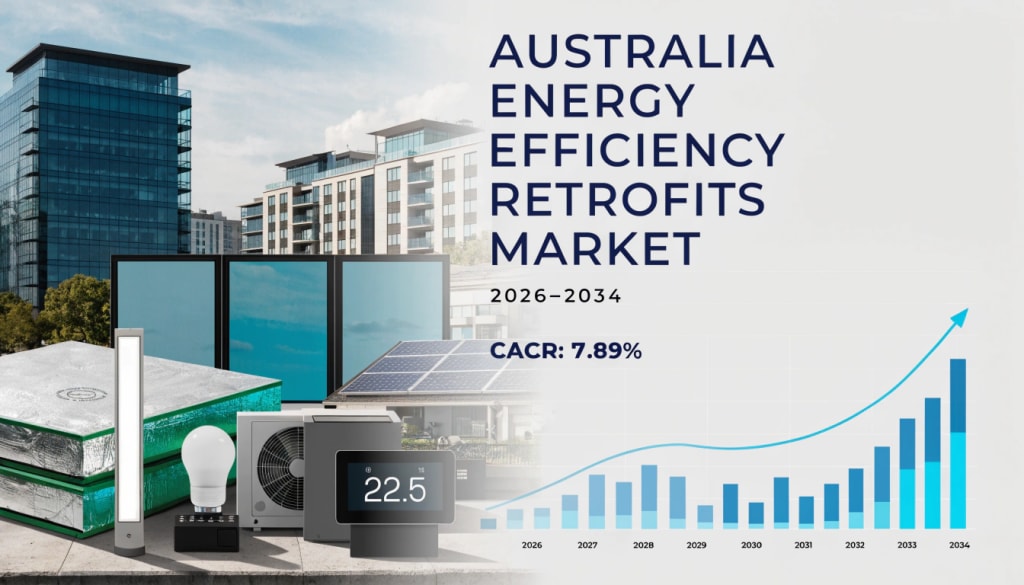
Australia Energy Efficiency Retrofits Market Overview
Australia’s energy efficiency retrofits market is gaining strong momentum as the country accelerates its transition toward low-carbon infrastructure and sustainable building practices. Retrofitting existing buildings with energy-efficient technologies — including insulation, lighting upgrades, HVAC improvements and smart energy management systems — has become a critical strategy for reducing energy consumption and operational costs. With a large share of Australia’s building stock constructed before modern efficiency standards, retrofit solutions offer substantial potential for emissions reduction and energy savings across residential, commercial and industrial sectors.
According to IMARC Group, the Australia energy efficiency retrofits market size reached USD 2,599.2 million in 2025 and is projected to grow to USD 5,146.2 million by 2034, exhibiting a compound annual growth rate (CAGR) of 7.89% during 2026–2034. Market expansion is driven by tightening regulations, financial incentives, rising energy prices and ongoing advancements in retrofit technologies improving scalability and cost-effectiveness.
Key Market Drivers
Government Regulations and Policy Incentives
Regulatory frameworks targeting emissions reduction and energy performance standards are encouraging property owners to upgrade existing buildings. Incentives, financing programs and sustainability policies are accelerating adoption of retrofit solutions across multiple building segments.
Rising Energy Costs and Operational Savings Focus
Increasing electricity prices are prompting building owners to invest in efficiency improvements that reduce long-term operating expenses. Retrofits offer measurable energy savings, supporting improved financial performance alongside sustainability objectives.
Advancements in Retrofit Technologies
Innovations in smart sensors, automation platforms and high-performance materials are improving retrofit effectiveness and simplifying deployment. Technology-enabled retrofits allow real-time energy monitoring and optimisation, strengthening value propositions for building operators.
Decarbonisation and ESG Commitments
Corporate ESG initiatives and national climate targets are increasing demand for energy-efficient infrastructure upgrades. Retrofitting provides a cost-effective pathway for organisations to achieve sustainability goals without full building replacement.
Request a Sample Report with the Latest 2026 Data & Forecasts
What the Opportunities Are
The Australia energy efficiency retrofits market presents significant opportunities as sustainability imperatives, infrastructure ageing and digital transformation converge.
Large-Scale Commercial Building Retrofit Programs
Commercial buildings represent a major energy consumption source, creating opportunities for comprehensive retrofit projects including HVAC modernisation, lighting upgrades and building automation integration. Service providers delivering turnkey retrofit solutions can capture multi-year project pipelines.
Residential Retrofit Expansion and Consumer Adoption
Homeowners are increasingly adopting insulation improvements, heat pumps, smart thermostats and energy-efficient appliances. Rising awareness of energy savings and government support programs create favourable conditions for residential retrofit growth.
Smart Building Integration and Data-Driven Energy Management
Integration of IoT sensors, AI analytics and building management systems enables continuous optimisation of energy consumption. Technology vendors offering digital retrofit platforms can strengthen long-term service revenues and operational insights.
Renewable Energy and Electrification Synergies
Combining retrofits with rooftop solar, battery storage and electrification technologies enhances building energy performance. Integrated retrofit-plus-renewable solutions present opportunities for energy service companies and system integrators.
Specialised Retrofit Solutions for Industrial Facilities
Industrial plants and warehouses require tailored efficiency upgrades addressing process energy consumption and equipment optimisation. Engineering firms providing sector-specific retrofit expertise can access niche but high-value opportunities.
Collectively, these opportunities position retrofitting as a central pillar of Australia’s building decarbonisation and energy transition strategy.
Recent News and Developments
March 2025: Government-backed renovation initiatives supported energy-efficient home upgrades, with industry estimates indicating nearly 50% of Australian homes expected to feature at least one energy-efficiency improvement by 2025, highlighting growing residential retrofit adoption.
June 2025: Sustainability-focused renovation segments recorded approximately 6.5% annual growth, reflecting rising demand for insulation upgrades, smart thermostats and energy-efficient building systems within retrofit projects.
October 2025: Infrastructure and sustainability investment pipelines exceeding AUD 240 billion supported ongoing development of retrofit-enabled building upgrades across commercial and public sector assets, reinforcing market expansion potential.
January 2026: National electrification and clean energy transition trends continued to accelerate retrofit adoption, with Australia’s broader electrification market projected to expand significantly toward 2030, strengthening demand for energy-efficient building upgrades and smart energy management technologies.
Why You Should Know About the Australia Energy Efficiency Retrofits Market?
The Australia energy efficiency retrofits market represents a cornerstone of the country’s sustainability and infrastructure modernisation agenda. Retrofitting existing buildings provides a scalable pathway to reduce emissions, enhance energy resilience and lower operational costs without extensive new construction.
With projected growth to USD 5.15 billion by 2034, supported by regulatory momentum, technological innovation and rising energy awareness, the market offers compelling opportunities for engineering firms, technology providers and investors within the green infrastructure ecosystem.
As Australia continues advancing toward net-zero objectives and smart building adoption, the energy efficiency retrofits market is positioned for sustained expansion while enabling more sustainable, resilient and digitally connected built environments.
About the Creator
Amyra Singh
Market research analyst who loves spotting patterns, digging into data, and turning insights into strategies that help brands grow and stay ahead of the curve.
Keep reading
More stories from Amyra Singh and writers in Trader and other communities.
Australia Die Casting Components Market 2026: Lightweight Manufacturing, EV Transition and Precision Engineering Growth
Australia Die Casting Components Market Overview Australia’s die casting components market is experiencing robust expansion as industrial modernisation, automotive electrification and infrastructure development drive demand for precision-engineered metal parts. Die casting components are widely used across automotive, aerospace, mining, construction and electronics sectors due to their dimensional accuracy, durability and ability to support high-volume production. As industries increasingly prioritise lightweight, high-performance components, die casting technologies are becoming central to advanced manufacturing strategies in Australia.
By Amyra Singhabout 19 hours ago in Trader




Comments
There are no comments for this story
Be the first to respond and start the conversation.