
Beauty Salon Market Size and Forecast 2025–2033
Rising Incomes, Social Media Influence, and Expanding Grooming Culture Propel the Global Beauty Salon Industry Toward US$ 352.05 Billion by 2033

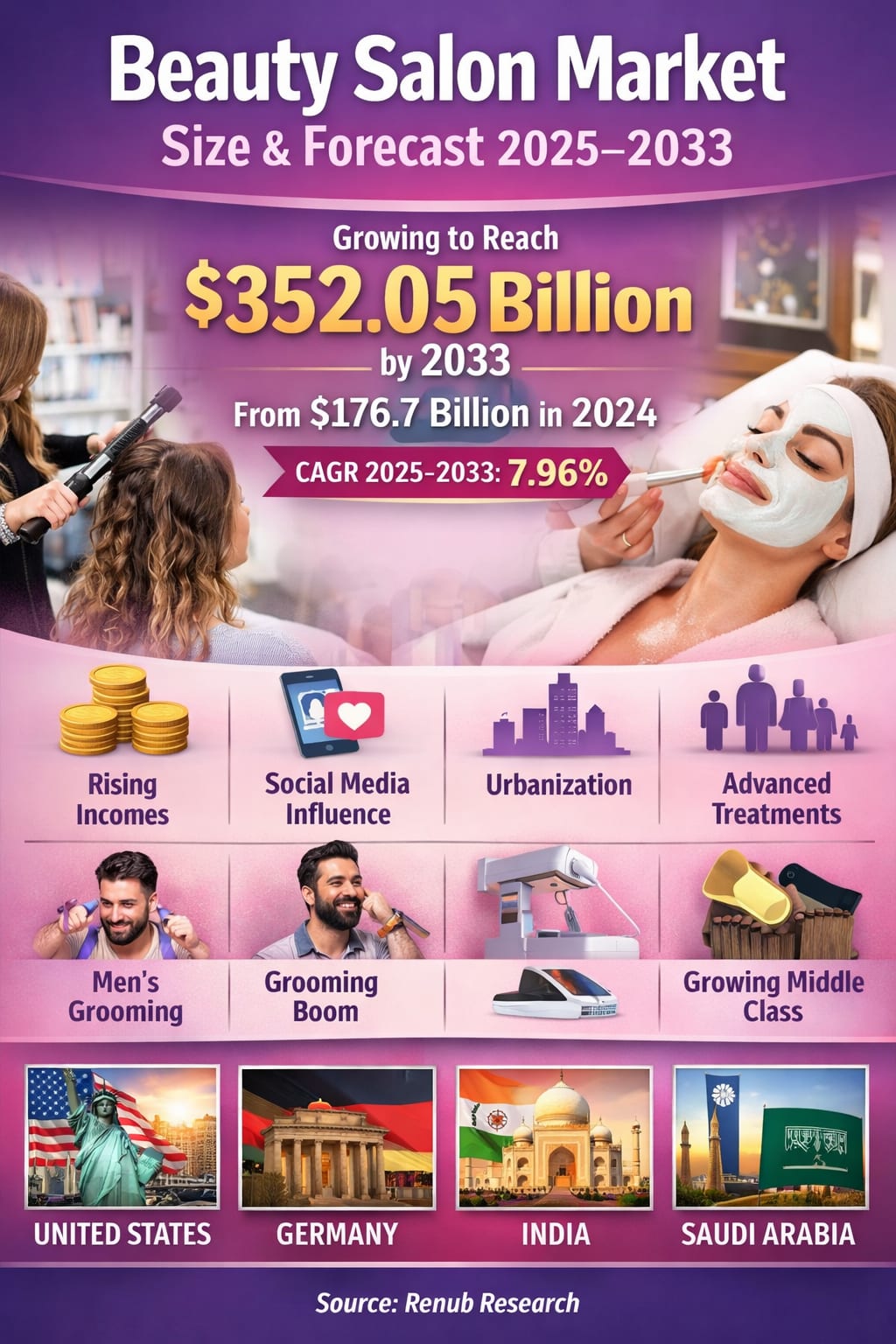
Beauty Salon Market: A Global Industry in Transformation
The global beauty salon market is undergoing a remarkable transformation, driven by changing lifestyles, rising disposable incomes, and an ever-growing emphasis on personal appearance and self-care. According to Renub Research, the Beauty Salon Market is expected to reach US$ 352.05 billion by 2033, up from US$ 176.7 billion in 2024, expanding at a compound annual growth rate (CAGR) of 7.96% from 2025 to 2033. This strong growth trajectory highlights how grooming and wellness services have evolved from occasional luxuries into routine lifestyle necessities for millions of consumers worldwide.
A beauty salon is no longer just a place for a haircut or a basic facial. Modern salons offer a wide range of services, including hair styling and coloring, advanced skincare treatments, nail care, spa therapies, waxing, and even technologically advanced procedures such as laser treatments, chemical peels, and microdermabrasion. These establishments cater to both men and women, increasingly tailoring their offerings to individual preferences, skin types, hair textures, and lifestyle needs. In many urban centers, salons have also become spaces for relaxation, confidence-building, and personal expression.
Several macro and microeconomic factors are shaping this industry. Urbanization, the growth of the middle class, and the rise of working professionals—especially women—have significantly increased demand for professional grooming services. At the same time, social media, celebrity culture, and influencer marketing have amplified awareness of beauty trends, pushing consumers to seek more frequent and more specialized salon services. Technology, too, is playing a critical role, with online booking platforms, digital consultations, and smart beauty devices enhancing both customer experience and operational efficiency.
Industry Overview: From Basic Grooming to Lifestyle Experience
Historically, beauty salons were primarily associated with basic haircuts and simple cosmetic treatments. Today, they represent a much broader lifestyle and wellness experience. Consumers now expect salons to provide not only aesthetic improvements but also personalized care, premium products, and a comfortable, service-oriented environment.
This shift is closely tied to changing consumer mindsets. Appearance and self-presentation are increasingly seen as extensions of personal and professional identity. Whether for social media, workplace confidence, or personal satisfaction, people are more willing than ever to invest time and money in grooming and self-care. As a result, salons are continuously upgrading their service portfolios, interiors, staff training programs, and digital presence to stay competitive in a crowded marketplace.
Another important trend is the growing acceptance and demand for male grooming services. Men are no longer limited to basic haircuts; they are increasingly opting for skincare treatments, beard styling, hair coloring, and wellness therapies. This broadening customer base has significantly expanded the addressable market for salon operators worldwide.
Key Growth Drivers Shaping the Beauty Salon Market
Rising Disposable Incomes
One of the most influential drivers of the beauty salon market is the steady rise in disposable incomes across both developed and emerging economies. As households gain greater financial stability, spending on non-essential but lifestyle-enhancing services such as grooming, skincare, and wellness increases. Consumers are not only visiting salons more frequently but are also opting for higher-end, premium services, including advanced hair treatments, specialized facials, and spa therapies.
Higher disposable income also encourages experimentation with new styles, products, and treatments, fostering innovation within the industry. Salons benefit from this trend by building long-term customer relationships, increasing average spending per visit, and strengthening brand loyalty.
Social Media Influence
Social media platforms such as Instagram, YouTube, and TikTok have become powerful engines of growth for the beauty salon industry. Beauty trends now spread globally in a matter of hours, driven by influencers, celebrities, and content creators showcasing hairstyles, makeup looks, skincare routines, and transformations. This visual culture fuels consumer aspiration and curiosity, often translating directly into salon visits.
Salons themselves actively use social media for marketing, customer engagement, and brand building. Before-and-after photos, client testimonials, and short video clips of treatments not only attract new customers but also build trust and credibility. User-generated content and online reviews further amplify a salon’s reach, making digital presence a critical success factor in today’s market.
Expanding Service Offerings
The expansion of service portfolios is another major growth driver. Modern salons are no longer limited to hair care; they now offer skincare, nail care, makeup, spa treatments, wellness therapies, and even technology-driven solutions such as laser treatments and advanced skin analysis. This diversification allows salons to attract a wider range of customers and increase revenue per client.
Customized and niche services—such as anti-aging treatments, bridal packages, and specialized men’s grooming—help salons differentiate themselves in a competitive market. By continuously updating their offerings based on consumer trends and feedback, salons can enhance customer satisfaction, encourage repeat visits, and build stronger brand loyalty.
Challenges Facing the Beauty Salon Industry
High Competition
The beauty salon market is highly fragmented and intensely competitive, with a mix of small independent salons and well-established chains operating side by side. This saturation makes it difficult for individual businesses to stand out and maintain a loyal customer base. To remain competitive, salons must invest in marketing, staff training, interior upgrades, and service innovation, all of which increase operational costs.
Price competition is another challenge, as salons often resort to discounts and promotional offers to attract customers. While this may boost short-term footfall, it can also pressure profit margins. In such an environment, building a strong brand identity and delivering consistent quality become critical—but increasingly difficult—tasks.
Customer Retention
Customer retention is a persistent challenge in this industry. With so many options available, consumers frequently switch salons in search of better prices, newer treatments, or improved service quality. Inconsistent service experiences, staff turnover, and a lack of personalized engagement can quickly drive customers away.
To address this, salons must focus on delivering exceptional customer experiences, implementing loyalty programs, maintaining strong digital communication, and continuously innovating their services. Long-term success depends not just on attracting new customers, but on building lasting relationships with existing ones.
Regional Market Insights
United States Beauty Salon Market
The United States represents one of the most dynamic and mature beauty salon markets in the world. Hair-related services play a dominant role in industry revenue. According to Trafft (June 2023), various hair services account for nearly 92% of the income generated by the U.S. hair salon business, with 62% coming from haircutting and styling and 23% from hair coloring services.
The market is heavily influenced by social media trends, a strong culture of personal grooming, and continuous innovation in beauty services. Digital booking systems, growing interest in wellness, and rising disposable incomes continue to support market expansion and service diversification across the country.
Germany Beauty Salon Market
In Germany, the beauty salon industry is characterized by a strong emphasis on quality, professionalism, and personalized services. German consumers value regular grooming and self-care, creating steady demand for hair, skincare, and wellness treatments. Sustainability is an increasingly important trend, with many salons adopting eco-friendly products and practices.
Digital booking platforms, customer loyalty programs, and service innovation are becoming essential competitive tools. The rise of male grooming and the influence of global beauty trends are further expanding the customer base, even as the market remains competitive and highly regulated.
India Beauty Salon Market
India’s beauty salon market is experiencing rapid growth, fueled by urbanization, rising disposable incomes, and a growing focus on personal grooming. Consumers are increasingly seeking professional hair, skincare, and wellness services, with a noticeable shift toward premium and luxury salon experiences.
Technology is playing a growing role, with virtual consultations, online booking, and AI-powered skin analysis enhancing customer experience. Social media strongly influences beauty trends and consumer choices. Despite challenges such as intense competition and a shortage of skilled professionals, the Indian market remains highly attractive for both domestic and international players.
Saudi Arabia Beauty Salon Market
Saudi Arabia’s beauty salon market is expanding significantly, supported by cultural shifts, technological adoption, and economic diversification under Vision 2030. A young population, with a large share under 30, plays a major role in shaping beauty trends, particularly through social media.
Growing interest in self-care, improved access to beauty services through online platforms, and increased investment in retail and consumer sectors are all contributing to market growth. The Kingdom is becoming an increasingly important destination for beauty and wellness businesses looking to expand in the Middle East.
Recent Developments in the Beauty Salon Market
March 2024: European hair salon chain Franck Provost launched a new beauty salon in Bengaluru, India, strengthening its global footprint.
June 2022: U.S.-based Regis Corporation partnered with Zenoti to introduce salon software solutions across its brands, aiming to improve business automation and staff retention.
April 2022: Nykaa, in collaboration with Estée Lauder Inc., opened a Nykaa-Aveda salon in Bengaluru, expanding its presence in the beauty and wellness retail space.
Market Segmentation Overview
By Service Type:
Hair Care
Skin Care
Nail Care
Others
By End User:
Men
Women
By Region and Country:
North America: United States, Canada
Europe: France, Germany, Italy, Spain, United Kingdom, Belgium, Netherlands, Turkey
Asia Pacific: China, Japan, India, Australia, South Korea, Thailand, Malaysia, Indonesia, New Zealand
Latin America: Brazil, Mexico, Argentina
Middle East & Africa: South Africa, United Arab Emirates, Saudi Arabia
Competitive Landscape and Key Players
Major companies operating in the global beauty salon market include:
Great Clips Inc.
Regis Corporation
Dessange International
Ulta Beauty Inc.
The Lounge Hair Salon
Drybar, LLC
Skin Rich
Seva Beauty
These companies are analyzed across multiple dimensions, including company overview, key persons, recent developments and strategies, SWOT analysis, and sales performance, reflecting a highly competitive and strategically active industry landscape.
Final Thoughts
The global beauty salon market is clearly on a strong growth path, driven by rising incomes, digital influence, expanding service portfolios, and a growing culture of self-care among both women and men. With the market projected to nearly double from US$ 176.7 billion in 2024 to US$ 352.05 billion by 2033, the industry offers significant opportunities for innovation, investment, and expansion.
While challenges such as intense competition and customer retention persist, salons that focus on service quality, personalization, technology adoption, and brand building are well-positioned to thrive in the years ahead. As beauty and wellness continue to merge into everyday lifestyles, the beauty salon industry is set to remain a powerful and dynamic force in the global consumer services market.
About the Creator
Sakshi Sharma
Content Writer with 7+ years of experience crafting SEO-driven blogs, web copy & research reports. Skilled in creating engaging, audience-focused content across diverse industries.
Keep reading
More stories from Sakshi Sharma and writers in Trader and other communities.
Nucleic Acid Amplification Testing Market Size and Forecast 2025–2033
Introduction: The Molecular Revolution in Diagnostics The global healthcare industry is undergoing a profound transformation, driven by the need for faster, more accurate, and more accessible diagnostic solutions. At the center of this transformation lies Nucleic Acid Amplification Testing (NAAT)—a powerful group of molecular techniques that detect genetic material from pathogens or abnormal cells with exceptional precision.
By Sakshi Sharmaabout 11 hours ago in Trader
Australia Courier, Express and Parcel (CEP) Market to Reach USD 17.7 Billion by 2033 on E-Commerce and Tech Adoption
The Australia courier, express and parcel (CEP) market is expanding steadily as digital commerce, delivery expectations, and logistics technologies evolve across the nation. According to IMARC Group, the market was valued at USD 12.8 billion in 2024 and is projected to reach USD 17.7 billion by 2033, reflecting a compound annual growth rate (CAGR) of 3.30% between 2025 and 2033.
By Rashi Sharma6 days ago in Trader
Australia Microgrid Market: Building Resilience and Renewable Power for Tomorrow
The Australia microgrid market is gaining strategic importance as Australia strengthens its energy infrastructure, responds to climate challenges, and empowers remote communities. In 2025, the market was valued at approximately USD 765.7 million and is projected to grow to USD 1,573.5 million by 2034, expanding at a compound annual growth rate (CAGR) of 8.08 percent from 2026 to 2034.
By Amélie Belleabout 5 hours ago in Trader
The Cave Part 6
If you have ever heard a tale about yourself that you cannot remember and doubtless think is made up, you will know how I felt when Tharkin related all that the eagle had seen of me before my memories were scattered. Of far distances and traveling companions that I did not recall, camping out under the stars and making our way to the mountains with deliberate purpose. The great bird had lost contact with my party once we entered the forests, and the seven other members were not seen again by him or his brethren since.
By Jamye Sharp8 days ago in Chapters



Comments
There are no comments for this story
Be the first to respond and start the conversation.