
Beyond Semis and Quantum: Why I'm Taking Sniper Shots on Nuclear, Space, and Robotics
Forget diversification. The next decade rewards precision - and I'm aiming at three targets.


Yesterday, I wrote about why I'm moving money from semiconductors into quantum computing.
The short version: silicon is hitting a wall, atoms don't shrink, and quantum represents a fundamentally different way to compute. Asymmetric bet. Early innings.
But quantum isn't my only target in the scope.
Most investors spray money everywhere - a little here, a little there, "diversified" into mediocrity. They're shooting blindfolded and hoping something hits.
Do you practice diversifying into mediocrity?
I'd rather take multiple precise shots at sectors I understand than fifty random bets at whatever's trending.
Nuclear. Space. Robotics.
These are my sniper shots. Let me tell you why I'm pulling the trigger.
Target #1: Nuclear - The Energy Paradigm Shift
Here's a truth nobody wants to say out loud:
You can't power the AI revolution with solar panels and good intentions.
AI data centers are energy monsters. Training a single large language model can consume as much electricity as a small town uses in a year. And we're just getting started - AI usage is exploding, and every query, every image generation, every autonomous vehicle requires power.
Where's that power coming from?
Not wind. Not solar. Those are part of the mix, but they're intermittent - the sun doesn't always shine, the wind doesn't always blow. You can't run a 24/7 data center on "maybe."
The answer - the one that tech companies are quietly racing toward - is nuclear.
Why nuclear makes sense now:
It's the only carbon-free energy source that runs 24/7. No intermittency. No storage problem. Just constant, reliable power.
Small Modular Reactors (SMRs) are changing the game. Traditional nuclear plants are massive, expensive, and take a decade to build. SMRs are smaller, cheaper, faster to deploy, and can be placed closer to where power is needed - like next to data centers.
Big tech is already moving. Microsoft, Google, and Amazon have all made nuclear-related deals in the past year. They see what's coming. They need power that scales with AI, and nuclear is the only thing that fits.
Public perception is shifting. For decades, nuclear was politically radioactive (pun intended). But climate concerns and energy security have changed the conversation. Nuclear is being reconsidered as essential, not dangerous.
The energy needs of AI alone could drive a nuclear renaissance. Add in electrification of vehicles, industrial processes, and heating - the demand curve is going vertical.
I'm betting on companies building SMRs, providing nuclear fuel, and developing next-generation reactor technology.
Target #2: Space - The New Frontier…For Real This Time
I know what you're thinking.
"Space? That's been 'the next big thing' for 60 years."
Fair. But something fundamental has changed: the cost of getting to space has collapsed.
In 2010, it cost roughly $54,500 to put one kilogram into orbit.
Today, thanks to SpaceX and reusable rockets (did you watch Return to Space btw? It's my favorite documentary to date), it's under $3,000 - and dropping.
That 95% cost reduction isn't incremental improvement. It's a paradigm shift. It makes things economically viable that were pure fantasy a decade ago.
What becomes possible when space is cheap:
Satellite internet everywhere. Starlink already has millions of subscribers. Imagine every human on Earth with high-speed internet access. That's not charity - that's a massive market.
Earth observation at scale. Thousands of satellites monitoring climate, agriculture, shipping, military movements, natural disasters - in real time. This data is valuable beyond measure.
Space-based manufacturing. Certain materials and pharmaceuticals can only be made in microgravity. As launch costs drop further, manufacturing in space becomes economically rational.
Resource extraction. A single asteroid can contain more platinum than has ever been mined on Earth. We're not there yet, but the economics are starting to work.
Defense. Governments are pouring money into space capabilities. Whoever controls orbital infrastructure has strategic advantage.
This isn't about putting flags on Mars (though that'll happen too). It's about building an economy in orbit. The infrastructure is being laid right now.
I'm betting on launch providers, satellite companies, space infrastructure plays, and the picks-and-shovels that enable all of it.
Target #3: Robotics - When Software Gets a Body
AI has been impressive, but it's been trapped inside screens.
ChatGPT can write your emails. It can pass the bar exam. It can generate images and code. But it can't make you a cup of coffee. It can't stock a warehouse shelf. It can't perform surgery.
That's changing.
Robotics is AI escaping into the physical world.
I'm going to explain this in terms that make sense to me - and hopefully it does for you too:
For years, robots were "dumb." They could do one repetitive task perfectly - like welding the same joint on a car assembly line 10,000 times - but they couldn't adapt. Move the joint two inches and the robot was useless.
AI changes that.
Modern robots can see, interpret, learn, and adjust. They can navigate environments they've never encountered. They can manipulate objects they've never touched. They can work alongside humans instead of in caged-off areas.
Why robotics is ready to explode:
Labor shortages are real and permanent. Birth rates are falling across developed nations. There literally aren't enough humans to do the work that needs doing. Robots aren't replacing workers - they're filling gaps that can't be filled any other way.
The AI piece finally works. Computer vision, natural language processing, reinforcement learning - the software that makes robots useful has reached a tipping point. Boston Dynamics robots do backflips now. Tesla's Optimus is stacking boxes. Figure AI's humanoid holds conversations while working.
Costs are dropping. The same sensors, processors, and motors that power your smartphone are powering robots. As these components get cheaper, robots get cheaper.
Humanoid form factor is winning. This surprised me. I thought specialized robots would dominate. But humanoid robots make sense because our entire world - doors, stairs, tools, vehicles - is built for the human body. A humanoid robot doesn't require the world to change.
The implications are massive: manufacturing, warehousing, agriculture, healthcare, elder care, construction, food service. Any industry with physical labor is about to be transformed.
I'm betting on humanoid robotics companies, the AI software powering them, and the component suppliers that enable it all.
Why These Targets Connect
Here's how I see the next two decades:
Quantum computing solves the problems we can't solve today - drug discovery, materials science, climate modeling, financial optimization. It's the brain upgrade.
Nuclear energy powers everything - the data centers running quantum computers, the factories building robots, the civilization scaling up. It's the unlimited fuel.
Space expands our reach - communication, observation, resources, eventually habitation. It's the new geography.
Robotics does the physical work - freeing humans from labor while filling gaps we can't fill ourselves. It's the body to AI's brain.
These aren't separate bets. They're interconnected pieces of the same future.
AI needs power. Nuclear provides it. AI needs to act in the physical world. Robotics enables it. AI needs data and connectivity. Space delivers it. AI needs to solve harder problems. Quantum unlocks them.
The investors who see these connections will build portfolios that compound together as these sectors reinforce each other.
The Timing: When to Pull the Trigger
"Aren't these too early? How do you know when to get in?"
Here's my framework:
Semiconductors - late innings. The easy 15x is done. Still investable, but you're optimizing, not revolutionizing.
AI (software) - middle innings. Huge growth ahead, but it's consensus now. Priced accordingly. Still worth owning, but not asymmetric anymore.
Quantum - early innings. Working technology exists. Commercial applications emerging. Most investors don't understand it. Asymmetric.
Nuclear - early innings. SMRs are being deployed. Big tech is buying in. Policy is shifting. Most retail investors haven't noticed. Asymmetric.
Space - early-to-middle innings. Launch economics have transformed. Revenue is real (Starlink). Still massive growth ahead. Somewhat recognized but under-owned.
Robotics - early innings. Humanoids are just reaching viability. Labor shortages are accelerating demand. Most people still think robots are science fiction. Asymmetric.
I want to be positioned in early innings, not late innings. That's where the multiples live.
Where I'm Aiming My Capital
How I'm thinking about allocation across these themes:
Semiconductors: Holding existing positions, not adding. It's a mature sector that still makes money, but the asymmetry is gone.
AI (software): Solid allocation. It's the foundation everything else runs on. Not as asymmetric as it was in 2020, but still growing.
Quantum: Building a position. Mix of pure-plays and big tech with quantum divisions. Long time horizon. High conviction.
Nuclear: Building a position. SMR developers, uranium miners, fuel suppliers. The energy need is undeniable.
Space: Building a position. Focused on launch, satellites, and infrastructure. Looking at private market opportunities too.
Robotics: Building a position. Humanoid developers, AI software for physical interaction, component suppliers. This one's accelerating faster than I expected.
I'm not going all-in on any single theme. But I'm overweight on early-innings asymmetric bets and underweight on late-innings consensus plays.
The Common Thread (Why These Targets, Not Others)
All four of these bets share something:
They're solving fundamental constraints.
- We're constrained by computational limits → Quantum
- We're constrained by energy limits → Nuclear
- We're constrained by terrestrial limits → Space
- We're constrained by labor limits → Robotics
The technologies that remove constraints create massive value. That's been true for every industrial revolution. Steam removed muscle constraints. Electricity removed daylight constraints. The internet removed distance constraints.
The next constraints to fall are computation, energy, geography, and labor.
That's where I'm putting my money.
If I Miss
Same deal as before.
If these sectors take longer to develop than I expect - 20 years instead of 10 - I'll have been early. Early is uncomfortable but survivable.
If these sectors don't develop at all - if nuclear stays politically blocked, if space economics don't work, if robots can't generalize - I'll miss some shots. That's investing. Concentrated conviction means some misses.
But if I hit even two or three of these?
The returns will be asymmetric. The kind of returns that change your financial life, not just improve it.
I'd rather take four aimed shots at the future than spray fifty rounds at the present.
Semis had their run. Quantum is my foundation bet.
But I'm not stopping there.
Nuclear solves the energy constraint.
Space solves the geography constraint.
Robotics solves the labor constraint.
These aren't spray-and-pray bets. These are sniper shots at sectors I've researched, understand, and believe in with conviction.
The Silicon Era created generational wealth for those who saw it early.
The next era - powered by qubits, atoms, orbits, and humanoids - will create the next wave.
Most investors will keep spraying bullets at whatever's trending. I'll keep taking aimed shots at what's coming.
I plan to be positioned when it arrives (if it works out that way).
This article is for informational purposes only. It should not be considered financial or legal advice. Consult a financial professional before making any significant financial decisions.
-
FL10 Workout: Space Man
(Open Space) Anywhere • Longevity / Balance / Stability • 2 Min / exercise
Zero Gravity Single Leg Float - stand on one leg with arms extended out like you're floating in space, slow controlled leg swings front to back without touching down (1 min each leg)
Moonwalk Lunges - reverse lunges in slow motion, 3 seconds down, 3 seconds up, like you're walking on the moon with no gravity to help you (balance under load)
Astronaut Vestibular Spin - stand on one leg, slowly turn your head left, right, up, down while holding position (this is how NASA tests astronaut balance after re-entry)
Orbit Reach - single leg stance, reach your free leg and opposite arm in a full 360 pattern around your body like you're orbiting a planet (1 min each side)
Re-Entry Stabilization - eyes closed, feet together, arms at your sides, hold completely still for 30 seconds, then single leg eyes closed for 30 seconds each leg (the final boss of balance)
About the Creator
Destiny S. Harris
Writing since 11. Investing and Lifting since 14.
destinyh.com
Keep reading
More stories from Destiny S. Harris and writers in Trader and other communities.
Are You Investing With Conviction - Or Mimicking Strangers on the Internet?
Let me ask you something uncomfortable. That ETF you bought - why did you buy it? That stock in your portfolio - can you explain the business model? The competitive advantage? Why it's worth what you paid?
By Destiny S. Harris6 days ago in Trader
Global Dialysis Market Size and Forecast 2025–2033
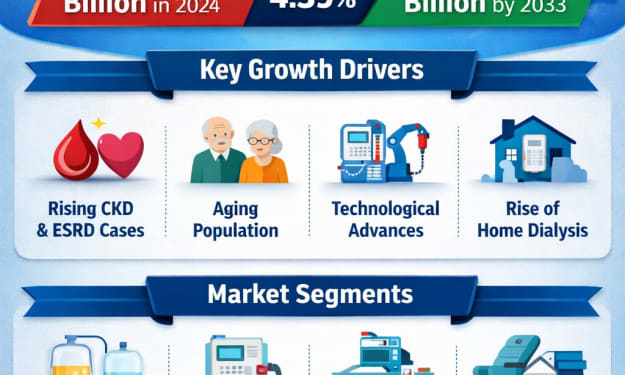
Introduction The global dialysis market is entering a decisive decade of transformation, driven by a sharp rise in chronic kidney disease (CKD), end-stage renal disease (ESRD), aging populations, and rapid technological innovation in renal care. According to Renub Research, the Dialysis Market is expected to reach US$ 171.61 billion by 2033, up from US$ 116.57 billion in 2024, growing at a compound annual growth rate (CAGR) of 4.39% from 2025 to 2033.
By shibansh kumar4 days ago in Trader
The Tango Connection
I suppose I've become a writer so I wouldn't bore everyone to death telling them my stories. Reading them is reading. Not the same. There's rhythm. And timing and, most importantly, drama and suspense. Unless you have tremendous magnetism and an undeniable stage presence, there's no way you can engage an audience the way you can by writing your story. That's my opinion.
By Rene Volpi 3 days ago in Beat



Comments
There are no comments for this story
Be the first to respond and start the conversation.