
Europe Medical Ceramics Market Size & Forecast 2026–2034
Why High-Performance Biomaterials Are Becoming the Backbone of Europe’s Next-Generation Healthcare

Introduction: A Quiet Revolution in Medical Materials
Europe’s healthcare sector is undergoing a material transformation—one that is less visible to patients but crucial to the future of medical treatment. From hip replacements and dental crowns to bone grafts and reconstructive surgery, medical ceramics are rapidly becoming the preferred materials for long-term, high-performance medical applications.
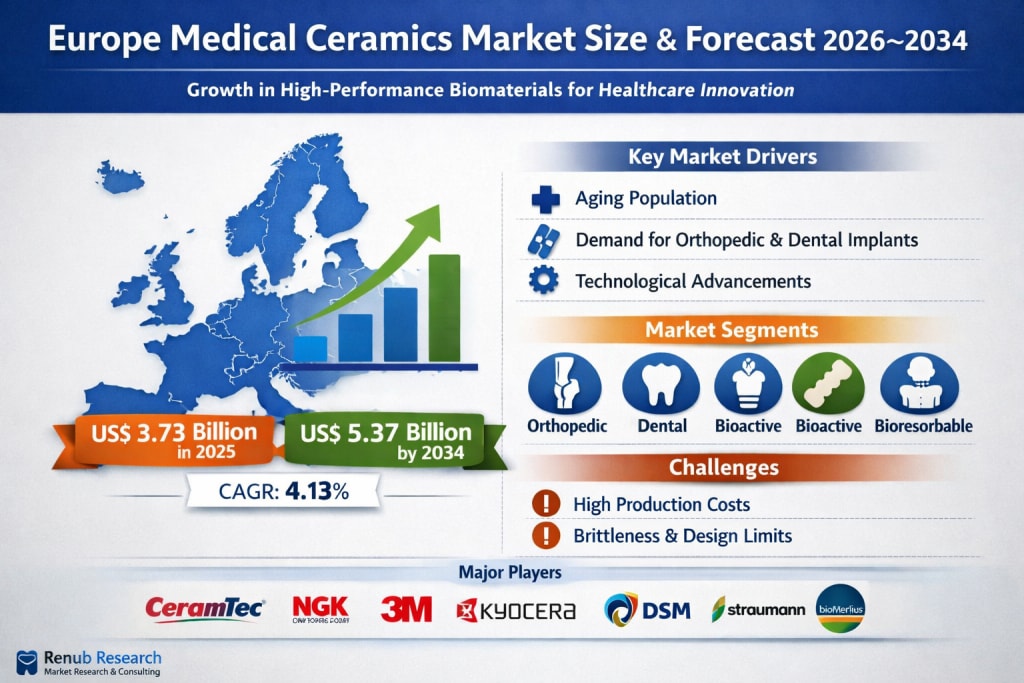
According to Renub Research, the Europe medical ceramics market is projected to grow steadily from US$ 3.73 billion in 2025 to US$ 5.37 billion by 2034, registering a compound annual growth rate (CAGR) of 4.13% from 2026 to 2034. This consistent expansion reflects rising demand for durable, biocompatible, and wear-resistant biomaterials, particularly in orthopedics, dentistry, and implantable medical devices.
The growth story is being shaped by multiple forces: Europe’s aging population, increasing surgical volumes, higher healthcare spending, and continuous innovation in ceramic processing technologies. Together, these factors are positioning medical ceramics as a cornerstone of modern European healthcare.
What Are Medical Ceramics and Why Do They Matter?
Medical ceramics are inorganic, non-metallic materials specifically engineered for use in medical and dental applications. The most commonly used types include alumina, zirconia, hydroxyapatite, and bioglass. These materials are widely applied in orthopedic implants, dental restorations, joint replacements, bone grafts, and surgical instruments.
What makes medical ceramics so valuable is their unique combination of properties:
Excellent biocompatibility, minimizing the risk of immune reactions
High wear and corrosion resistance, ensuring long implant life
Strong mechanical stability under long-term physiological stress
Chemical inertness, reducing inflammation and adverse tissue responses
Unlike some metallic implants, ceramics do not release metal ions into the body, making them particularly suitable for long-term implantation. As Europe’s healthcare systems continue to emphasize patient safety, longevity of implants, and reduced revision surgeries, medical ceramics are gaining strong clinical preference.
Europe’s Healthcare Landscape: A Perfect Fit for Medical Ceramics
The European market has seen significant adoption of biomedical ceramics, supported by advanced healthcare infrastructure, strict regulatory standards, and a strong focus on patient outcomes. The region’s aging population is a major driver, with rising cases of osteoarthritis, osteoporosis, dental disorders, and musculoskeletal conditions increasing the demand for reliable implant materials.
European regulators also enforce high-quality standards for medical devices, which favors materials with proven performance records. Medical ceramics, with their long history of clinical use and well-documented safety profiles, fit perfectly into this environment.
In addition, Europe’s growing emphasis on long-lasting, cost-effective treatments is pushing hospitals and surgeons toward materials that reduce complications and the need for repeat surgeries—another area where ceramics excel.
Key Growth Catalysts in the Europe Medical Ceramics Market
1. Rising Demand for Orthopedic and Dental Implants
One of the strongest growth drivers is the surging demand for orthopedic and dental implants. With Europe’s population aging rapidly, conditions such as joint degeneration, bone fractures, and tooth loss are becoming more common.
Medical-grade ceramics like alumina, zirconia, and hydroxyapatite are now widely used in:
Hip and knee joint replacements
Dental crowns, bridges, and implant abutments
Bone implants and reconstructive procedures
These materials offer excellent mechanical strength, long-term durability, and low risk of allergic reactions, making them ideal for implantable devices. As surgical volumes continue to rise across Europe, the demand for ceramic-based implants is expected to grow steadily throughout the forecast period.
2. Technological Advancements in Ceramic Processing
Innovation in manufacturing is another major growth engine. Precision sintering, advanced coatings, and computer-aided design and manufacturing (CAD/CAM) technologies have significantly improved the strength, reliability, and customization of medical ceramics.
Today, manufacturers can produce complex, patient-specific implant designs with higher accuracy and better aesthetic outcomes, particularly in dental and reconstructive applications. These advancements are helping medical ceramics move beyond standard components into the era of personalized medicine.
The broader medical device industry is also exploring next-generation implant technologies, including regenerative and bioengineered solutions, which further strengthens the long-term outlook for advanced ceramic materials.
3. Strong Focus on Biocompatibility and Durability
European healthcare systems are increasingly prioritizing patient safety, implant longevity, and reduced complication rates. Medical ceramics naturally align with these goals due to their:
Low wear particle generation
Resistance to corrosion
High compatibility with human tissue
Compared to traditional metallic implants, ceramics offer lower risks of inflammatory reactions and long-term complications. This shift toward safer and more durable materials is accelerating the adoption of medical ceramics across hospitals and specialty clinics in Europe.
Challenges Facing the Europe Medical Ceramics Market
High Manufacturing and Material Costs
One of the main restraints is the high cost of production. Advanced ceramic components require sophisticated equipment, strict quality control, and complex manufacturing processes, all of which increase the final product price.
For healthcare systems operating under budget constraints, this can limit adoption in certain applications. However, many providers still view medical ceramics as a long-term investment, given their durability and lower likelihood of requiring revision surgeries.
Brittleness and Design Limitations
While ceramics are extremely wear-resistant and strong, they are also more brittle than metals. This characteristic can limit their use in applications that require high impact resistance or extreme mechanical stress.
Ongoing research aims to improve toughness and fracture resistance, but brittleness remains a technical challenge that designers and engineers must carefully manage when developing ceramic-based implants.
Segment Spotlight: Europe’s Medical Ceramics by Type
Bioactive Medical Ceramics
Bioactive ceramics, such as hydroxyapatite and bioactive glass, are designed to interact with biological tissues and promote bone bonding and regeneration. These materials are widely used in:
Bone grafts
Implant coatings
Dental and orthopedic applications
Their ability to support osteoconduction and tissue integration makes them increasingly popular in modern implant surgeries across Europe, especially where faster healing and stronger biological fixation are desired.
Bioresorbable Medical Ceramics
Bioresorbable ceramics are engineered to gradually degrade and be absorbed by the body after fulfilling their medical purpose. They are commonly used in:
Bone repair and fracture treatment
Temporary scaffolds for tissue regeneration
Craniofacial and orthopedic applications
A major advantage is that they eliminate the need for a second surgery to remove the implant. As Europe moves toward minimally invasive and patient-centric treatments, demand for bioresorbable ceramics is expected to grow.
Plastic Surgery Medical Ceramics
In plastic and reconstructive surgery, medical ceramics are valued for their biocompatibility, mechanical stability, and ability to mimic natural bone structures. Materials such as alumina and zirconia are used in:
Facial reconstruction
Bone contouring
Aesthetic and reconstructive implants
With the rising popularity of aesthetic and reconstructive procedures in Europe, this segment is creating new opportunities for ceramic-based solutions that are both durable and biologically safe.
Orthopedic Medical Ceramics
Orthopedics remains one of the largest application areas for medical ceramics in Europe. Zirconia and alumina are widely used in hip and knee joint implants due to their:
Excellent wear resistance
Low friction properties
Ability to extend implant lifespan
As musculoskeletal disorders become more common among the elderly population, the demand for high-performance orthopedic implants is set to remain a major growth pillar for the market.
Dental Medical Ceramics
The dental segment is particularly dynamic, driven by demand for restorative and cosmetic dentistry. Ceramics such as zirconia and porcelain are used in:
Crowns and bridges
Veneers
Implant abutments
Patients increasingly prefer solutions that offer both durability and natural appearance, and medical ceramics meet both requirements. Rising awareness of dental health across Europe continues to fuel this segment’s expansion.
Country-Level Market Highlights
Germany
Germany stands as one of the largest and most advanced markets for medical ceramics in Europe. The country’s strong medical device manufacturing base, engineering expertise, and robust healthcare system support widespread use of ceramics in orthopedic, dental, and surgical applications. An aging population and high surgical volumes ensure stable long-term demand.
United Kingdom
The UK market is growing steadily, driven by rising demand for orthopedic and dental implants and a strong focus on evidence-based medical practices. Advances in material science and implant technologies continue to support the adoption of ceramic-based solutions.
France
France’s market faces challenges related to cost pressures and competition from alternative biomaterials, but innovation in digital dentistry and medical technologies is helping maintain momentum. The country remains an important player in Europe’s broader medical ceramics ecosystem.
Russia
Russia’s medical ceramics market is still developing, supported by healthcare infrastructure upgrades and growing demand for dental and orthopedic implants. While adoption levels remain lower than in Western Europe, increasing investment in healthcare modernization is gradually improving market prospects.
Competitive Landscape: Key Players in the Market
Major companies shaping the Europe medical ceramics market include:
CeramTec GmbH
NGK Spark Plug Co., Ltd.
3M
Kyocera Corporation
Morgan Advanced Materials
DSM
Straumann
BioMérieux SA
These companies compete through product innovation, material science advancements, strategic partnerships, and expansion of medical-grade ceramic portfolios.
Final Thoughts: A Market Built for Long-Term Growth
The Europe medical ceramics market is entering a phase of steady, sustainable expansion, supported by strong clinical demand, technological progress, and an aging population that requires durable, high-performance medical solutions. With the market expected to grow from US$ 3.73 billion in 2025 to US$ 5.37 billion by 2034 at a CAGR of 4.13%, medical ceramics are set to play an increasingly vital role in Europe’s healthcare future.
As healthcare providers continue to prioritize safety, longevity, and patient outcomes, and as manufacturers push the boundaries of advanced ceramic engineering, medical ceramics will remain at the heart of next-generation implants and medical devices across the continent.
About the Creator
Keep reading
More stories from shibansh kumar and writers in Trader and other communities.
Global Small Gas Engine Market Trends, Size & Forecast 2025–2033
Introduction: A Market Still Running Strong The worldwide Small Gas Engine Market is projected to grow from US$ 3.96 billion in 2024 to US$ 6.14 billion by 2033, registering a CAGR of 4.99% between 2025 and 2033. This steady expansion reflects the continued relevance of compact, reliable, and powerful gasoline engines across a wide range of applications, from gardening and landscaping to construction, agriculture, and emergency power generation.
By shibansh kumar2 days ago in Trader
Silver Price: Trends, Influences, and Its Connection to the MSCI World Index
Introduction The silver price is one of the most closely monitored indicators in both commodities and financial markets. Known for its dual role as a precious metal and industrial resource, silver attracts a wide range of investors. Traders, portfolio managers, and individual investors watch silver prices for clues about inflation, economic health, and safe-haven demand.
By Hammad Nawaz2 days ago in Trader
Echoes
I stepped carefully around the corner, the familiar sights and sounds hitting me like a brick to the face. My eyes watered. I could practically see us, all of us, back then, clustered around the outdoor tables in front of the pizza shop, the bar, the coffee shop. I could smell the various stalls from the events we’d been to on this street. I could taste the churros and nachos.
By Phoenixica243 days ago in Fiction




Comments
There are no comments for this story
Be the first to respond and start the conversation.