
Global Advertising Market Size and Forecast 2025–2033: Digital Transformation Reshapes a Trillion-Dollar Industry
From programmatic buying and influencer marketing to connected TV and data-driven personalization, advertising is entering a smarter, more accountable era

Global Advertising Market Outlook
The global advertising industry stands at the center of modern commerce, culture, and communication. Advertising is a planned communication process employed by companies, organizations, or individuals to promote products, services, ideas, or brands to a public audience. It involves paid messages delivered through various media such as television, radio, print, digital platforms, social media, and outdoor formats. The core objective of advertising is simple yet powerful: to influence consumer behavior, generate demand, and build lasting brand awareness.
In today’s hyper-competitive environment, advertising plays a critical role not only in driving sales but also in shaping consumer perceptions, launching new products, and sustaining a brand’s presence in crowded markets. Beyond commercial use, advertising is also widely applied in public awareness campaigns, political communication, and social causes, making it one of the most influential tools in modern society.
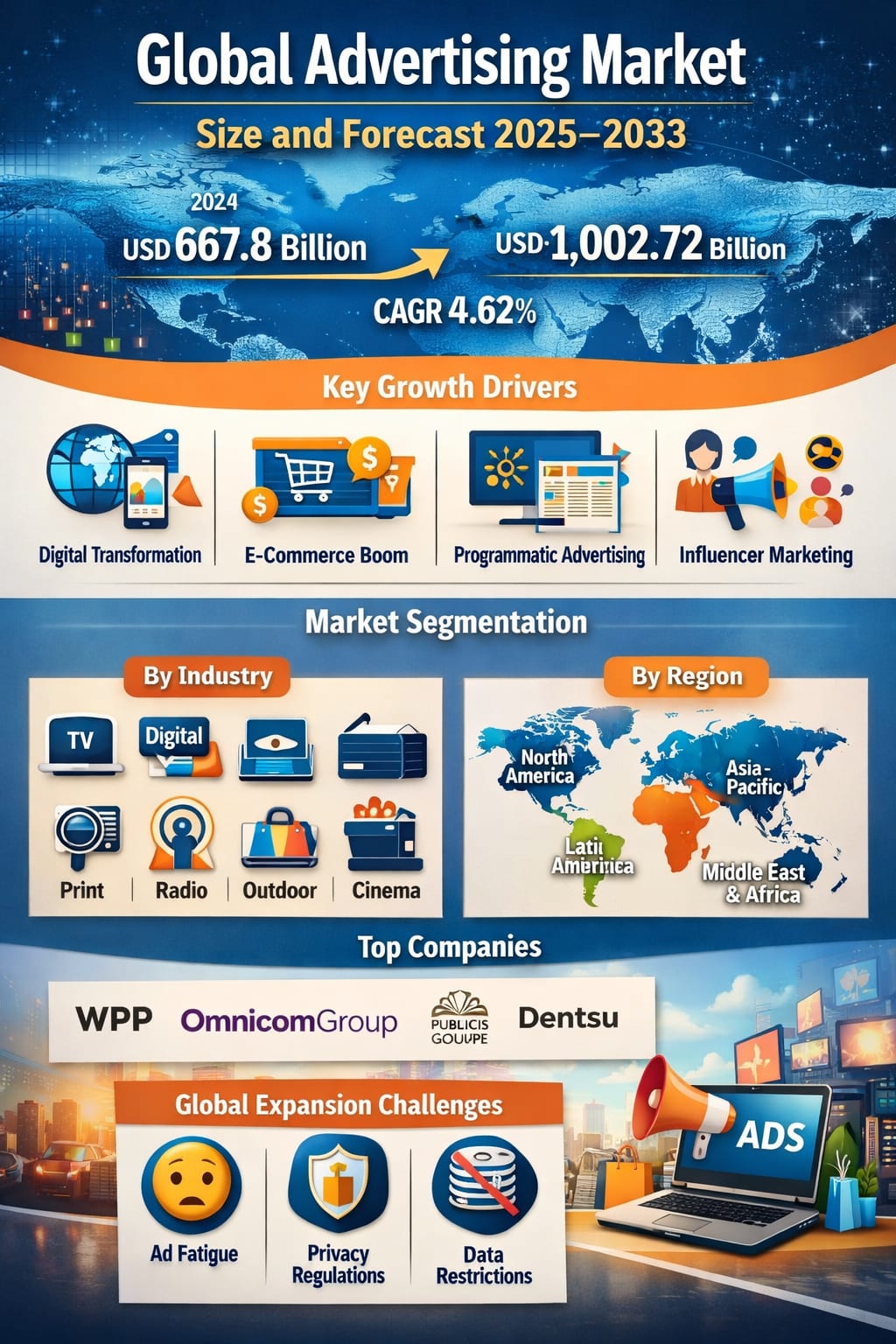
According to Renub Research, the Global Advertising Market was valued at USD 667.8 billion in 2024 and is expected to reach USD 1,002.72 billion by 2033, expanding at a compound annual growth rate (CAGR) of 4.62% during the forecast period. This steady growth reflects the increasing importance of digital channels, mobile-first strategies, programmatic buying, and data-driven marketing in a world where attention has become the most valuable currency.
Advertising in the internet age has become more precise, measurable, and interactive than ever before. Platforms such as Google, Meta (Facebook and Instagram), YouTube, TikTok, and Amazon allow brands to target specific audiences based on interests, location, and online behavior. With the rise of e-commerce, influencer marketing, and mobile-first media consumption, advertising has evolved into a dynamic, performance-oriented industry that is essential for both business growth and cultural influence worldwide.
Growth Drivers in the Global Advertising Market
Digital Transformation and Mobile Usage Growth
One of the strongest forces behind the expansion of the global advertising market is the rapid shift from traditional media to digital-first strategies. The widespread adoption of smartphones and affordable internet access has fundamentally changed how people consume content and how brands reach their audiences. Consumers now spend a significant portion of their daily time on mobile apps, social media platforms, streaming services, and search engines, prompting advertisers to follow them into these digital environments.
Digital advertising offers several advantages over traditional formats: real-time performance measurement, precise audience targeting, flexible budgeting, and automated ad buying through programmatic platforms. These benefits make digital channels attractive not only to large multinational brands but also to small and medium-sized businesses seeking cost-effective customer acquisition. The continued growth of mobile apps, streaming platforms, and social commerce is expected to push even more advertising budgets toward digital media across both developed and emerging economies such as India and Brazil.
Television advertising has also shown resilience, with spending increasing by USD 17 billion between 2020 and 2021 and projected to maintain a steady spend of around USD 131 billion between 2023 and 2028. However, the broader trend clearly favors digital platforms, including social media, search engine marketing, and display advertising, which continue to gain a larger share of total ad expenditure.
E-commerce and Performance-Based Advertising
The rapid global expansion of e-commerce has significantly strengthened the role of performance-based advertising. Online retailers and digital-first brands increasingly rely on advertising models that deliver measurable results, such as pay-per-click (PPC), affiliate marketing, and influencer partnerships. These approaches allow companies to track return on investment (ROI) more accurately and optimize campaigns in real time.
Major platforms like Google Ads, Meta Ads, TikTok, and Amazon Ads now offer highly integrated shopping features, enabling consumers to move from discovery to purchase within a single digital environment. This seamless connection between advertising and commerce makes performance marketing especially attractive during peak shopping seasons, product launches, and promotional events.
In May 2025, Universal Ads launched the Incrementality Fund, a new USD 5 million initiative aimed at helping e-commerce brands generate incremental sales through television advertising. This development highlights how even traditional channels are being reshaped by performance-driven, data-backed strategies that focus on measurable business outcomes.
Content Personalization and Data-Driven Campaigns
Personalization has become a defining feature of modern advertising. With the help of big data and artificial intelligence, brands can now deliver highly relevant messages to specific audience segments based on demographics, interests, location, and behavior. This shift from mass marketing to tailored communication improves engagement rates, click-through performance, and long-term brand loyalty.
From dynamic ad creatives to predictive targeting models, data-driven advertising enables marketers to stand out in increasingly crowded media environments. As data privacy regulations evolve, first-party data and consent-based targeting are becoming more important, encouraging brands to build direct relationships with their audiences.
In March 2025, Omneky, a generative AI platform for digital advertising, introduced “Smart Ads,” a new feature designed to transform how advertising creatives are created and optimized. Innovations like these demonstrate how artificial intelligence is becoming a core component of modern marketing strategies across industries such as retail, finance, and entertainment.
Challenges in the Global Advertising Market
Ad Fatigue and Consumer Skepticism
One of the biggest challenges facing advertisers today is ad fatigue. Consumers are exposed to thousands of promotional messages every day across multiple screens, leading to declining attention spans and lower engagement rates. Repetitive or intrusive advertising formats, such as pop-ups and autoplay videos, often create negative user experiences, particularly on mobile devices.
Younger audiences, especially Gen Z, are increasingly skeptical of traditional advertising and more likely to use ad blockers or ignore overtly promotional content. This shift forces brands to focus more on creativity, storytelling, authenticity, and context in order to rebuild trust and maintain relevance.
Privacy Laws and Data Constraints
Stricter data privacy regulations, including GDPR in Europe and CCPA in California, are reshaping how advertisers collect, store, and use consumer data. The gradual phase-out of third-party cookies and increased scrutiny of data-sharing practices are making audience targeting and performance measurement more complex.
As a result, marketers are investing more in first-party data strategies, contextual advertising, and privacy-compliant tracking solutions. While these changes aim to protect consumers, they also require continuous adaptation and innovation in advertising technology and data management practices.
Global Digital Advertising Market
Digital advertising represents the largest and fastest-growing segment of the global advertising industry. Driven by social media platforms, search engines, video streaming services, and mobile apps, digital advertising offers real-time targeting, detailed performance analytics, and global reach at scale.
Programmatic buying, influencer marketing, and AI-powered optimization tools continue to transform how digital campaigns are planned and executed. Brands increasingly rely on platforms such as Google, YouTube, TikTok, Instagram, and Facebook to reach highly specific audience segments with personalized messages.
Emerging formats such as augmented reality (AR) ads, shoppable videos, and interactive content are further expanding the role of digital advertising across industries ranging from retail and banking to entertainment and travel. The continued shift of consumer attention toward online and mobile environments ensures that digital advertising will remain the primary growth engine of the global market.
Global Television Advertising Market
Television advertising remains a powerful channel, particularly for large-scale brand building, political campaigns, and major product launches. Live sports events, award shows, and prime-time programming still attract massive audiences, making TV an effective medium for broad reach and high-impact messaging.
However, the rise of streaming services and connected TV (CTV) platforms is changing how television advertising works. Many brands now combine traditional TV commercials with digital extensions and second-screen engagement strategies. While linear TV viewership is gradually declining in some markets, television continues to play a central role in integrated, multi-channel advertising campaigns, especially in developed economies.
Global Print Advertising Market
Print advertising, including newspapers and magazines, has experienced a long-term decline but continues to hold relevance in certain niches. It remains effective among older demographics, premium publications, and local or regional campaigns. Luxury brands, in particular, still value print for its tactile quality and perceived credibility.
In sectors such as B2B marketing and real estate, targeted print advertising can still generate strong response rates. To stay relevant, many publishers are adopting hybrid formats that integrate print with digital features such as QR codes and augmented reality elements, helping bridge the gap between traditional and modern media experiences.
Global Outdoor (OOH) Advertising Market
Out-of-home (OOH) advertising includes billboards, transit ads, street furniture, and public digital displays. It offers consistent visibility and strong impact in high-traffic urban areas. The rise of digital out-of-home (DOOH) has brought new capabilities, including dynamic content, real-time updates, and location-based messaging.
OOH advertising is less intrusive than many online formats and cannot be blocked by ad-blocking software, making it a valuable channel for brand awareness campaigns. As urbanization and smart city initiatives continue to expand, outdoor advertising is expected to play an increasingly important role in omnichannel marketing strategies.
Global Influencer Advertising Market
Influencer marketing has become a key strategy for reaching younger audiences, particularly Gen Z and Millennials. Social media creators with loyal followings offer brands access to highly engaged niche communities through authentic, relatable content.
Platforms such as Instagram, TikTok, and YouTube dominate this space, with micro-influencers often delivering higher engagement rates at lower costs compared to celebrity endorsements. Common formats include product reviews, unboxing videos, tutorials, and short-form lifestyle content. As regulations around disclosure become stricter, transparency, authenticity, and brand alignment are becoming essential for successful influencer campaigns.
Global Programmatic Advertising Market
Programmatic advertising uses artificial intelligence and real-time bidding systems to automate the buying and selling of ad inventory. This approach allows advertisers to target audiences based on data such as location, behavior, device type, and time of day, delivering more relevant ads at scale.
Today, programmatic advertising accounts for more than half of global digital ad spending. Innovations in contextual targeting, supply path optimization, and cookieless solutions are shaping the next phase of growth. Despite ongoing concerns around ad fraud and viewability, programmatic advertising remains a cornerstone of modern media buying due to its efficiency, scalability, and precision.
Regional Insights
United States Advertising Market
The United States is the largest advertising market in the world, supported by a mature digital ecosystem, a massive consumer base, and strong innovation in marketing technology. Digital advertising—especially search, social media, and connected TV—accounts for the majority of spending, with Google, Meta, and Amazon leading platforms.
Influencer marketing and programmatic buying are widely adopted, and key spending industries include technology, retail, automotive, finance, and entertainment. Major events such as the Super Bowl, election cycles, and holiday shopping seasons drive significant spikes in advertising activity. In May 2024, Amazon Ads launched new interactive ad formats for streaming TV, highlighting the continued innovation in the U.S. market.
Germany Advertising Market
Germany, Europe’s largest economy, represents a major advertising hub with strong demand across digital, print, and television channels. Traditional media remains influential, particularly among older audiences, while digital video and mobile advertising are growing rapidly.
Data privacy is a major concern for German consumers, leading to more cautious targeting strategies and a preference for transparent, content-driven campaigns. B2B and automotive sectors are among the biggest advertisers, and strict compliance with GDPR continues to shape marketing practices across the country.
China Advertising Market
China’s advertising market is expanding rapidly, driven by mobile-first consumers, e-commerce integration, and powerful super apps such as WeChat, Douyin, and Xiaohongshu. Short-form video, livestream shopping, and influencer-led campaigns dominate digital strategies.
Local tech giants like Alibaba, Tencent, and Baidu provide highly advanced advertising ecosystems. While digital leads growth, television and outdoor advertising remain relevant, especially in lower-tier cities. Content regulation and cultural considerations require advertisers to stay compliant and locally relevant.
Saudi Arabia Advertising Market
Saudi Arabia’s advertising market is growing steadily, supported by economic diversification under Vision 2030, rapid digitalization, and a young, tech-savvy population. Social media, mobile apps, and influencer marketing are gaining strong momentum, while television and outdoor advertising remain effective during major cultural and national events.
Large-scale government projects and tourism initiatives have increased both corporate and public sector advertising spend, making localized content and cultural sensitivity crucial for success in this market.
Market Segmentation Overview
By Industry Performance:
Television Advertising, Print Advertising, Newspaper Advertising, Magazine Advertising, Radio Advertising, Outdoor Advertising, Internet Advertising, Search Advertising, Display Advertising, Classified Advertising, Video Advertising, Mobile Advertising, Cinema Advertising
By Region and Country:
North America (United States, Canada), Europe (France, Germany, Italy, Spain, United Kingdom, Belgium, Netherlands, Turkey), Asia Pacific (China, Japan, India, South Korea, Thailand, Malaysia, Indonesia, Australia, New Zealand), Latin America (Brazil, Mexico, Argentina), Middle East & Africa (Saudi Arabia, UAE, South Africa)
Key Players Include:
WPP Group PLC, Omnicom Group Inc., Publicis Groupe, The Interpublic Group of Companies, Dentsu Inc., Hakuhodo DY Holdings, Accenture Interactive, MDC Partners, and IPG Mediabrands. These companies are analyzed across business overview, leadership, recent developments, SWOT, and revenue performance.
Final Thoughts
The global advertising industry is undergoing a profound transformation, shaped by digital innovation, data-driven strategies, and changing consumer expectations. With the market projected to grow from USD 667.8 billion in 2024 to USD 1,002.72 billion by 2033, advertising is firmly on track to remain a trillion-dollar powerhouse of the global economy.
While challenges such as privacy regulations and ad fatigue persist, the industry’s ability to adapt through technology, creativity, and personalization continues to unlock new opportunities. From programmatic and influencer marketing to connected TV and digital out-of-home, the future of advertising will be defined by smarter, more accountable, and more engaging communication between brands and consumers.
About the Creator
Long-Term Investing vs Short-Term Trading: Which Strategy Builds Real Wealth?
Building wealth in the financial markets is one of the most common goals among investors, yet the path to achieving it can look very different depending on strategy. Two of the most popular approaches are long-term investing and short-term trading. While both aim to generate profits, their mindset, risk level, and long-term outcomes vary significantly. Understanding these differences is essential before committing your time and capital.
By Hammad Nawaz2 days ago in Trader
AI Stock Research: Tools, Strategies, and Market Insights
Introduction The rise of AI stock research is transforming how investors approach the market. Traditional stock analysis often relies on manually reviewing financial reports, tracking market trends, and interpreting news—tasks that are time-consuming and prone to human error. AI, however, can analyze massive datasets in seconds, detect patterns, and generate actionable insights, giving investors a distinct edge in today’s fast-paced markets.
By Hammad Nawaz4 days ago in Trader



Comments
There are no comments for this story
Be the first to respond and start the conversation.