
Global Champagne Market Size Set to Reach USD 12.74 Billion by 2033 as Luxury Consumption and Premiumization Accelerate
From heritage vineyards in France to celebratory tables across Asia and North America, champagne continues to evolve from a symbol of tradition into a fast-growing global luxury category

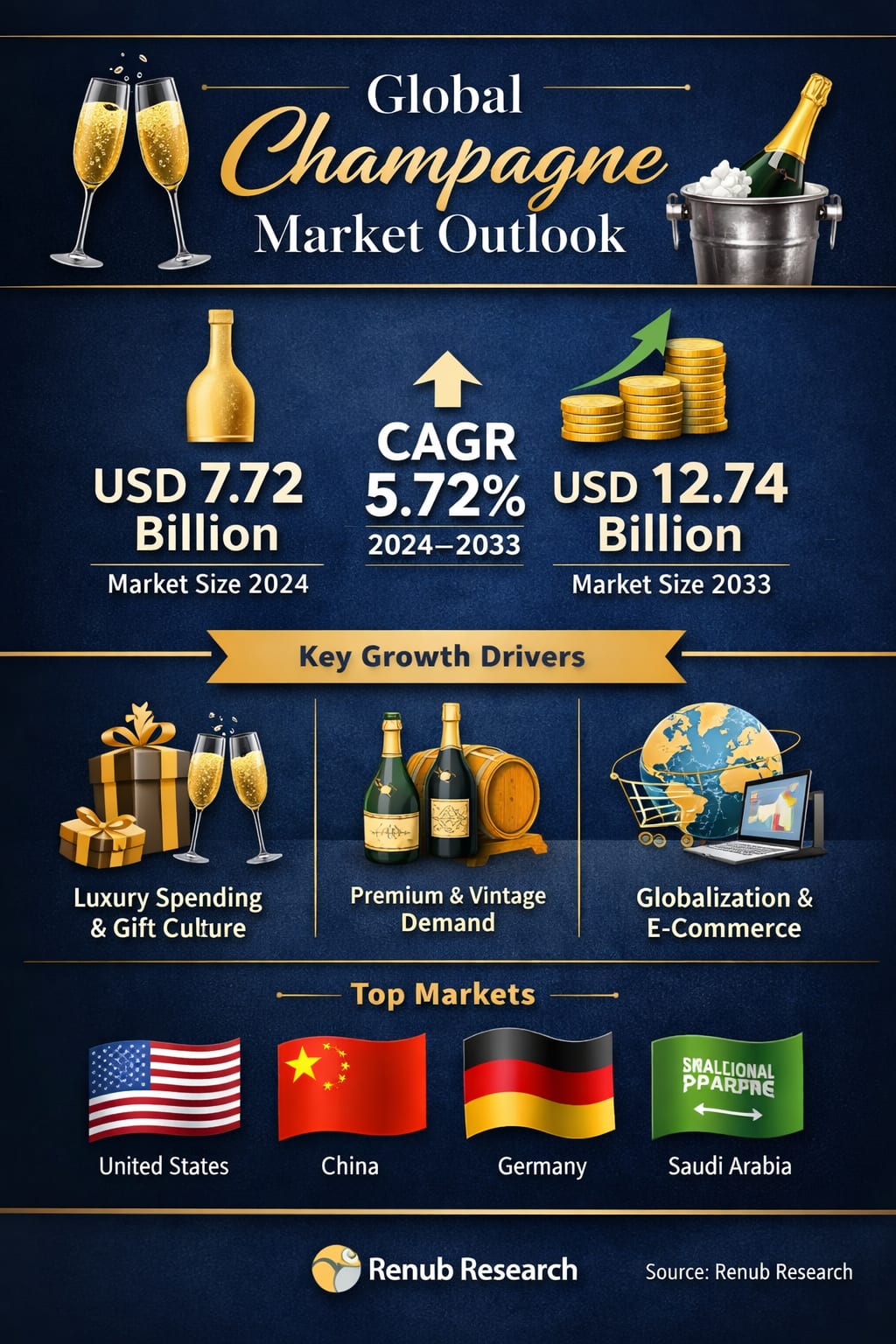
Global Champagne Market Outlook
The Global Champagne Market was valued at USD 7.72 billion in 2024 and is expected to reach USD 12.74 billion by 2033, expanding at a CAGR of 5.72% during the forecast period. This growth is being driven by rising luxury spending, premium gifting trends, and a surging demand for celebratory beverages in emerging economies, supported by strong brand prestige and evolving lifestyle patterns across Europe, North America, and Asia-Pacific.
Champagne is a type of sparkling wine produced exclusively in the Champagne region of France, made from specific grape varieties—primarily Chardonnay, Pinot Noir, and Pinot Meunier—and crafted under strict traditional methods known as the méthode champenoise. Its signature effervescence, refined taste profile, and aromatic complexity have made it one of the most prestigious alcoholic beverages in the world.
For centuries, champagne has been closely associated with celebration, luxury, and milestone occasions. It is a staple at weddings, New Year’s Eve parties, corporate events, award ceremonies, and upscale social gatherings. Beyond festivities, it also plays a growing role in fine dining, premium gifting, and curated culinary experiences. Global branding, heritage storytelling, and strong cultural links with success and prestige continue to reinforce its premium image.
While Europe and North America have traditionally dominated consumption, demand is now rising steadily in Asia-Pacific and parts of the Middle East, driven by growing wealth, Western lifestyle influence, and expanding luxury hospitality sectors. The market has also diversified with the increasing popularity of rosé champagnes, vintage releases, and prestige cuvées, appealing to younger consumers and seasoned wine enthusiasts alike. Despite evolving trends, champagne remains an enduring symbol of sophistication and a benchmark within the premium beverage industry.
Growth Drivers in the Global Champagne Market
Increased Luxury Consumption and Gift Culture
The expansion of global wealth—especially in emerging economies—is significantly boosting demand for luxury products, and champagne remains one of the most recognizable status symbols in this space. In many cultures, high-end beverages are central to gift-giving traditions during festivals, weddings, corporate celebrations, and personal milestones.
As middle-class and upper-middle-class populations grow in countries such as China, India, and parts of the Middle East, discretionary spending on premium lifestyle products is increasing. Champagne, with its strong association with success, prestige, and celebration, benefits directly from this shift. It is increasingly viewed not just as a drink, but as a social statement—a way to signal taste, achievement, and refined living.
Growth of Premium and Vintage Products
Champagne producers are placing greater emphasis on prestige cuvées, vintage champagnes, and limited-edition releases to differentiate their portfolios and attract high-value consumers. These premium offerings are often aged longer, produced in smaller quantities, and priced significantly higher, helping to lift both brand image and profit margins.
Collectors, connoisseurs, and high-end consumers are showing growing interest in rare vintages and exclusive blends. Wine tourism, tasting experiences, and gourmet food pairings further support this premiumization trend. Social media and digital storytelling have amplified the desirability of high-end bottles, turning certain labels into lifestyle icons.
In June 2024, Laurent-Perrier introduced Heritage, a multi-vintage blend positioned between its entry-level non-vintage champagne and top-tier premium offerings. Such innovations not only attract new customers but also encourage existing consumers to explore more of a brand’s range, strengthening long-term loyalty.
Globalization and Digital Accessibility
Improvements in global logistics, retail networks, and e-commerce platforms have made champagne more accessible than ever before. Consumers in Asia, Latin America, and Africa can now explore and purchase a wide variety of champagne brands through supermarkets, specialty wine stores, and online platforms.
Digital marketing, influencer partnerships, virtual tastings, and online education campaigns are helping demystify champagne for new audiences. In 2022, Laurent-Perrier partnered with luxury retailer Selfridges to launch an in-store and online customization service, offering personalized packaging for its iconic Cuvée Rosé bottle—highlighting how digital and physical retail are merging to enhance the premium experience.
As digital-first shopping behavior continues to grow, especially among younger consumers, online platforms are becoming a critical driver of both awareness and sales in the global champagne market.
Challenges Facing the Global Champagne Market
Strict AOC Regulations and Limited Production
Champagne is protected under Appellation d’Origine Contrôlée (AOC) regulations, which strictly limit production to a defined geographic area and specific grape varieties. While these rules safeguard quality and authenticity, they also constrain supply.
Producers cannot easily expand vineyard acreage or significantly increase yields, even when global demand rises. This creates a structural supply limitation that often pushes prices higher and can make champagne less accessible to price-sensitive consumers. Additionally, climate variability poses risks to grape quality and harvest consistency, adding further pressure within these strict regulatory boundaries.
Competition from Alternative Sparkling Wines
Champagne faces growing competition from more affordable sparkling wines such as Prosecco (Italy), Cava (Spain), and various traditional-method sparkling wines from the U.S., Australia, and England. These alternatives often deliver a similar celebratory experience at a lower price point and are increasingly positioned as “accessible luxury.”
For consumers seeking festive drinks without the premium cost, these substitutes are attractive. As a result, champagne producers must continue to justify their price premium through heritage, terroir, craftsmanship, and brand storytelling to maintain their competitive edge.
Key Market Segments and Trends
Global Prestige Cuvée Champagne Market
Prestige cuvée champagnes—such as Dom Pérignon and Cristal—represent the pinnacle of the category. Made from top-quality grapes and aged for extended periods, these wines cater to collectors, connoisseurs, and high-end gift buyers. Limited availability and strong brand heritage fuel their exclusivity and investment appeal.
Rising global wealth and the continued trend toward premiumization are driving strong demand for this segment, particularly in North America, Europe, and Asia.
World Blanc de Noirs Champagne Market
Blanc de Noirs champagnes, produced exclusively from Pinot Noir and/or Pinot Meunier, offer richer, fuller-bodied flavor profiles with red fruit and nutty notes. These wines appeal to experienced consumers seeking depth and complexity beyond traditional blends.
Interest is especially strong in Europe, North America, and Japan, where consumers are more experimental and receptive to niche wine styles.
Global Economy Champagne Market
Entry-level and non-vintage champagnes play a crucial role in expanding the consumer base. These more affordable options are popular for casual celebrations, restaurant dining, and first-time buyers. Widely available in supermarkets and large retail chains, they support volume growth and act as a gateway to higher-priced segments over time.
Global Luxury Champagne Market
The luxury segment includes premium non-vintage, limited editions, special packaging, and fashion or celebrity collaborations. This category focuses heavily on experience, image, and lifestyle positioning, particularly in markets such as China, the Gulf countries, and Western luxury hubs.
Distribution Channel Dynamics
Specialty Stores
Specialty wine shops and boutiques offer curated selections, expert guidance, and tasting experiences. They play a key role in educating consumers, building brand loyalty, and promoting premium and vintage champagnes.
Online Stores
E-commerce has transformed champagne retail. Platforms such as Vivino, Wine.com, and regional wine e-tailers provide access to rare bottles, customer reviews, and personalized recommendations. The digital shift that accelerated during the pandemic has now become a permanent feature of the buying journey, expanding champagne’s reach far beyond traditional wine markets.
Regional Market Insights
United States
The U.S. is one of the world’s largest champagne importers, driven by strong demand for premium beverages across weddings, holidays, corporate events, and lifestyle occasions. Younger consumers are increasingly experimenting with sparkling wines, while premiumization trends are pushing higher spending on special occasions.
According to the U.S. Alcohol and Tobacco Tax and Trade Bureau (TTB), U.S. imports of sparkling wine, including champagne, totaled about 26.6 million cases in 2022, highlighting sustained interest in the category.
Germany
Germany has a strong sparkling wine culture and growing appreciation for imported champagne, especially among affluent consumers. Demand is supported by specialty stores, online platforms, and gourmet retailers, with rising interest in sustainability and organic certifications.
China
China represents one of the most promising growth markets, fueled by rising incomes, Western lifestyle influence, and luxury consumption. Champagne is popular for gifting, business dining, and high-end social events, particularly in major cities like Beijing, Shanghai, and Shenzhen. As wine education and digital marketing expand, China is expected to remain a key growth engine for the global market.
Saudi Arabia
While alcoholic champagne sales are restricted, non-alcoholic “halal champagne” alternatives are gaining traction in celebrations and hospitality settings. As the country’s luxury tourism and dining sectors expand under Vision 2030, niche opportunities are emerging for premium alcohol-free sparkling beverages.
Market Segmentation Overview
By Product:
Prestige Cuvée
Blanc de Noirs
Blanc de Blancs
Rosé Champagne
Others
By Price:
Economy
Mid-Range
Luxury
By Distribution Channel:
Supermarkets and Hypermarkets
Specialty Stores
Online Stores
By Region:
North America, Europe, Asia Pacific, Latin America, Middle East & Africa
Competitive Landscape
Key players operating in the global champagne market include:
Diageo plc
La Marca USA
F. Korbel & Bros.
Cook's Champagne Cellars
Champagne Taittinger CCVC
Société Jacques Bollinger SA
André Champagne Cellars
Laurent-Perrier Group
Champagne AYALA
LVMH Moët Hennessy
These companies compete through brand heritage, product innovation, global distribution networks, and strategic marketing initiatives.
Final Thoughts
The global champagne market is entering a new phase of growth, shaped by premiumization, digital transformation, and expanding demand from emerging economies. While strict production regulations and competition from alternative sparkling wines pose challenges, champagne’s unmatched heritage, prestige, and cultural significance continue to set it apart.
With the market projected to grow from USD 7.72 billion in 2024 to USD 12.74 billion by 2033 at a CAGR of 5.72%, champagne is not just preserving its legacy—it is redefining its future as a truly global luxury icon.
About the Creator
Keep reading
More stories from shibansh kumar and writers in Trader and other communities.
Reconstituted Milk Market Size and Forecast 2025–2033
Introduction: A Quiet Revolution in the Global Dairy Aisle The global dairy industry is undergoing a subtle but powerful transformation. While fresh milk continues to dominate consumer perception, reconstituted milk—produced by adding water to milk powder—has been steadily carving out a critical role in modern food systems. From food processing plants and bakeries to households in regions with limited cold-chain infrastructure, reconstituted milk has become an indispensable solution for affordability, accessibility, and long-term storage.
By shibansh kumarabout 8 hours ago in Trader
Cerumen Removal Market Size and Forecast 2025–2033
Global Cerumen Removal Market: An Industry Gaining Attention The global cerumen removal market is steadily transforming from a niche healthcare segment into a widely discussed and commercially significant industry. According to Renub Research, the cerumen removal market was valued at US$ 2.31 billion in 2024 and is expected to reach US$ 4.23 billion by 2033, growing at a CAGR of 6.95% from 2025 to 2033. This consistent growth reflects a broader shift in how consumers and healthcare systems approach ear health, preventive care, and non-invasive treatment solutions.
By Sakshi Sharma5 days ago in Trader
Philippines Higher Education Market 2026: A Thriving Sector Driven by Increasing Demand for Quality Education and Global Learning Opportunities
Philippines Higher Education Market The Philippines higher education market size is on a rapid growth trajectory. In 2025, the market size is expected to be USD 154.0 million, with a projected compound annual growth rate (CAGR) of 20.23%, reaching USD 847.0 million by 2034. This expansion is being driven by the growing demand for quality tertiary education, increasing opportunities for international collaborations, and the government's commitment to improving the higher education system.
By Manisha Dixit5 days ago in Trader


Comments
There are no comments for this story
Be the first to respond and start the conversation.