
Global Game-based Learning Market Size & Forecast 2026–2034
How Gamification, AI, and Digital Education Are Reshaping the Future of Learning Worldwide

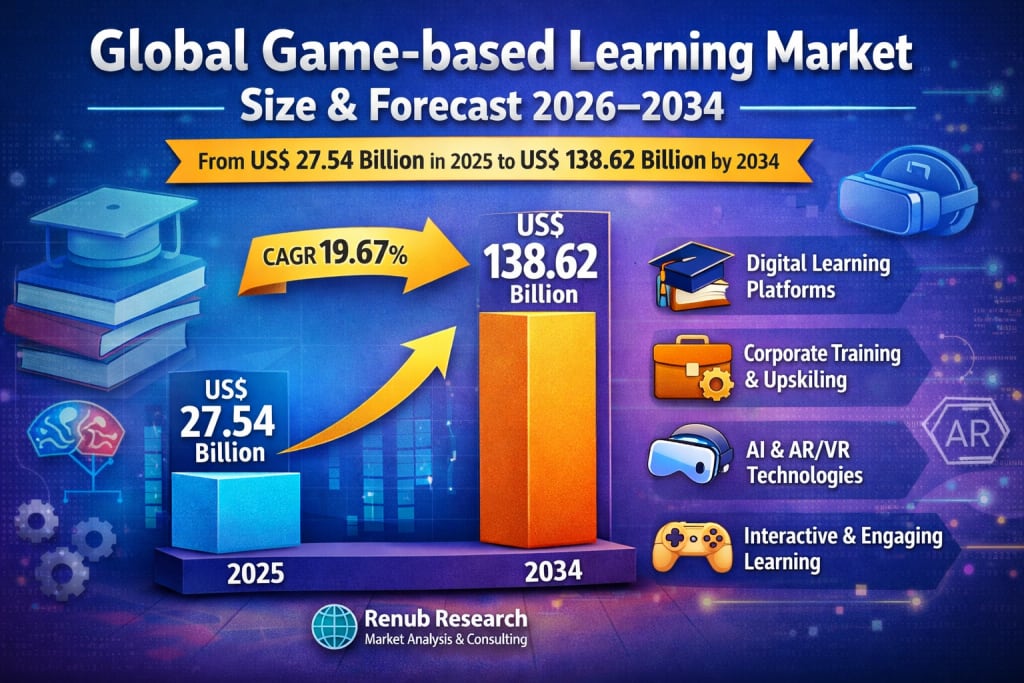
Global Game-based Learning Market: A New Era of Interactive Education
The global game-based learning market is entering a powerful growth phase as education systems, enterprises, and individual learners increasingly turn toward interactive and technology-driven learning models. According to Renub Research, the market is expected to expand from US$ 27.54 billion in 2025 to US$ 138.62 billion by 2034, registering an impressive compound annual growth rate (CAGR) of 19.67% during 2026–2034.
This remarkable expansion reflects a fundamental shift in how knowledge and skills are delivered across the world. Traditional classroom methods and static e-learning modules are gradually giving way to immersive, engaging, and experience-driven learning environments. Game-based learning sits at the heart of this transformation, blending education with gameplay mechanics such as challenges, rewards, storytelling, simulations, and competition to create more motivating and effective learning experiences.
Driven by the rapid digitalization of education, the widespread adoption of smartphones and tablets, and the growing acceptance of remote and hybrid learning models, game-based learning has evolved from a niche concept into a mainstream educational strategy. From primary schools and universities to corporate training rooms and consumer self-learning apps, this approach is redefining how people learn, practice, and retain knowledge in the digital age.
Understanding Game-based Learning and Its Growing Relevance
Game-based learning is an educational approach that integrates learning objectives directly into games or game-like environments. Unlike simple gamification, which adds points or badges to existing content, game-based learning embeds educational content into interactive gameplay itself. Learners progress by solving problems, completing missions, making decisions, and engaging with realistic scenarios, all while absorbing knowledge and developing skills.
This model supports both cognitive and behavioral development. It encourages active participation instead of passive consumption, improves motivation through feedback and rewards, and enhances long-term retention by allowing learners to “learn by doing.” Today, game-based learning is delivered through digital platforms, mobile applications, simulations, virtual environments, and even hybrid physical-digital formats.
Worldwide, its adoption has accelerated due to the rapid digital transformation of education and training systems. The normalization of online learning, the need for continuous workforce upskilling, and the preferences of younger, tech-savvy generations have all contributed to the rising popularity of interactive learning formats. As a result, game-based learning is increasingly viewed not just as a supplement, but as a core component of modern education and professional development strategies.
Key Growth Drivers Powering the Market
Rapid Digitalization of Education and Training
One of the strongest drivers of the global game-based learning market is the accelerating digital transformation of education and corporate training. Schools, universities, and enterprises are steadily shifting away from purely traditional teaching methods toward digital platforms that support interactive and learner-centric experiences.
Game-based learning aligns perfectly with this transition. Cloud platforms, mobile learning apps, and learning management systems are increasingly integrating simulations, quizzes, leaderboards, and scenario-based challenges to improve engagement and outcomes. In corporate environments, digital learning tools are being used to train geographically distributed workforces efficiently and consistently.
Governments and institutions across the world are investing heavily in digital infrastructure and e-learning initiatives, further supporting adoption. For example, in May 2025, the Congolese government launched an online learning platform developed by the African Centre for Research in Artificial Intelligence (Caria) to train young people in IT and communication skills, highlighting how digital education initiatives are expanding even in emerging markets.
Growing Demand for Engaging and Personalized Learning Experiences
Modern learners expect education and training to be interactive, engaging, and tailored to their individual needs. Game-based learning meets these expectations by offering personalized pathways, adaptive difficulty levels, and real-time feedback. Instead of passively consuming information, learners actively participate, experiment, and solve problems in simulated environments.
The integration of data analytics and artificial intelligence enables platforms to track progress, identify skill gaps, and adjust content accordingly. This personalization improves motivation, increases completion rates, and leads to better learning outcomes. In July 2025, D2L introduced new AI-powered experiences under its D2L Lumi platform to support hyper-personalized learning, reflecting the broader industry trend toward adaptive and learner-centric education technologies.
As attention spans shorten and competition for learner engagement increases, institutions and organizations are increasingly turning to game-based approaches to make learning more effective and enjoyable.
Expansion of Corporate Training and Workforce Upskilling
The global need for continuous upskilling and reskilling is another major growth engine for the game-based learning market. Rapid technological change, automation, and evolving job roles are forcing organizations to rethink how they train and develop their workforce.
Game-based learning is particularly effective in corporate settings because it supports scenario-based simulations, role-playing exercises, and decision-making challenges that mirror real-world situations. These methods help employees apply knowledge in practical contexts, improving both performance and confidence. Gamification elements such as rewards, badges, and competition also increase participation in training programs that might otherwise be seen as routine or mandatory.
In November 2025, LinkedIn Learning launched AI-driven corporate training modules that personalize skill development paths across technology, leadership, and compliance areas, reinforcing the growing role of intelligent, interactive learning solutions in enterprise environments.
Challenges Facing the Market
High Development Costs and Content Complexity
Despite its strong growth prospects, the game-based learning market faces challenges related to development costs and content complexity. Creating high-quality educational games requires collaboration between subject matter experts, instructional designers, game developers, and user experience designers. This makes development both time-consuming and expensive, especially for advanced simulations or immersive AR/VR experiences.
Smaller institutions and organizations may find these costs difficult to justify, particularly in price-sensitive markets. Additionally, content must be regularly updated to stay aligned with curricula, industry standards, or regulatory requirements, further increasing long-term costs and operational complexity.
Resistance to Adoption and Learning Curve Issues
Another barrier is resistance to adoption in some educational and corporate environments. Educators and decision-makers may remain skeptical about the effectiveness of games compared to traditional teaching methods. Concerns about screen time, lack of familiarity with digital tools, and insufficient training can also slow acceptance.
In corporate settings, employees from non-digital-native generations may struggle with game-based platforms, reducing engagement. Poorly designed games also risk being perceived as entertainment rather than serious learning tools, which can undermine credibility. Overcoming these issues requires awareness, training, and clear evidence of measurable learning outcomes.
Market Segments Shaping the Industry
Game-based Learning Services Market
The services segment plays a critical role in the ecosystem, covering consulting, design, development, integration, and ongoing support. Many organizations lack in-house expertise to build pedagogically sound and engaging learning games, creating strong demand for specialized service providers.
These services include needs assessment, instructional design, custom development, localization, analytics integration, and trainer support. As organizations increasingly focus on return on investment and measurable outcomes, professional services become essential for successful implementation and long-term optimization.
Online Game-based Learning Market
Online delivery is one of the fastest-growing segments, driven by widespread internet access and the normalization of remote and hybrid learning. Online platforms allow learners to access content from anywhere, making them ideal for schools, universities, and distributed workforces.
Scalability, centralized performance tracking, and social features such as multiplayer modes and leaderboards make online game-based learning highly attractive. As flexible work and learning models continue to expand, online deployment will remain a core growth pillar.
Cloud Game-based Learning Market
Cloud-based platforms are gaining strong traction as organizations move away from on-premise systems. Cloud deployment offers lower upfront costs, rapid scalability, easier updates, and global accessibility. It also supports advanced analytics and seamless integration with learning management systems and HR platforms.
As organizations pursue digital transformation and data-driven learning strategies, cloud-based game-based learning solutions are becoming the preferred choice across both education and enterprise sectors.
AI Game-based Learning Market
AI-driven game-based learning represents one of the most dynamic and high-potential segments. Artificial intelligence enables adaptive learning, intelligent tutoring, predictive analytics for skill gaps, and automated assessments. This creates highly personalized experiences that significantly improve engagement and retention.
In corporate training, AI-powered simulations allow employees to practice decision-making in realistic, evolving scenarios. In education, AI helps address diverse learning styles and pacing needs. Although still emerging, AI integration is becoming a key differentiator and growth engine for the market.
End-User Perspectives
Game-based Education Learning Market
In K–12 and higher education, game-based learning is increasingly used to teach subjects such as mathematics, science, languages, and history through interactive simulations and problem-solving activities. These tools help improve comprehension, participation, and knowledge retention, while also enabling real-time assessment of student progress.
Government initiatives supporting digital classrooms and e-learning infrastructure are further boosting adoption, making game-based education a vital part of modern, student-centered learning models.
Game-based Consumer Learning Market
On the consumer side, game-based learning targets individuals seeking self-improvement, skill development, or knowledge outside formal institutions. Popular areas include language learning, coding basics, financial literacy, and brain training. Mobile apps dominate this segment, supported by freemium and subscription business models.
The combination of entertainment and education makes learning more habit-forming and accessible, supporting the broader trend of lifelong learning.
Regional Market Highlights
United States
The United States represents one of the most advanced markets, supported by strong digital infrastructure, high education spending, and a mature corporate training ecosystem. AI, analytics, AR/VR, and cloud platforms are widely adopted across both education and enterprise sectors. In June 2025, Arizona State University partnered with Games for Change to advance educational innovation through game-based learning, research, and microcredentials, highlighting the country’s leadership in this space.
France
France’s market is growing steadily, driven by digital education initiatives and structured adoption in schools and enterprises. The focus remains on pedagogical quality, curriculum alignment, and localized content, supporting demand for specialized solutions and services.
India
India is one of the fastest-growing and most volume-driven markets, fueled by a large youth population, widespread smartphone usage, and rising demand for affordable education. Mobile-first platforms dominate, and government support for digital education continues to strengthen adoption. The Meghalaya government’s move to introduce game-based learning for children reflects this momentum.
Saudi Arabia
Saudi Arabia’s market is gaining momentum as part of broader education and digital transformation reforms. In November 2025, the King Salman Science Oasis introduced a new play-based learning program to strengthen children’s cognitive and creative abilities, highlighting the country’s growing focus on innovative education models.
Competitive Landscape
Key players operating in the global game-based learning market include Badgeville (CallidusCloud), Bunchball (BI WORLDWIDE), Classcraft Studios Inc., Six Waves Inc., Recurrence, Inc., Gametize Pte. Ltd., Kuato Studios, BreakAway Ltd., Inc., Filament Games, and LearningWare, Inc. These companies are evaluated across five viewpoints: overviews, key persons, recent developments, SWOT analysis, and revenue analysis, reflecting a competitive and innovation-driven market environment.
Final Thoughts
The global game-based learning market is on a powerful growth trajectory, supported by digital transformation, rising demand for personalized and engaging learning, and the urgent need for continuous skill development. With the market projected to grow from US$ 27.54 billion in 2025 to US$ 138.62 billion by 2034 at a CAGR of 19.67%, game-based learning is no longer a niche trend—it is becoming a cornerstone of modern education and training systems worldwide.
As cloud, AI, and online platforms continue to mature, and as educators and organizations increasingly prioritize outcomes, engagement, and flexibility, game-based learning will play an even more central role in shaping the future of how the world learns, works, and grows.
About the Creator
Keep reading
More stories from shibansh kumar and writers in Trader and other communities.
Water Soluble Polymer Market Size and Forecast, 2026–2034
The global water-soluble polymer market is entering a phase of steady, structurally supported growth, driven by rising demand from water treatment, pharmaceuticals, food processing, personal care, and energy-related industries. According to Renub Research, the market is expected to expand from US$ 36.87 billion in 2025 to US$ 58.34 billion by 2034, growing at a compound annual growth rate (CAGR) of 5.23% from 2026 to 2034.
By shibansh kumarabout 7 hours ago in Trader
Long-Term Investing vs Short-Term Trading: Which Strategy Builds Real Wealth?
Building wealth in the financial markets is one of the most common goals among investors, yet the path to achieving it can look very different depending on strategy. Two of the most popular approaches are long-term investing and short-term trading. While both aim to generate profits, their mindset, risk level, and long-term outcomes vary significantly. Understanding these differences is essential before committing your time and capital.
By Hammad Nawaz4 days ago in Trader
AI Stock Research: Tools, Strategies, and Market Insights
Introduction The rise of AI stock research is transforming how investors approach the market. Traditional stock analysis often relies on manually reviewing financial reports, tracking market trends, and interpreting news—tasks that are time-consuming and prone to human error. AI, however, can analyze massive datasets in seconds, detect patterns, and generate actionable insights, giving investors a distinct edge in today’s fast-paced markets.
By Hammad Nawaz6 days ago in Trader



Comments
There are no comments for this story
Be the first to respond and start the conversation.