
Global Vitamin K2 Market Size and Forecast (2025–2033)
Why Vitamin K2 Is Emerging as a Cornerstone of Preventive Health and Functional Nutrition

Introduction: A Quiet Vitamin with a Powerful Market Story
The global health and wellness industry is undergoing a profound transformation. Consumers today are no longer satisfied with reactive healthcare alone; instead, they are increasingly investing in preventive solutions that promise long-term vitality, better quality of life, and reduced risk of chronic disease. Within this shifting landscape, vitamin K2 has emerged as one of the most promising yet previously underappreciated nutrients.
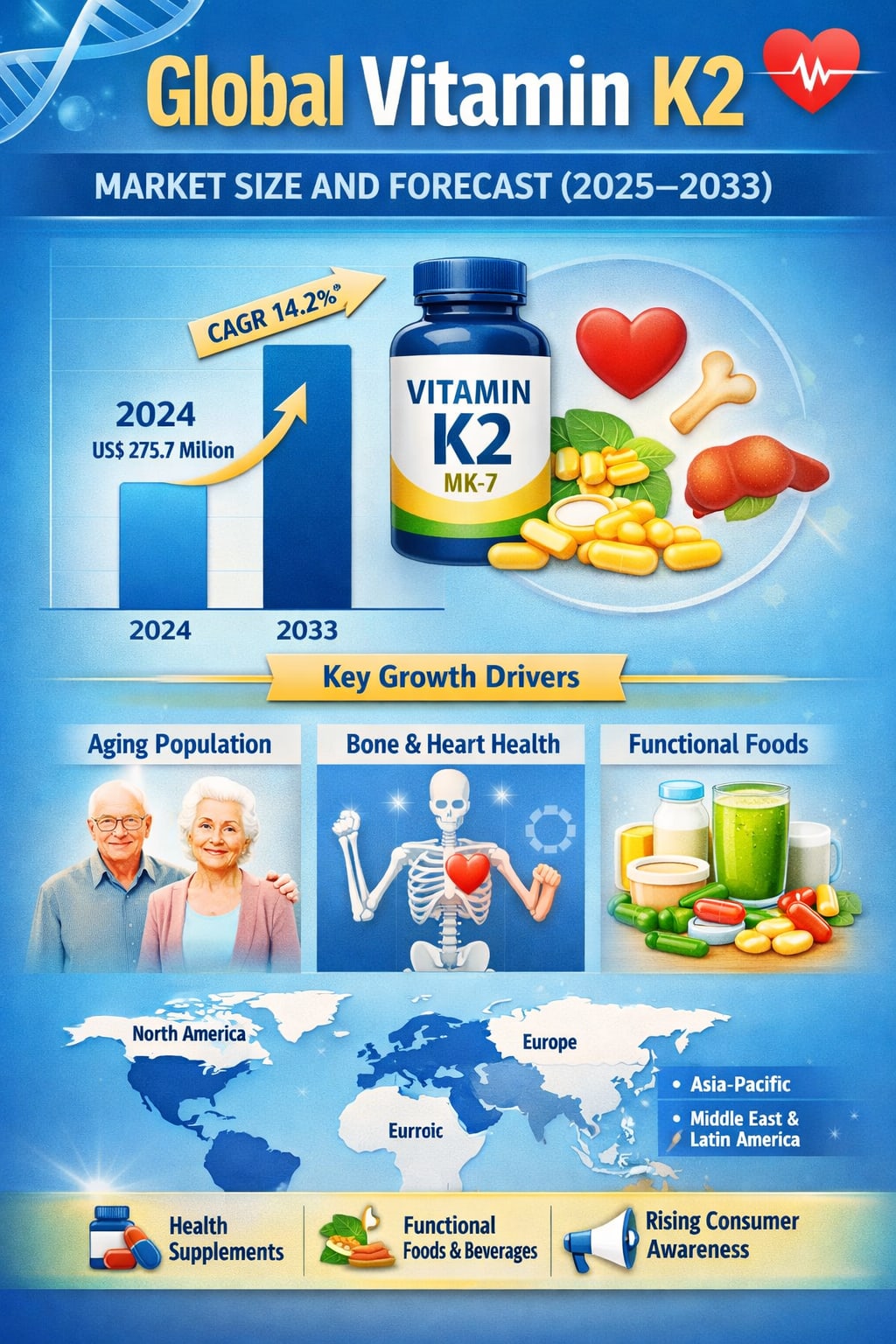
According to Renub Research data, the Global Vitamin K2 Market is expected to grow from US$ 275.2 million in 2024 to US$ 909.17 million by 2033, registering an impressive compound annual growth rate (CAGR) of 14.2% from 2025 to 2033. This rapid expansion reflects more than just a trend in dietary supplements—it signals a broader change in how consumers, healthcare professionals, and food manufacturers view the role of targeted micronutrients in long-term health management.
Vitamin K2, particularly in its MK-7 and MK-4 forms, is gaining recognition for its critical role in bone health, cardiovascular protection, and calcium metabolism. Unlike vitamin K1, which is primarily associated with blood clotting, vitamin K2 directs calcium to the bones and teeth while helping prevent it from accumulating in the arteries. This dual action has made it especially attractive in an era marked by aging populations, rising cardiovascular disease, and growing concern about osteoporosis.
Global Vitamin K2 Market at a Glance
The vitamin K2 market spans a wide range of product categories and applications, reflecting its growing acceptance across both the supplement and food industries. The market is segmented by:
Product: MK-7, MK-4
Dosage Form: Powder & Crystalline, Capsules & Tablets, Oils & Liquid
Source: Natural, Synthetic
Application: Health Supplements, Functional Foods and Beverages
Distribution Channel: Offline, Online
Geography: North America, Europe, Asia Pacific, Latin America, Middle East & Africa
From traditional capsules and tablets to fortified foods and liquid formulations, vitamin K2 is steadily moving into everyday consumption patterns. This diversification of formats is helping the market reach not only health enthusiasts, but also mainstream consumers who prefer convenient, food-based nutrition solutions.
Industry Overview: From Niche Nutrient to Mainstream Health Essential
The global vitamin K2 industry is experiencing notable momentum, driven by growing scientific evidence and increasing consumer awareness. Among the different forms, MK-7 has gained particular popularity due to its longer half-life and higher bioavailability, making it more effective at maintaining stable vitamin K2 levels in the body over time.
Health-conscious consumers are increasingly seeking supplements and functional foods that support preventive healthcare, rather than simply addressing deficiencies. Vitamin K2 fits perfectly into this narrative, as it plays a vital role in maintaining strong bones, flexible arteries, and overall metabolic health. Its application now extends across nutraceuticals, pharmaceuticals, and functional food products, making it one of the more versatile micronutrients in the modern wellness market.
The market is also benefiting from continued product innovation. In April 2023, for example, Petrovax Pharm introduced SunDevit in the Russian market, a combined vitamin D3 and K2 formulation designed to support immunity, muscles, bones, and joint health. Such combination products highlight a growing trend: pairing vitamin K2 with complementary nutrients to enhance overall efficacy and consumer appeal.
Health Trends Fueling Market Expansion
Several long-term health trends are converging to support the rapid growth of the vitamin K2 market.
1. Rising Burden of Cardiovascular Disease and Osteoporosis
Cardiovascular disorders and bone-related conditions such as osteoporosis are becoming increasingly common worldwide, particularly as populations age. Vitamin K2 plays a crucial role in directing calcium into bones while preventing arterial calcification, making it highly relevant for both conditions.
Scientific interest continues to strengthen this narrative. In February 2024, research indicated that vitamin K2 significantly reduced weight gain, liver fat, and abdominal fat in mice fed a high-fat diet, highlighting its potential preventive role against non-alcoholic fatty liver disease (NAFLD). Such findings are expanding the perceived benefits of vitamin K2 beyond just bone and heart health.
2. Preventive Healthcare Takes Center Stage
Governments and healthcare organizations are increasingly emphasizing preventive healthcare and nutrition-based interventions. This has resulted in more supportive regulatory environments that encourage innovation, quality control, and research in dietary supplements and functional foods.
In October 2023, a study published in Food & Function suggested that vitamin K2 supplementation may help reduce the incidence of type 2 diabetes mellitus (T2DM) by improving insulin resistance and fasting blood sugar levels. Discoveries like these are opening up new growth avenues for vitamin K2 in metabolic health and chronic disease prevention.
Key Factors Driving the Vitamin K2 Market
Rising Awareness of Bone and Heart Health
Public awareness around osteoporosis, heart disease, and calcium metabolism is steadily increasing. Vitamin K2’s unique ability to activate proteins that guide calcium to the bones while keeping it out of arteries has made it a focal point in discussions about long-term skeletal and cardiovascular health.
Medical professionals, supplement brands, and health media are increasingly promoting vitamin K2 as a critical yet previously overlooked nutrient. As more consumers adopt proactive health strategies, demand for vitamin K2 supplements continues to rise, especially among individuals seeking natural ways to maintain mobility, bone density, and heart function.
Aging Global Population
Demographic shifts are another powerful growth driver. As the global population ages, the prevalence of bone fractures, joint issues, and cardiovascular disease naturally increases. Vitamin K2 is now widely recognized for its supportive role in addressing these age-related concerns.
Older adults, in particular, are becoming a core consumer group for vitamin K2 products, as they seek solutions that help preserve independence, mobility, and overall quality of life. This trend is pushing manufacturers to develop targeted formulations designed specifically for senior health and healthy aging.
Increased Use in Functional Foods and Nutraceuticals
Vitamin K2 is no longer confined to traditional supplement bottles. It is increasingly being incorporated into functional foods and beverages, such as fortified dairy products, nutrition bars, and wellness drinks. This shift reflects changing consumer preferences toward convenient, everyday nutrition solutions that fit seamlessly into busy lifestyles.
The stability of MK-7, in particular, makes it well-suited for food and beverage applications. As a result, innovation in product formats is accelerating, further broadening the market’s reach and appeal.
Challenges Facing the Vitamin K2 Market
Limited Consumer Awareness
Despite growing scientific support, vitamin K2 is still far less well-known than vitamins like C or D. Many consumers also confuse vitamin K2 with vitamin K1, which mainly supports blood clotting and does not offer the same cardiovascular and bone benefits.
This lack of clear differentiation continues to limit broader adoption. Bridging this knowledge gap will require stronger education efforts, clearer labeling, and more consistent communication from both healthcare professionals and brands.
High Production Costs
Producing high-quality vitamin K2—especially MK-7—requires complex fermentation processes, strict quality control, and long production cycles. These factors significantly increase manufacturing costs, which are often passed on to consumers in the form of higher retail prices.
In price-sensitive markets, this can limit accessibility and slow adoption. While technological advancements may eventually help reduce costs, production expenses remain a notable barrier to faster market penetration, particularly in developing regions.
Regional Outlook: A Market with Global Momentum
United States
The U.S. vitamin K2 market is expanding steadily, supported by strong interest in preventive healthcare and a mature nutraceutical industry. Consumers are increasingly aware of vitamin K2’s role in bone density and vascular health, and retail availability continues to improve through both offline and online channels.
In October 2022, Kappa Bioscience introduced the first USDA organic-certified vitamin K2-MK7 under the K2Vital brand, specifically designed for oil-based supplements. This development highlights the growing demand for premium, clean-label, and organic health products in the U.S. market.
United Kingdom
In the UK, rising awareness of cardiovascular and bone health, combined with an aging population, is driving demand for vitamin K2 supplements. Consumers are also showing a growing preference for plant-based and natural nutrient sources, encouraging diversification in product offerings, including both MK-7 and MK-4 formulations.
India
India represents one of the fastest-growing markets, supported by increasing health awareness, a strong nutraceutical sector, and rising concerns about heart disease and osteoporosis. While challenges such as limited awareness and higher product costs remain, expanding retail access and greater focus on holistic health are expected to strengthen market growth in the coming years.
United Arab Emirates
In the UAE, demand for vitamin K2 is rising alongside broader interest in preventive healthcare and premium nutrition products. A growing focus on lifestyle-related diseases and bone health, combined with strong retail infrastructure and product innovation, continues to support market expansion, despite ongoing challenges related to awareness and pricing.
Recent Industry Developments
In March 2024, SunWay Biotech and Gnosis by Lesaffre launched MenaQ7 Metabolic, a combination of vitamin K2 and statin-free red yeast rice fermentate Ankascin 568-R, aimed at supporting bone and heart health. Backed by more than 130 scientific studies and granted NDI classification, this product reflects the industry’s move toward science-backed, multifunctional formulations.
Competitive Landscape
The vitamin K2 market features a mix of established supplement brands and global nutrition companies. Key players include:
NOW Foods
Life Extension
Nestlé
Bronson
NatureWise
Solaray
Natural Factors
Source Naturals
These companies compete through product innovation, quality positioning, brand trust, and expanding distribution channels, particularly in the fast-growing online retail segment.
Final Thoughts: A Market Built on Science, Prevention, and Longevity
The global vitamin K2 market is no longer a niche corner of the supplement industry—it is rapidly becoming a core pillar of preventive health and functional nutrition. With the market projected to grow from US$ 275.2 million in 2024 to US$ 909.17 million by 2033, the future looks both dynamic and promising.
Driven by aging populations, rising awareness of bone and cardiovascular health, expanding applications in functional foods, and continuous scientific validation, vitamin K2 is steadily earning its place in everyday health routines. While challenges such as limited awareness and high production costs remain, ongoing education, innovation, and regulatory support are likely to accelerate adoption worldwide.
About the Creator
Keep reading
More stories from shibansh kumar and writers in Trader and other communities.
Nucleic Acid Methylation Market Size and Forecast 2025–2033
Global Nucleic Acid Methylation Market Overview The Global Nucleic Acid Methylation Market is entering a powerful growth phase, driven by rapid advances in epigenetics, sequencing technologies, and precision medicine. According to Renub Research, the market is expected to reach US$ 9.19 billion by 2033, up from US$ 3.01 billion in 2024, expanding at a robust CAGR of 13.2% from 2025 to 2033.
By shibansh kumarabout 10 hours ago in Trader
Mexico Generative AI Market Size, Growth & Forecast 2034
Mexico Generative AI Market Overview The Mexico Generative AI Market is experiencing strong momentum as businesses increasingly integrate artificial intelligence into core operations. Generative AI technologies, including large language models, AI-powered content generation tools, and intelligent automation systems, are transforming industries such as media, finance, healthcare, retail, and manufacturing.
By Kim Soo hyuna day ago in Trader




Comments
There are no comments for this story
Be the first to respond and start the conversation.