
Graphics Processing Unit (GPU) Market Size and Forecast 2025–2033
How AI, Gaming, and Cloud Computing Are Powering a Trillion-Dollar Compute Revolution

Introduction: The Engine Behind the Digital World
From ultra-realistic video games and blockbuster visual effects to artificial intelligence, cloud computing, and scientific simulations, graphics processing units (GPUs) have become the silent workhorses of the modern digital economy. What began as a specialized chip for rendering images on screens has evolved into one of the most critical computing technologies of the 21st century.
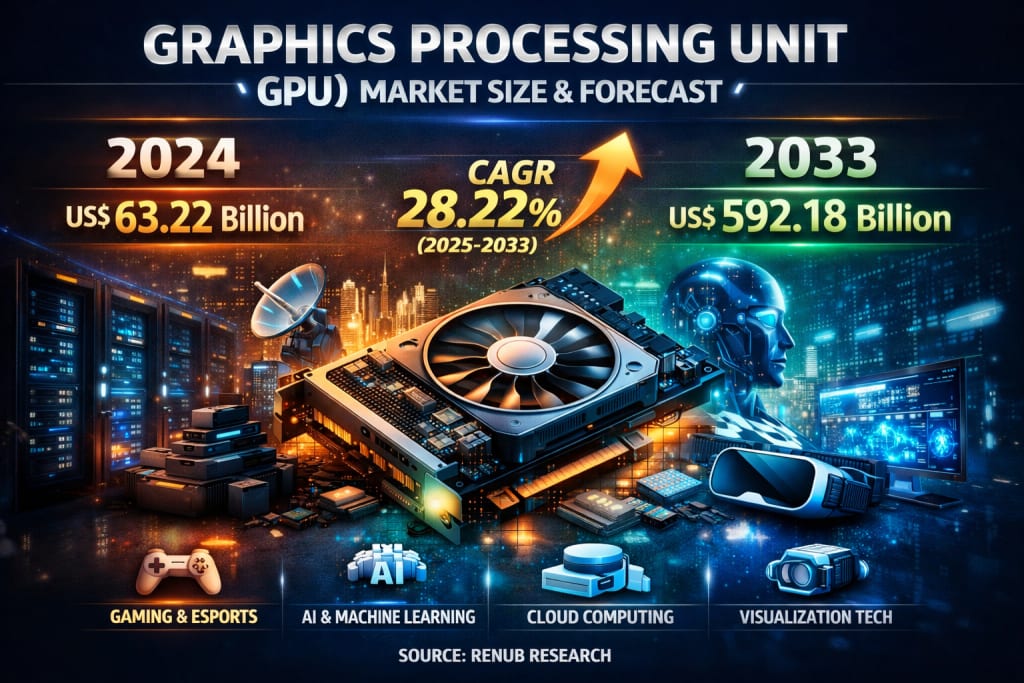
According to Renub Research’s latest industry analysis, the Global Graphics Processing Unit (GPU) Market is expected to surge from US$ 63.22 billion in 2024 to US$ 592.18 billion by 2033, growing at an impressive compound annual growth rate (CAGR) of 28.22% from 2025 to 2033. This extraordinary expansion reflects not just rising consumer demand for better graphics, but also the central role GPUs now play in artificial intelligence (AI), machine learning (ML), data centers, cloud platforms, and high-performance computing (HPC).
As industries race to adopt automation, advanced analytics, and immersive digital experiences, GPUs are no longer optional upgrades—they are becoming foundational infrastructure for the global digital economy.
Understanding the GPU: More Than Just Graphics
A Graphics Processing Unit (GPU) is a specialized electronic circuit designed to rapidly manipulate and alter memory to accelerate the creation of images and visual content. Unlike traditional central processing units (CPUs), which are optimized for sequential tasks, GPUs are built for massively parallel processing. This means they can handle thousands of operations simultaneously, making them exceptionally efficient for tasks that involve large volumes of data and repetitive calculations.
Modern GPUs consist of a computational core, memory, and input/output interfaces. The computational core executes complex mathematical operations, while the memory stores data and instructions for fast access. By breaking workloads into smaller tasks and processing them in parallel, GPUs deliver dramatic performance gains—especially in applications like 3D rendering, video editing, scientific simulations, AI training, and gaming.
Today’s market offers multiple forms of GPUs, including integrated GPUs, discrete GPUs, hybrid GPUs, and even external GPU solutions, each serving different performance and cost requirements across consumer and enterprise segments.
A Market Shaped by Semiconductors and Data Centers
The GPU industry is undergoing a structural transformation, driven by changes in the global semiconductor supply chain and massive investments in chip manufacturing capacity. Leading technology companies such as Intel and Samsung are pouring billions of dollars into expanding fabrication facilities, while strategic partnerships are forming to reduce dependence on a single manufacturing hub.
The role of data centers in this ecosystem is equally critical. As of March 2024, the United States alone hosts over 5,300 data centers, underscoring the scale of digital infrastructure now required to support cloud computing, AI workloads, and real-time data processing. GPUs sit at the heart of this infrastructure, accelerating everything from recommendation algorithms and language models to financial simulations and medical imaging.
This combination of semiconductor expansion, cloud growth, and AI adoption is redefining what GPUs mean to the global economy—and why their market is growing at such a remarkable pace.
Key Factors Driving the GPU Market Growth
1. The Explosive Growth of Gaming and Esports
The global gaming industry has transformed into a mainstream entertainment powerhouse, fueled by esports, virtual reality (VR), augmented reality (AR), and immersive 3D experiences. Today’s gamers demand ultra-high resolutions, realistic lighting, higher frame rates, and seamless performance—all of which rely heavily on powerful GPUs.
As game developers continue to push the boundaries of realism and interactivity, hardware requirements rise accordingly. Competitive gaming and live streaming have further intensified the need for low-latency, high-performance graphics processing, encouraging both casual and professional gamers to upgrade their systems more frequently. This constant cycle of innovation and upgrading continues to sustain strong demand for GPUs worldwide.
2. The Rise of Artificial Intelligence and Machine Learning
Few technologies have benefited more from GPUs than artificial intelligence and machine learning. Training modern AI models involves processing enormous datasets and performing billions of matrix and vector calculations—tasks that GPUs handle far more efficiently than traditional CPUs.
From computer vision and natural language processing to autonomous systems and medical diagnostics, GPUs have become essential tools in data centers, research institutions, and cloud platforms. As AI adoption accelerates across industries such as healthcare, finance, automotive, and manufacturing, the demand for faster, more energy-efficient GPUs continues to grow.
In many ways, GPUs are not just supporting the AI revolution—they are enabling it.
3. Expanding Use in Data Centers and Cloud Computing
Data centers and cloud service providers are increasingly relying on GPUs to handle big data analytics, scientific simulations, rendering workloads, and AI model training. The parallel processing capabilities of GPUs allow cloud platforms to deliver high-performance computing services without requiring massive increases in physical infrastructure.
Moreover, GPUs often provide better performance per watt than traditional CPUs for certain workloads, helping operators reduce energy consumption and operating costs. As cloud adoption continues to expand globally, GPUs are becoming a cornerstone of scalable, efficient, and cost-effective digital infrastructure.
Challenges Facing the GPU Market
1. Intense Market Competition
The GPU market is highly competitive, dominated by a small number of major players that invest heavily in research and development. This intense rivalry drives rapid innovation but also compresses profit margins and raises barriers for smaller companies trying to enter the market.
Frequent product launches, aggressive pricing strategies, and complex supply chains create constant pressure on manufacturers to balance cost, performance, and innovation. While consumers benefit from better products and more choices, companies must work harder than ever to maintain brand loyalty and market share.
2. Rapid Technological Change
The pace of innovation in the GPU industry is relentless. New architectures, features, and performance improvements appear in increasingly shorter cycles, which shortens product life spans and complicates inventory planning and long-term strategy.
Manufacturers must invest continuously in R&D to stay ahead of technological trends, while customers face faster obsolescence of their hardware. Despite these challenges, rapid innovation remains essential to meet the growing demands of gaming, AI, and data center workloads.
Regional Market Overview
United States: A Global Innovation Hub
The United States remains one of the most influential markets for GPUs, driven by strong demand from data centers, gaming, AI research, and cloud computing. The country hosts many of the world’s leading GPU developers and technology firms, supported by advanced infrastructure and a vibrant innovation ecosystem.
Rising investments in AI, expanding cloud platforms, and strong consumer demand for high-performance computing continue to fuel GPU adoption across both enterprise and consumer segments.
United Kingdom: Building an AI-Ready Future
The UK GPU market is gaining momentum through investments in AI infrastructure, data centers, and high-performance computing. Government initiatives to expand national AI computing capacity, including the development of new supercomputers, are increasing GPU availability for public and private sector use.
At the same time, a strong gaming culture and the presence of technology firms such as Imagination Technologies support continued growth in both consumer and enterprise GPU adoption.
India: A Fast-Emerging Growth Engine
India’s GPU market is expanding rapidly, supported by growth in data centers, AI initiatives, and gaming. The government’s IndiaAI Mission aims to provide access to tens of thousands of GPUs for researchers, startups, and academic institutions, accelerating AI innovation across the country.
Investments by global cloud providers and technology companies in Indian data center infrastructure are further strengthening demand, positioning India as a key player in the global GPU landscape.
United Arab Emirates: A Rising AI Powerhouse
The UAE is emerging as a significant GPU market through heavy investments in AI, high-performance computing, and smart infrastructure. The country’s ambition to become a global AI leader by 2031 has led to the development of large-scale AI data center clusters and increased adoption of GPU-powered computing across sectors such as healthcare, energy, education, and government services.
Recent Industry Developments
In March 2024, Amazon Web Services (AWS) and NVIDIA announced an expansion of their partnership to accelerate generative AI innovation. The collaboration includes the introduction of NVIDIA’s GB200 Grace Blackwell superchip and B100 Tensor Core GPUs, designed to deliver next-generation performance for AI workloads. This move highlights how strategic partnerships between cloud providers and GPU manufacturers are shaping the future of high-performance computing.
Market Segmentation Overview
By Component:
Hardware
Software
Services
By Type:
Integrated GPU
Discrete GPU
Hybrid GPU
By Deployment:
On-Premise
Cloud
By Application:
Consumer Electronics
IT & Telecommunication
Healthcare
Media & Entertainment
Others
By Region:
North America (United States, Canada)
Europe (France, Germany, Italy, Spain, United Kingdom, Belgium, Netherlands, Turkey)
Asia Pacific (China, Japan, India, Australia, South Korea, Thailand, Malaysia, Indonesia, New Zealand)
Latin America (Brazil, Mexico, Argentina)
Middle East & Africa (South Africa, Saudi Arabia, United Arab Emirates)
Key Companies Profiled
Intel Corporation
Advanced Micro Devices (AMD) Inc.
NVIDIA Corporation
Imagination Technologies Group
Samsung Electronics Co. Ltd
Arm Limited (SoftBank Group)
EVGA Corporation
SAPPHIRE Technology Limited
Qualcomm Technologies Inc.
Each of these players is actively investing in new architectures, energy efficiency, AI acceleration, and next-generation computing platforms to secure their position in this fast-evolving market.
Final Thoughts: The GPU as the Backbone of the Digital Age
The global GPU market is no longer just about better graphics—it is about powering the future of computing itself. With Renub Research forecasting growth from US$ 63.22 billion in 2024 to US$ 592.18 billion by 2033, the industry is clearly entering a golden era driven by AI, cloud computing, gaming, and data-intensive applications.
As digital transformation accelerates across every major industry, GPUs will remain at the center of innovation—quietly enabling smarter machines, richer digital experiences, and faster scientific breakthroughs. In many ways, the GPU is no longer just a component—it is becoming the engine of the modern digital economy.
About the Creator
Global Spices Market Size and Forecast 2025–2033
Global Spices Market Outlook The global spices market is entering a phase of sustained and dynamic growth, supported by changing food habits, rising health awareness, and the globalization of cuisine. According to Renub Research, the Global Spices Market was valued at US$ 30.52 billion in 2024 and is projected to expand at a CAGR of 6.71% during 2025–2033, reaching an estimated US$ 54.75 billion by 2033.
By Sakshi Sharmaa day ago in Trader
Latin America & Caribbean Automotive Tire Market: Growth, Trends, and Forecast 2025–2033
Introduction The Latin America & Caribbean Automotive Tire Market is steadily gaining momentum, supported by rising vehicle ownership, improving road infrastructure, and expanding mobility needs across both mainland and island economies. According to Renub Research, the market was valued at USD 4.08 billion in 2024 and is projected to reach USD 5.56 billion by 2033, growing at a CAGR of 3.51% from 2025 to 2033.
By Sakshi Sharma8 days ago in Trader




Comments
There are no comments for this story
Be the first to respond and start the conversation.