
Janitorial Service Market Size and Forecast 2025–2033
Why Cleanliness, Compliance, and Sustainability Are Turning Janitorial Services into a US$ 421 Billion Global Industry

Introduction: Cleaning as a Strategic Business Function
Once viewed as a routine operational necessity, janitorial services have evolved into a strategic pillar for businesses, institutions, and residential complexes worldwide. Clean, hygienic, and well-maintained spaces are no longer just about appearances—they are closely linked to health, safety, employee productivity, regulatory compliance, and brand reputation. In a world that has become far more conscious of sanitation and environmental responsibility, professional cleaning services have moved from the background to the spotlight.
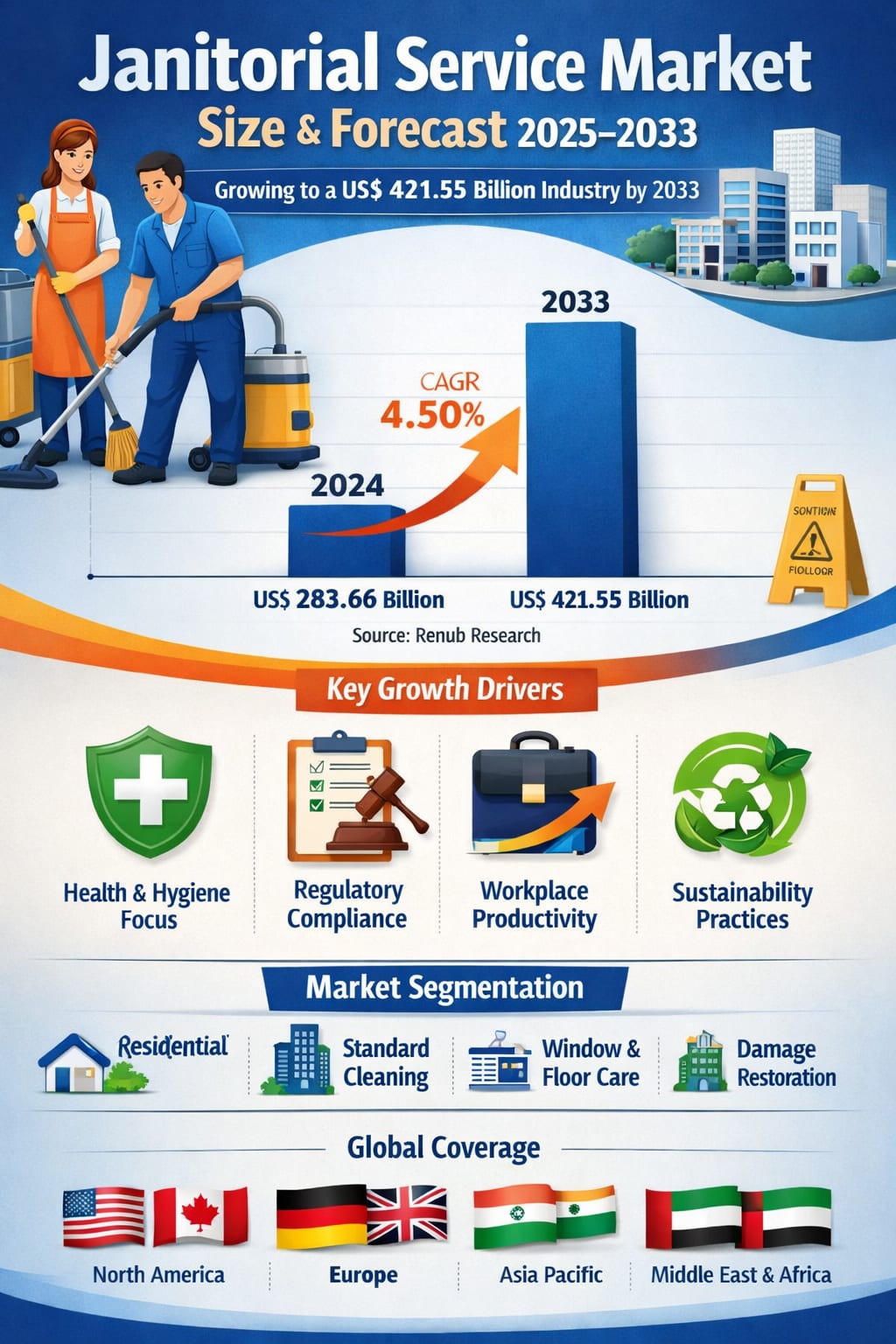
According to Renub Research, the Janitorial Service Market is expected to reach US$ 421.55 billion by 2033, up from US$ 283.66 billion in 2024, expanding at a compound annual growth rate (CAGR) of 4.50% from 2025 to 2033. This steady growth reflects not only rising demand across commercial and residential sectors, but also the increasing complexity of cleaning requirements in modern facilities.
From hospitals and airports to offices, shopping malls, schools, and smart buildings, janitorial services today cover far more than basic sweeping and mopping. They include specialized disinfection, floor care, exterior window cleaning, damage restoration, and environmentally responsible cleaning solutions. As regulations tighten and expectations rise, the industry is becoming more professionalized, technology-driven, and quality-focused than ever before.
Janitorial Service Industry Overview
A janitorial service is a professional cleaning and maintenance solution provided to residential, commercial, and industrial facilities. These services typically include waste disposal, dusting, vacuuming, sweeping, mopping, floor polishing, surface disinfection, restroom sanitation, and deep cleaning of high-traffic areas. The primary goal is to maintain hygienic, safe, and visually appealing environments for occupants, employees, customers, and visitors.
Planning and outsourcing janitorial services allow organizations to focus on their core operations while ensuring consistent cleanliness standards. In sectors such as healthcare, hospitality, food service, and corporate offices, professional cleaning is not optional—it is a regulatory and operational necessity. Clean environments reduce the spread of disease, improve indoor air quality, enhance employee morale, and create a positive impression for clients and partners.
The global market’s expansion is being driven by several structural trends: rising health awareness, stricter sanitation regulations, growth in commercial real estate, urbanization, and the increasing preference for outsourced facility management services. Together, these forces are reshaping janitorial services from a cost center into a value-adding function within modern organizations.
Key Growth Drivers of the Janitorial Service Market
1. Rising Industry Standards and Regulatory Compliance
Across the world, industries are facing stricter rules related to health, safety, and hygiene. Healthcare facilities, hotels, restaurants, schools, airports, and manufacturing plants must comply with detailed cleanliness and sanitation standards. Failure to meet these requirements can result in legal penalties, reputational damage, and even operational shutdowns.
Professional janitorial service providers help organizations navigate these regulatory demands by offering trained staff, standardized procedures, and documented cleaning protocols. Outsourcing to specialized cleaning companies ensures consistency, accountability, and compliance with evolving regulations. As governments and regulatory bodies continue to tighten hygiene standards, especially in public-facing and high-risk environments, demand for professional cleaning services is expected to remain strong.
2. Growing Focus on Cleanliness and Public Health
The global focus on hygiene and sanitation has intensified, particularly after recent worldwide health crises. Businesses, institutions, and individuals are far more aware of the role that clean environments play in preventing disease transmission and protecting public health.
This heightened awareness has translated into higher cleaning frequencies, more rigorous disinfection routines, and greater use of specialized cleaning services. Hospitals, offices, shopping centers, transportation hubs, and residential complexes are all investing more in professional cleaning to reassure occupants and visitors. As cleanliness becomes a visible marker of safety and responsibility, janitorial services are increasingly seen as essential rather than optional.
3. Employee Well-Being and Productivity
A clean and well-organized workplace directly influences employee health, morale, and productivity. Dust-free surfaces, sanitized restrooms, clean air, and clutter-free spaces contribute to fewer sick days, better concentration, and a more positive work environment. Companies are recognizing that investing in professional cleaning is not just about compliance or aesthetics—it is also about performance and retention.
By maintaining high standards of cleanliness, janitorial services help reduce distractions, improve indoor air quality, and create spaces where employees feel comfortable and valued. This link between cleanliness and workplace performance is a powerful driver of sustained demand, especially in competitive corporate environments.
Challenges Facing the Janitorial Service Industry
Cost Pressures and Thin Profit Margins
Despite strong demand, the janitorial services industry operates under intense cost pressure. Price competition is fierce, and many clients prioritize low-cost contracts, which compresses profit margins for service providers. At the same time, operating costs—including labor, cleaning supplies, equipment maintenance, insurance, and compliance—continue to rise.
These thin margins make it difficult for companies, especially smaller players, to invest in workforce training, new technologies, or service quality improvements. Managing cash flow, scaling operations, and differentiating services in a price-sensitive market remain ongoing challenges. To stay competitive, companies must find ways to improve efficiency while maintaining consistent service standards.
Regulatory and Environmental Compliance
Janitorial service providers must comply with a wide range of health, safety, and environmental regulations. These include chemical handling rules, waste disposal laws, worker safety standards, and increasingly, environmental sustainability requirements. The shift toward eco-friendly cleaning products and processes, while beneficial in the long term, can increase short-term costs and require additional training.
Keeping up with changing regulations across multiple locations can be resource-intensive, particularly for smaller firms. Non-compliance can lead to fines, legal issues, and loss of contracts, making regulatory management a critical operational priority for the industry.
Regional Market Insights
United States Janitorial Service Market
The U.S. janitorial services market is highly competitive and dynamic, driven by strong demand from commercial real estate, healthcare, education, retail, and hospitality sectors. Clients increasingly expect not only reliable cleaning but also eco-friendly practices and technology-enabled service delivery.
In March 2024, ServiceMaster Clean partnered with Aspire Software to enhance its business management systems, aiming to improve operational efficiency and support future growth. Such initiatives reflect a broader industry trend toward digitalization, automation, and data-driven service management. Major players in the U.S. market are focusing on sustainability, workforce optimization, and service quality differentiation to maintain their competitive edge.
Germany Janitorial Service Market
Germany’s janitorial services market is mature but continues to grow steadily, supported by demand from commercial, industrial, and public sectors. The market is fragmented, with many small and medium-sized companies offering services such as daily office cleaning, window cleaning, and specialized sanitation.
Urbanization, higher hygiene awareness, and sustainability concerns are shaping customer expectations. While competition is intense and labor shortages pose challenges, there are clear opportunities for providers that adopt modern cleaning technologies and environmentally friendly solutions. Sectors such as healthcare, education, and corporate facilities remain key demand drivers.
India Janitorial Service Market
India’s janitorial services market is experiencing rapid expansion due to rising urbanization, increased hygiene awareness, and the growth of commercial and institutional infrastructure. Offices, hospitals, malls, schools, and residential complexes are increasingly turning to professional cleaning services.
Government initiatives promoting cleanliness and sanitation, along with the adoption of eco-friendly products and robotic cleaning equipment, are transforming the market. As businesses and institutions move away from informal cleaning arrangements toward organized service providers, the Indian market offers significant long-term growth potential.
Saudi Arabia Janitorial Service Market
Saudi Arabia’s janitorial services market is growing quickly, fueled by large-scale infrastructure development, urbanization, and rising hygiene standards across commercial, residential, and industrial sectors. The government’s Vision 2030 program has driven major investments in real estate, tourism, healthcare, and public infrastructure, all of which require professional cleaning services.
The rise of smart cities and sustainable building practices is also creating opportunities for advanced and eco-friendly cleaning solutions. Hospitality, retail, and healthcare sectors are increasingly outsourcing cleaning operations to specialized providers, supporting strong market growth in the years ahead.
Recent Developments in the Janitorial Service Market
The industry has seen several notable developments that highlight its growing scale and professionalization:
March 2024: ABM Industries Incorporated secured a multi-year contract to provide housekeeping and event staff for the Arizona Diamondbacks and Chase Field, covering over 1.3 million square feet of spectator space.
March 2024: ServiceMaster Clean partnered with Aspire Software, a ServiceTitan subsidiary, to strengthen its business management systems and support long-term growth.
January 2024: ISS A/S announced the extension of its partnership with Nordea under a five-year contract covering full-service deliverables, including cleaning, security, catering, technical support, and facility management services.
These moves reflect the industry’s shift toward larger, longer-term contracts, integrated service offerings, and technology-enabled operations.
Market Segmentation Overview
By Application:
Residential
Commercial
By End Use:
Standard Cleaning
Damage Restoration Cleaning
Exterior Window Cleaning
Floor Care Services
Others
By Geography (25-Country Viewpoint):
North America: United States, Canada
Europe: France, Germany, Italy, Spain, United Kingdom, Belgium, Netherlands, Turkey
Asia Pacific: China, Japan, India, Australia, South Korea, Thailand, Malaysia, Indonesia, New Zealand
Latin America: Brazil, Mexico, Argentina
Middle East & Africa: South Africa, United Arab Emirates, Saudi Arabia
Competitive Landscape and Key Players
The janitorial services market features a mix of global players, regional specialists, and franchise-based operators. Companies compete on service quality, price, geographic coverage, technology adoption, and sustainability practices.
Key players analyzed include:
Coverall Health Based Cleaning System
ABM Industries Inc.
Pritchard Industries, Inc.
Aeon Delight Co., Ltd. (Aeon Co., Ltd.)
Anago Cleaning Systems
Aramark
Bonus Building Care
Mitie Group plc.
Jani-King International, Inc.
Jan-Pro Franchising, Inc.
Each company is evaluated across multiple dimensions, including company overview, key leadership, recent developments and strategies, SWOT analysis, and sales performance, providing a comprehensive view of the competitive environment.
Final Thoughts: A Market Built on Trust, Health, and Consistency
The global janitorial service market is no longer just about cleaning—it is about trust, safety, compliance, and experience. With the market projected to grow from US$ 283.66 billion in 2024 to US$ 421.55 billion by 2033, the industry is set to remain a critical part of the global service economy.
Driven by rising hygiene standards, regulatory requirements, workplace well-being priorities, and sustainability goals, janitorial services are becoming more professional, technology-driven, and strategically important. While challenges such as cost pressures and regulatory complexity persist, companies that invest in efficiency, workforce training, and innovation will be best positioned to thrive.
In a world where cleanliness is closely linked to health, productivity, and reputation, the janitorial services industry is not just cleaning spaces—it is helping shape safer, healthier, and more resilient environments for the future.
About the Creator
AI Stock Research: Tools, Strategies, and Market Insights
Introduction The rise of AI stock research is transforming how investors approach the market. Traditional stock analysis often relies on manually reviewing financial reports, tracking market trends, and interpreting news—tasks that are time-consuming and prone to human error. AI, however, can analyze massive datasets in seconds, detect patterns, and generate actionable insights, giving investors a distinct edge in today’s fast-paced markets.
By Hammad Nawaz5 days ago in Trader



Comments
There are no comments for this story
Be the first to respond and start the conversation.