
Japan Retinal Surgery Device Market Size and Forecast 2025–2033
How Aging Demographics, Diabetic Eye Disease, and Surgical Innovation Are Reshaping Japan’s Ophthalmology Landscape

Introduction
Japan stands at the crossroads of demographic change and medical innovation. With one of the world’s most rapidly aging populations and a healthcare system known for its technological sophistication, the country is witnessing a steady rise in demand for advanced ophthalmic care. Among the most critical segments benefiting from this shift is the retinal surgery device market—an industry that sits at the intersection of precision engineering, clinical expertise, and growing public health needs.
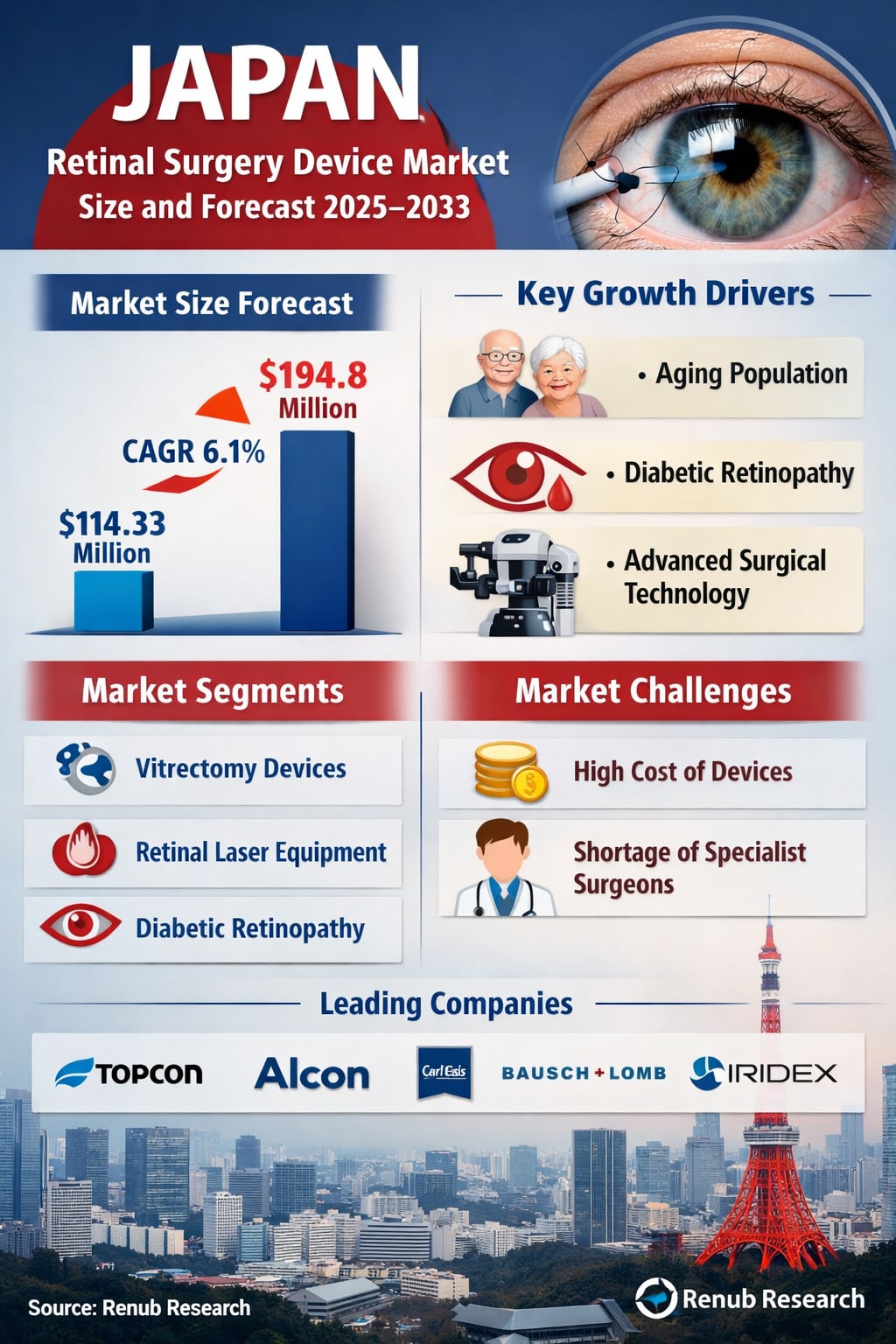
According to Renub Research, the Japan Retinal Surgery Device Market is expected to reach US$ 194.8 million by 2033, up from US$ 114.33 million in 2024, growing at a compound annual growth rate (CAGR) of 6.1% from 2025 to 2033. This growth trajectory is being shaped by a combination of factors: an aging population, a rising burden of diabetic retinopathy, continuous improvements in surgical technology, a strong healthcare infrastructure, and supportive government policies that make advanced ophthalmic treatments more accessible.
As vision-related disorders increasingly impact quality of life and productivity, retinal surgery devices are no longer niche medical tools—they are becoming essential components of modern healthcare delivery in Japan. This article explores the forces driving this market, the challenges it faces, how it is segmented, and the companies shaping its future.
Japan Retinal Surgery Device Market Overview
The Japanese retinal surgery device market is experiencing consistent expansion, driven largely by demographic and epidemiological trends. As life expectancy continues to rise, so does the prevalence of age-related eye diseases such as diabetic retinopathy, age-related macular degeneration, retinal detachment, epiretinal membrane, and macular holes. Many of these conditions, if left untreated, can lead to irreversible vision loss or blindness—making timely surgical intervention not just beneficial, but essential.
Japan’s healthcare system provides a strong foundation for this growth. With a dense network of hospitals, specialized eye clinics, and university medical centers, patients have broad access to high-quality ophthalmic care. Universal health coverage further ensures that even complex retinal procedures are financially accessible to a large segment of the population. This combination of accessibility and quality has created a favorable environment for the adoption of advanced surgical devices.
Technological progress has also played a transformative role. Innovations in microsurgical instruments, high-resolution imaging systems, vitrectomy platforms, and retinal laser equipment have significantly improved surgical precision, safety, and patient outcomes. Procedures that once required longer recovery times and carried higher risks can now be performed with greater efficiency and predictability.
Moreover, government-backed healthcare initiatives and a supportive regulatory environment encourage the adoption of new medical technologies. Increased awareness of eye health and the importance of early diagnosis has led to more routine screenings, which in turn results in higher detection rates of retinal disorders. Taken together, these factors position the Japanese retinal surgery device market for sustained, long-term growth.
Key Factors Driving the Japan Retinal Surgery Device Market Growth
1. Rising Aging Population
Japan’s demographic profile is one of the most significant drivers of the retinal surgery device market. The country has one of the highest proportions of elderly citizens globally, and this segment of the population is particularly vulnerable to retinal disorders. Conditions such as macular degeneration, diabetic retinopathy, and retinal detachment become more common with age and often require surgical intervention to preserve vision.
As older adults place a higher priority on maintaining independence and quality of life, demand for effective vision-saving procedures continues to rise. This has led hospitals and eye clinics to invest heavily in advanced retinal surgical equipment. The growing volume of procedures directly translates into increased demand for vitrectomy machines, surgical instruments, illumination systems, and laser devices, making population aging a cornerstone of market expansion.
2. Strong Healthcare Infrastructure
Japan’s well-developed and interconnected healthcare system provides fertile ground for the growth of the retinal surgery device market. The country boasts a wide network of modern hospitals, specialized ophthalmology clinics, and research-oriented medical institutions. Universal health insurance coverage ensures that a large portion of the population can access even high-cost retinal procedures.
The government’s emphasis on preventive care and early diagnosis has led to more frequent eye examinations and screenings, particularly among high-risk groups such as the elderly and individuals with diabetes. Early detection often means earlier intervention, which increases the number of surgical procedures performed annually. This steady procedural volume sustains consistent demand for retinal surgery devices and supports long-term market stability.
3. Rapid Technological Advancements
Technological innovation is perhaps the most dynamic force shaping the Japanese retinal surgery device market. The development of minimally invasive surgical tools, high-definition optical imaging systems, advanced vitrectomy platforms, and precision laser technologies has revolutionized the way retinal surgeries are performed.
Surgeons now benefit from better visualization, improved control, and enhanced accuracy, which translates into better clinical outcomes and shorter recovery times for patients. The integration of real-time imaging and, increasingly, AI-assisted diagnostics allows for more precise treatment planning, especially in complex retinal cases.
Hospitals and specialty clinics are eager adopters of these technologies, not only to improve patient outcomes but also to enhance their reputation as centers of excellence. Continuous research and development by both domestic and international manufacturers ensure a steady pipeline of innovation, reinforcing Japan’s position as a technologically advanced market for ophthalmic care.
Challenges in the Japan Retinal Surgery Device Market
1. High Cost of Advanced Surgical Devices
Despite strong demand, the high cost of cutting-edge retinal surgical equipment remains a significant barrier. Technologies such as robotic-assisted systems, high-resolution imaging platforms, and advanced laser devices require substantial capital investment. For smaller clinics and hospitals in rural or less densely populated areas, these costs can be prohibitive.
Beyond the initial purchase, ongoing expenses related to maintenance, software updates, staff training, and integration with existing hospital systems further increase the financial burden. As a result, access to the latest technologies can be uneven, with well-funded urban institutions enjoying greater advantages. This disparity can slow the overall pace of market modernization and limit the widespread adoption of next-generation devices.
2. Shortage of Specialized Ophthalmic Surgeons
Another critical challenge is the shortage of ophthalmologists trained in advanced retinal surgical techniques. These procedures demand a high level of skill, precision, and familiarity with sophisticated equipment. The long training period and the demanding nature of the specialty have contributed to a limited influx of new specialists.
This shortage is particularly pronounced outside major metropolitan areas, leading to longer waiting times for patients and, in some cases, delayed treatment. Moreover, even when advanced devices are available, their effective use depends on the presence of skilled professionals. This mismatch between technological availability and human expertise can constrain the market’s full growth potential.
Market Segmentation
By Product
The Japan retinal surgery device market is segmented into:
Vitrectomy Machines
Vitrectomy Packs
Surgical Instruments
Microscopic Illumination Equipment
Retinal Laser Equipment
Others
Among these, vitrectomy machines and surgical instruments form the backbone of most retinal procedures, while illumination systems and laser equipment play a critical supporting role in enhancing precision and safety.
By Application
Key application areas include:
Diabetic Retinopathy
Retinal Detachment
Epiretinal Membrane
Macular Hole
Others
Diabetic retinopathy represents a particularly important segment, reflecting the rising prevalence of diabetes and its ocular complications in Japan’s aging society.
By End User
The market is further segmented by end users into:
Hospitals
Eye Clinics
Others
Hospitals account for a significant share due to their capacity to handle complex cases and invest in high-end equipment, while specialized eye clinics continue to grow in importance as centers for focused ophthalmic care.
Competitive Landscape and Company Analysis
The Japanese retinal surgery device market is characterized by the presence of several prominent global and regional players. These companies compete on the basis of technological innovation, product reliability, clinical performance, and service support. Key players covered in the market include:
Topcon Corporation
Alcon AG
Carl Zeiss
Bausch Health Companies Inc.
Iridex Corporation
Escalon Medicals
Quantel Medical
Rhein Medical, Inc.
These companies focus heavily on research and development, strategic partnerships, and product portfolio expansion. Recent developments across the industry highlight a strong emphasis on improving surgical efficiency, enhancing imaging quality, and developing more user-friendly systems. Revenue analysis and company strategies indicate a competitive but innovation-driven market environment, where technological leadership often translates into stronger market positioning.
Future Outlook: 2025–2033
Looking ahead, the outlook for the Japan retinal surgery device market remains highly positive. With Renub Research projecting the market to grow from US$ 114.33 million in 2024 to US$ 194.8 million by 2033, the sector is set for robust and sustained expansion. The expected 6.1% CAGR reflects not only rising demand but also the continued evolution of surgical technologies and healthcare delivery models.
Future growth will likely be driven by further integration of digital technologies, improved imaging and visualization tools, and the gradual adoption of more automated and AI-assisted surgical systems. At the same time, efforts to train more specialized ophthalmic surgeons and to make advanced technologies more affordable will play a crucial role in shaping the market’s long-term trajectory.
Final Thoughts
The Japan retinal surgery device market stands as a compelling example of how demographic trends, technological innovation, and healthcare policy can converge to create meaningful growth opportunities. An aging population and a rising burden of retinal diseases are increasing the need for effective surgical interventions, while Japan’s strong healthcare infrastructure and commitment to innovation provide the tools to meet this demand.
Although challenges such as high equipment costs and a shortage of specialized surgeons remain, the overall direction of the market is clearly upward. With continued investment in technology, training, and accessibility, retinal surgery devices will play an increasingly vital role in preserving vision and improving quality of life for millions of people in Japan.
As the market moves toward 2033, one thing is certain: retinal surgery in Japan is not just advancing—it is transforming, guided by precision, innovation, and an unwavering focus on patient outcomes.
About the Creator
Keep reading
More stories from shibansh kumar and writers in Trader and other communities.
Australia Tomato Seeds Market Size and Forecast 2025–2033 | Renub Research
Australia Tomato Seeds Market Overview Australia Tomato Seeds Market is expected to reach US$ 42.18 million by 2033 from US$ 23.69 million in 2024, growing at a CAGR of 6.62% from 2025 to 2033. This steady growth highlights the increasing importance of high-quality seeds in supporting Australia’s evolving horticulture sector. The expansion of greenhouse farming, rising consumer preference for fresh and locally grown produce, and continuous improvements in seed breeding technology are collectively reshaping the country’s tomato production landscape.
By shibansh kumar2 days ago in Trader
Near Protocol (NEAR) Blockchain, Market Trends, and Investment Insights
Introduction Near Protocol has gained prominence as a highly scalable, developer-friendly blockchain platform. Designed to support decentralized applications, DeFi, and NFTs, NEAR focuses on usability, low transaction costs, and high throughput. Unlike traditional blockchains that often struggle with congestion, Near Protocol utilizes innovative sharding and consensus mechanisms to provide fast, efficient, and secure transactions. From an investment perspective, NEAR provides exposure to a Layer-1 blockchain with a growing ecosystem and strong long-term potential. Understanding its price trends, adoption, and risk factors is crucial for making informed investment decisions.
By Hammad Nawazabout 18 hours ago in Trader
Philippines Dairy Market 2026: Rising on Nutrition Awareness, Urban Lifestyles & Supply Expansion
Philippines Dairy Market Overview The Philippines dairy market size is on a strong growth trajectory, supported by rising nutritional consciousness, shifting lifestyle preferences, and strategic efforts to strengthen domestic production and distribution. According to the latest analysis from IMARC Group, the market reached USD 20,980.1 million in 2025 and is expected to grow to USD 33,997.8 million by 2034, exhibiting a compound annual growth rate (CAGR) of 5.51% from 2026 to 2034.
By Manisha Dixit4 days ago in Trader



Comments
There are no comments for this story
Be the first to respond and start the conversation.