
Junk Silver in 2026: Is It Still a Smart Investment?
Discover what junk silver is, how it’s valued, and why 90% silver coins minted before 1965 may still be a powerful hedge in 2026 and beyond.

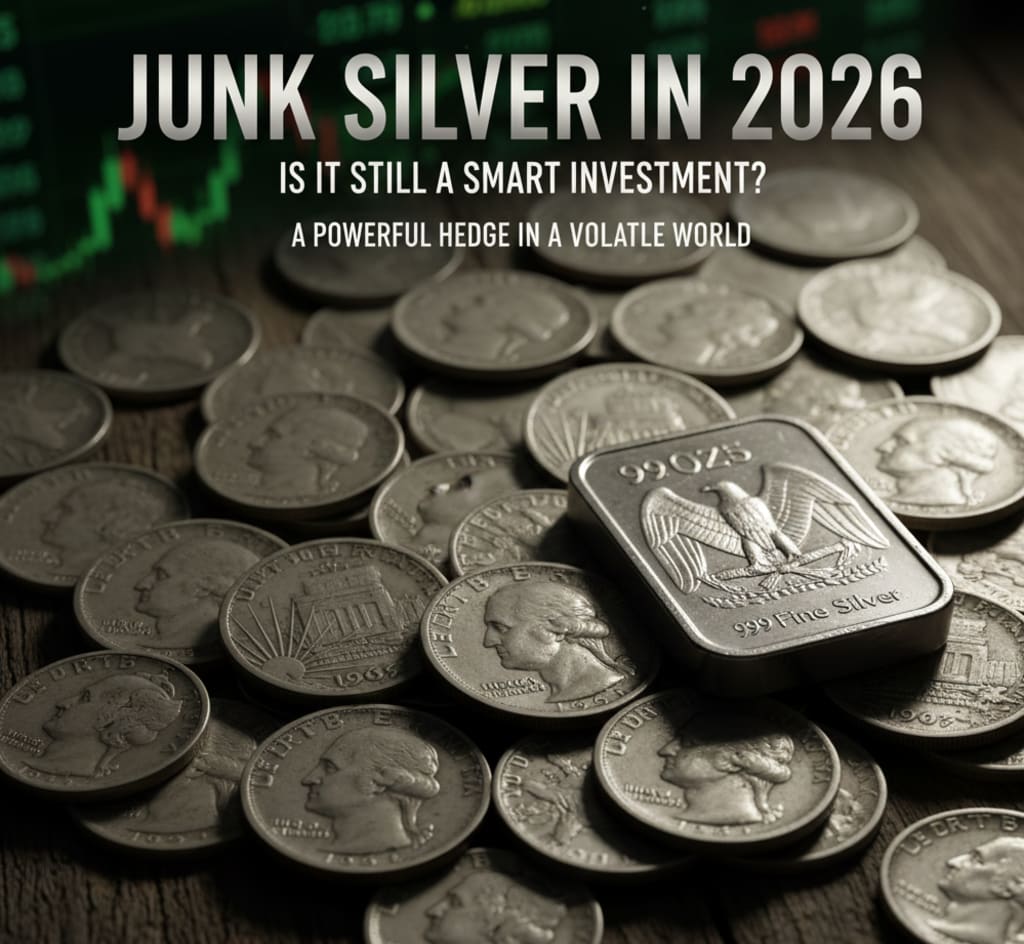
In a world of digital currencies, volatile stock markets, and persistent inflation concerns, many investors are turning back to tangible assets. Gold often dominates the conversation — but silver, especially junk silver, is quietly regaining attention in 2026.
But is junk silver still a good investment today?
Let’s break down what junk silver is, how it works, and whether it deserves a place in your portfolio this year.
________________________________________
What Is Junk Silver?
Despite its name, junk silver is anything but junk.
The term refers to U.S. dimes, quarters, and half dollars minted before 1965 that contain 90% silver and 10% copper. These coins were once everyday currency, used for buying groceries, gas, and coffee — long before rising silver prices forced the U.S. government to remove precious metal from circulating coins.
Many investors prefer calling it “Constitutional silver”, because its composition traces back to the Coinage Act of 1792, which required U.S. silver coins to contain 90% silver.
That standard remained in place until 1965, when silver prices climbed higher than the face value of the coins themselves. People began hoarding them. To stop the silver drain, Congress passed the Coinage Act of 1965, replacing silver coins with copper-nickel versions (except for half dollars, which briefly contained 40% silver until 1970).
Today, these older coins survive mostly in private collections and precious metals markets — and they continue to track the price of silver.
________________________________________
Why Is Junk Silver Valuable?
Unlike collectible coins that derive value from rarity or condition, junk silver is valued primarily for its melt value — the amount of silver it contains.
Here’s the key formula investors use:
$1 face value of 90% junk silver = 0.715 troy ounces of pure silver (on average, circulated condition).
So if silver is trading at $30 per ounce in 2026:
0.715 × $30 = $21.45 per $1 face value
Its value moves with the silver spot price, making it a direct play on the silver market.
However, buyers usually pay a small premium above melt value, and sellers may receive slightly below melt value — that’s how dealers make their margin.
________________________________________
What Coins Count as Junk Silver?
Most commonly, junk silver includes:
Dimes (90% silver)
• Barber Dimes (1892–1916)
• Mercury Dimes (1916–1945)
• Roosevelt Dimes (1946–1964)
Quarters (90% silver)
• Barber Quarters (1892–1916)
• Standing Liberty Quarters (1916–1930)
• Washington Quarters (1932–1964)
Half Dollars
• Barber Half Dollars (1892–1915)
• Walking Liberty Half Dollars (1916–1947)
• Franklin Half Dollars (1948–1963)
• Kennedy Half Dollars (1964 – 90% silver)
• Kennedy Half Dollars (1965–1970 – 40% silver)
Silver Dollars
• Morgan Dollars
• Peace Dollars
While silver dollars are sometimes included, the term “junk silver” typically refers to pre-1965 dimes, quarters, and half dollars.
________________________________________
Junk Silver vs. Silver Bullion: What’s the Difference?
If you’re comparing junk silver to silver bars or modern bullion coins like American Silver Eagles, here’s how they differ:
Junk Silver Silver Bullion
90% silver purity Usually 99.9%+ purity
Lower premiums Higher premiums
Legal tender Investment product
Highly divisible Larger unit sizes
Often circulated Usually pristine
Junk silver may not look shiny and perfect — but that worn appearance is part of its charm and history.
________________________________________
Why Investors Still Like Junk Silver in 2026
With inflation cycles, economic uncertainty, and global currency fluctuations still shaping financial markets, junk silver continues to offer unique advantages.
1. Lower Premiums
Compared to modern bullion, junk silver often carries lower premiums over spot price, making it attractive for cost-conscious investors.
2. High Liquidity & Recognizability
These coins were once everyday money. That means they’re instantly recognizable and trusted. In uncertain times, recognizability matters.
There’s also a lower risk of counterfeiting compared to large bullion bars.
3. Affordable Entry Point
You don’t need thousands of dollars to start.
Buying small denominations like dimes or quarters allows new investors to build silver exposure gradually. It’s one of the most beginner-friendly ways to enter the precious metals market.
4. Divisibility for Barter
In economic instability scenarios, junk silver’s small denominations make it more practical for barter than large bars.
A 100-ounce silver bar isn’t ideal if you only need a small transaction. A few silver dimes? Much more flexible.
5. Finite and Decreasing Supply
No more 90% silver coins are being minted.
As more are melted down or locked away in private holdings, supply continues to shrink. Basic economics suggests that decreasing supply combined with sustained demand supports long-term value.
________________________________________
Is Junk Silver a Good Investment in 2026?
The answer depends on your goals.
If you’re looking for:
• A hedge against inflation
• A tangible asset outside the banking system
• A historically trusted store of value
• A way to diversify your portfolio
Then junk silver can absolutely make sense.
However, it’s not a “get rich quick” asset. Silver prices can fluctuate, and premiums vary depending on market demand.
Junk silver works best as:
• A long-term wealth preservation tool
• A diversification asset
• A defensive position in uncertain markets
________________________________________
Frequently Asked Questions
Is junk silver better than bullion?
Not necessarily better — just different. Junk silver offers lower premiums and divisibility, while bullion offers higher purity and easier storage efficiency.
How much is $1 face value worth in 2026?
It depends on the silver spot price. Multiply 0.715 × current silver price to estimate melt value.
Can junk silver be used during a currency crisis?
Many investors believe so. Its small denominations and legal tender history make it widely accepted in barter communities.
________________________________________
Final Thoughts: Should You Buy Junk Silver?
Junk silver isn’t flashy.
It’s worn. It’s historic. It’s practical.
And in 2026, practicality is powerful.
While stocks rise and fall, digital assets swing wildly, and economic headlines shift daily, junk silver remains something tangible you can hold in your hand.
School textbooks teach economic theory.
Markets teach volatility.
Time teaches the value of real assets.
Whether you’re a beginner building your first precious metals stack or an experienced investor diversifying your holdings, junk silver deserves consideration.
As always, consult with a financial advisor before making major investment decisions. But if you’re looking for a historically trusted, inflation-resistant, and accessible entry into silver investing — junk silver may still shine in 2026 and beyond.
About the Creator
Adil Ali Khan
I’m a passionate writer who loves exploring trending news topics, sharing insights, and keeping readers updated on what’s happening around the world.
Keep reading
More stories from Adil Ali Khan and writers in Trader and other communities.
Global Ready-to-Drink Tea and Coffee Market Forecast 2025–2033
The global beverage industry is undergoing a powerful transformation. Consumers no longer have the time—or patience—to brew tea at home or wait in long café lines for their daily caffeine fix. Instead, they are reaching for chilled bottles, sleek cans, and portable cartons that deliver premium taste instantly.
By Adil Ali Khan2 days ago in Trader
Global Smart Speaker Market Size and Forecast 2025–2033
Introduction: The Rise of Voice-First Technology The way people interact with technology has undergone a dramatic transformation over the past decade. From typing commands and tapping screens, users are increasingly shifting toward voice-driven interfaces that feel more natural, faster, and more intuitive. At the heart of this change lies the global smart speaker market, a sector that has quickly evolved from a novelty category into a central pillar of the smart home and digital lifestyle ecosystem.
By shibansh kumar2 days ago in Trader
Australia Advertising Market — Growth, Forecast & Strategic Insights
The Australia advertising market continues to adapt to rapidly evolving media landscapes and consumer behaviours. According to IMARC Group, the market reached USD 21.7 billion in 2025 and is projected to grow to USD 27.8 billion by 2034, exhibiting a compound annual growth rate (CAGR) of 2.83% during 2026–2034.
By Amélie Belle2 days ago in Trader


Comments
There are no comments for this story
Be the first to respond and start the conversation.