
Knee Replacement Market Size & Forecast 2026–2034
Rising Demand for Mobility, Innovation in Implants, and the Future of Orthopedic Care

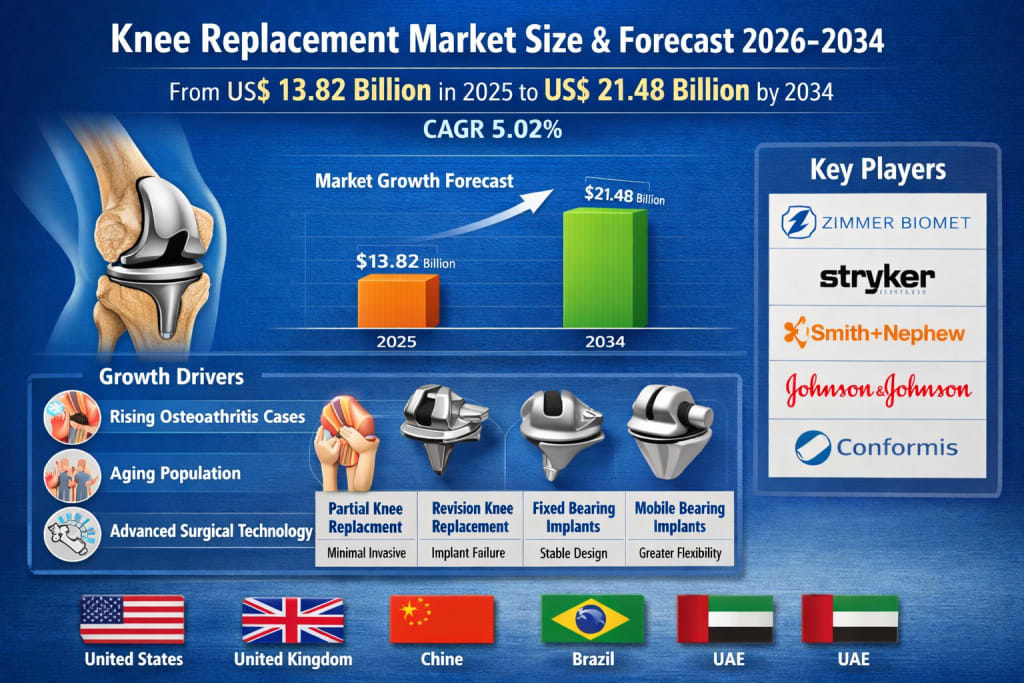
Global Knee Replacement Market: An Industry on the Move
The global knee replacement market is entering a phase of steady and sustainable expansion, reflecting the growing medical and social importance of mobility, independence, and quality of life. The market is projected to grow from US$ 13.82 billion in 2025 to US$ 21.48 billion by 2034, registering a Compound Annual Growth Rate (CAGR) of 5.02% during the forecast period from 2026 to 2034.
This growth is being driven by a powerful combination of demographic shifts, lifestyle changes, and technological advancements. Rising cases of osteoarthritis, an aging global population, increasing sports-related injuries, and continuous improvements in implant materials and surgical techniques are collectively reshaping the future of orthopedic care. Knee replacement surgery, once considered a last resort, is now widely accepted as a reliable and life-enhancing solution for millions of patients worldwide.
As healthcare systems place greater emphasis on long-term outcomes, faster recovery, and improved patient satisfaction, knee replacement has become one of the most commonly performed and clinically successful orthopedic procedures globally.
Knee Replacement Market Outlook
Knee replacement, also known as knee arthroplasty, is a surgical procedure in which damaged or worn-out surfaces of the knee joint are replaced with artificial implants made of metal, ceramic, or medical-grade plastic. The primary objective of this procedure is to relieve chronic pain, restore joint function, and improve mobility in patients suffering from conditions such as osteoarthritis, rheumatoid arthritis, post-traumatic arthritis, or severe knee injuries.
Depending on the extent of joint damage, knee replacement can be performed as a partial procedure, where only the affected compartment of the knee is replaced, or as a total knee replacement, where the entire joint surface is resurfaced. Over the past two decades, advances in surgical techniques, implant design, and minimally invasive approaches have significantly improved patient outcomes, reduced hospital stays, and shortened recovery times.
Globally, the popularity of knee replacement surgery has increased steadily. Longer life expectancy, rising obesity rates, and higher participation in sports and physical activities have contributed to a greater incidence of knee degeneration and injuries. In developed regions such as North America and Europe, knee replacement is widely adopted due to advanced healthcare infrastructure and high patient awareness. Meanwhile, emerging economies in Asia-Pacific and Latin America are witnessing rapid growth driven by improving healthcare access, expanding insurance coverage, and rising acceptance of surgical treatment for chronic joint pain.
Overall, knee replacement has become a globally recognized and effective solution for enhancing mobility, independence, and quality of life.
Key Growth Drivers in the Knee Replacement Market
Rising Prevalence of Osteoarthritis and Joint Disorders
The increasing incidence of osteoarthritis (OA) and other degenerative joint disorders is one of the strongest drivers of the global knee replacement market. In 2019, approximately 528 million people worldwide were living with osteoarthritis, representing an increase of 113% since 1990. Among all musculoskeletal disorders, osteoarthritis accounts for nearly 50% of cases, with knee OA being the leading cause worldwide.
Aging populations across both developed and developing countries are more susceptible to cartilage degeneration, chronic knee pain, and reduced mobility. In addition to age-related factors, rising obesity rates place greater stress on knee joints, accelerating wear and tear. Sports injuries and post-traumatic arthritis among younger populations further contribute to the growing patient pool.
When conservative treatments such as medication, injections, and physical therapy become less effective in advanced stages, patients increasingly turn to surgical intervention. The high burden of disability associated with hip and knee osteoarthritis, ranked among the top causes of years lived with disability (YLDs) globally, further reinforces the long-term demand for knee replacement procedures.
Advancements in Implant Design and Surgical Technology
Technological progress is playing a transformative role in accelerating growth in the knee replacement market. Modern implants are designed with improved biocompatibility, enhanced durability, and better anatomical fit, resulting in longer implant lifespan and superior functional outcomes.
Innovations such as robotic-assisted surgery, computer-guided navigation, and patient-specific instrumentation have significantly improved surgical precision while reducing complication rates. Minimally invasive techniques allow for smaller incisions, reduced blood loss, and faster recovery, making the procedure more appealing to both patients and surgeons.
A notable example of this trend is the successful completion of a robotic knee replacement surgery by Even Healthcare in Bengaluru in December 2025, just six months after the launch of its hospital. This milestone reflects the growing emphasis on technology-enabled, outcomes-focused orthopedic care models across emerging and developed markets alike.
Increasing Demand for Better Quality of Life and Mobility
Modern patients are no longer satisfied with merely managing pain—they seek long-term mobility, independence, and an active lifestyle well into older age. Improved post-operative outcomes, faster rehabilitation protocols, and high success rates have significantly strengthened patient confidence in knee replacement procedures.
Growing awareness through healthcare providers, digital platforms, and patient education initiatives has further increased acceptance. In emerging economies, expanding access to orthopedic care and the rise of medical tourism are also supporting market growth. As societies place greater value on healthy aging and functional independence, knee replacement surgery is increasingly viewed not just as a medical necessity, but as a life-enhancing intervention.
Challenges in the Knee Replacement Market
High Cost of Surgery and Limited Accessibility
Despite its clinical benefits, the high cost of knee replacement surgery remains a major barrier, particularly in low- and middle-income countries. Expenses related to implants, hospital stays, surgical expertise, and post-operative rehabilitation can significantly limit patient access.
Even in developed regions, insurance coverage limitations, reimbursement policies, and long waiting lists in public healthcare systems can delay treatment. These financial and structural barriers continue to restrict broader market penetration and highlight the need for more cost-effective solutions and healthcare reforms.
Surgical Risks and Post-Operative Complications
Although outcomes have improved significantly, knee replacement surgery still carries risks such as infection, implant loosening, blood clots, and limited range of motion. Concerns about recovery time, rehabilitation requirements, and the possibility of revision surgery can discourage some patients from undergoing the procedure.
Additionally, clinical outcomes may vary depending on patient health, surgeon experience, and implant quality. Ensuring consistent results and minimizing complications remain ongoing challenges for both healthcare providers and medical device manufacturers.
Market Segmentation Insights
Partial Knee Replacement Market
Partial knee replacement involves replacing only the damaged compartment of the knee rather than the entire joint. This approach is suitable for patients with localized osteoarthritis and relatively healthy surrounding structures. The segment is growing due to its minimally invasive nature, shorter hospital stays, faster recovery, and preservation of more natural knee movement.
Patients often experience less post-operative pain and a quicker return to daily activities compared to total knee replacement. Advances in imaging, robotics, and implant design have further improved surgical precision, boosting surgeon confidence and patient outcomes. Rising preference for less invasive procedures, particularly among younger and active patients, continues to support growth in this segment.
Revision Knee Replacement Market
Revision knee replacement refers to secondary surgeries performed to replace or repair failed implants. As the number of primary knee replacement procedures increases worldwide, the demand for revision surgeries is also rising. Implant wear, loosening, infection, and mechanical failure are key factors driving this segment.
Revision procedures are more complex and require specialized implants and surgical expertise. However, advances in implant materials, modular components, and fixation techniques have improved outcomes, supporting steady growth in this specialized market.
Fixed Bearing Knee Replacement Market
Fixed bearing implants, where the polyethylene insert is firmly attached to the tibial component, continue to dominate the market. Their long clinical history, cost-effectiveness, and reliability make them suitable for a wide range of patients, particularly older or less active individuals.
Continuous improvements in polyethylene materials and implant geometry have reduced wear rates and improved performance, ensuring sustained demand for fixed bearing systems globally.
Mobile Bearing Knee Replacement Market
Mobile bearing implants allow slight rotation of the polyethylene insert, better mimicking natural knee movement and reducing wear. These systems are especially attractive for younger, more active patients who require greater flexibility and long-term durability.
Although they require higher surgical precision and are more expensive, improved outcomes and growing demand for personalized orthopedic solutions are driving adoption in this segment.
End-User Landscape
Hospitals
Hospitals remain the largest end-user segment due to their advanced infrastructure, skilled surgical teams, and ability to manage complex and high-risk cases. The availability of advanced imaging, robotic-assisted surgery, and comprehensive post-operative care further strengthens hospital dominance.
Orthopedic Clinics
Orthopedic clinics are emerging as important centers for elective and minimally invasive knee replacement procedures. They offer specialized care, shorter waiting times, and cost-efficient treatment options, supporting steady growth in this segment.
Regional Market Highlights
United States
The United States represents the largest and most advanced knee replacement market globally. High osteoarthritis prevalence, an aging population, rising obesity rates, and strong healthcare infrastructure drive procedure volumes. The market is also characterized by rapid adoption of robotic-assisted surgery and patient-specific implants. In April 2025, THINK Surgical announced the first use of Maxx Orthopedics’ Freedom Total Knee implant with the TMINI® Miniature Robotic System in Florida, highlighting continued innovation in the sector.
United Kingdom
The UK market is supported by the National Health Service (NHS) and a growing elderly population. While public sector waiting lists remain a challenge, advancements in implant technology and enhanced recovery programs are improving outcomes. In June 2025, Johnson & Johnson MedTech reported the first European cases using the VELYS Robotic-Assisted Solution for unicompartmental knee arthroplasty.
China
China is one of the fastest-growing markets due to its large aging population, healthcare reforms, and expanding insurance coverage. In July 2023, Beijing Tinavi Medical Technologies received approval for its Tirobot Recon system for total knee replacement, reflecting strong momentum in surgical robotics adoption.
Brazil and UAE
Brazil’s market is supported by gradual healthcare improvements and growing private sector investment, while the UAE benefits from advanced infrastructure, medical tourism, and strong government support for specialized care.
Competitive Landscape
Key players operating in the global knee replacement market include:
Zimmer Biomet Holdings, Inc.
Stryker Corporation
Smith & Nephew PLC
Johnson & Johnson
Conformis Inc.
Integra LifeSciences Corporation
MicroPort Scientific Corporation
B. Braun Melsungen AG
All major companies are analyzed across five viewpoints: Overview, Key Person, Recent Developments, SWOT Analysis, and Revenue Analysis, providing a comprehensive understanding of competitive positioning and strategic direction.
Final Thoughts
The global knee replacement market is on a clear upward trajectory, supported by strong demographic trends, rising patient expectations, and continuous technological innovation. With the market expected to grow from US$ 13.82 billion in 2025 to US$ 21.48 billion by 2034 at a CAGR of 5.02%, knee replacement is set to remain one of the most important and impactful segments of the orthopedic industry.
As healthcare systems evolve and technology continues to improve surgical precision, recovery times, and long-term outcomes, knee replacement will increasingly be seen not just as a treatment for pain—but as a gateway to longer, healthier, and more active lives.
About the Creator
AI Stock Research: Tools, Strategies, and Market Insights
Introduction The rise of AI stock research is transforming how investors approach the market. Traditional stock analysis often relies on manually reviewing financial reports, tracking market trends, and interpreting news—tasks that are time-consuming and prone to human error. AI, however, can analyze massive datasets in seconds, detect patterns, and generate actionable insights, giving investors a distinct edge in today’s fast-paced markets.
By Hammad Nawaz5 days ago in Trader




Comments
There are no comments for this story
Be the first to respond and start the conversation.