
Latin America Non-Lethal Weapons Market Trends & Summary
Growing Civil Unrest, Urbanization, and Law Enforcement Modernization Drive Demand for Safer Security Solutions Across the Region

Introduction
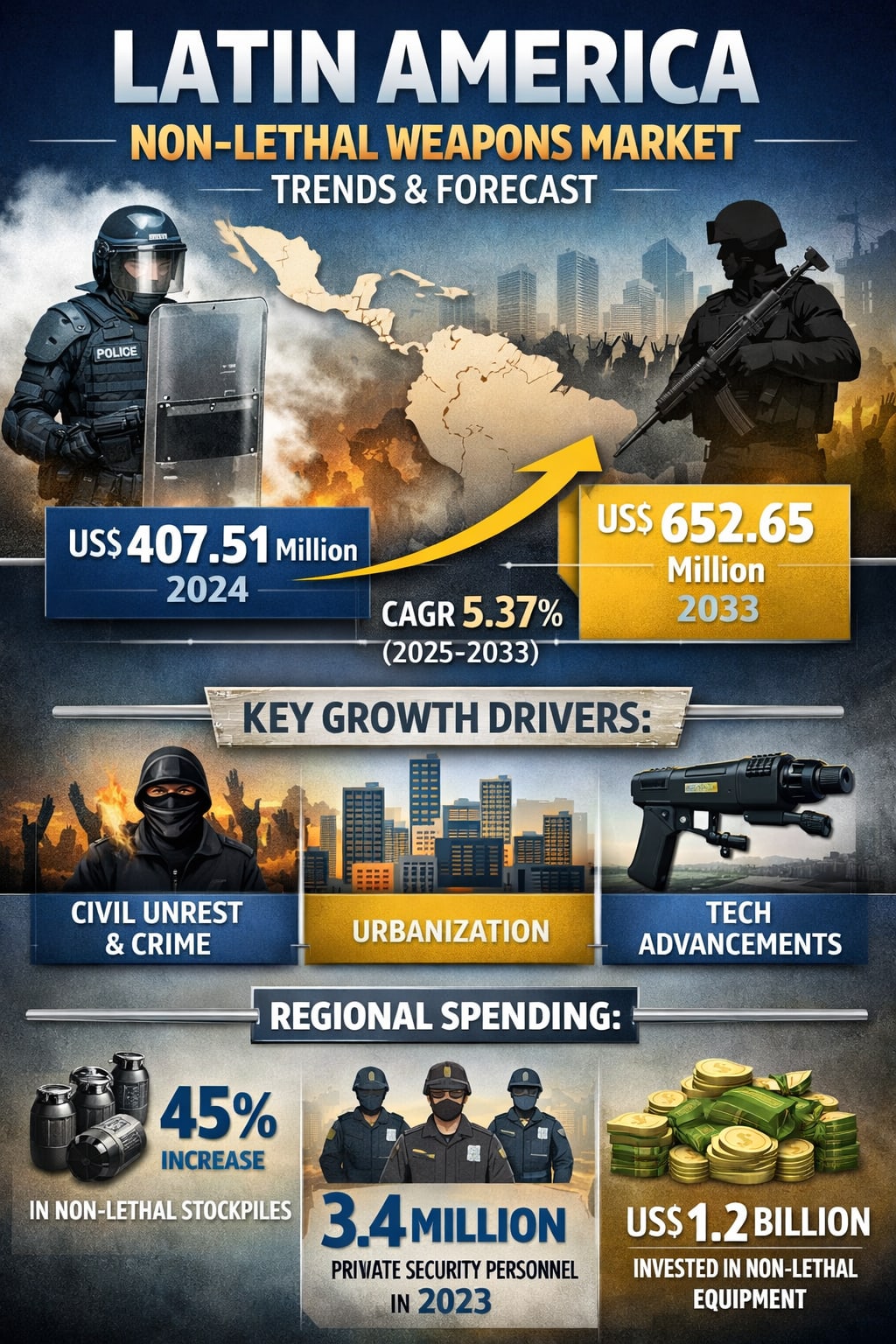
The Latin America Non-Lethal Weapons Market is entering a phase of steady and strategic expansion, reflecting the region’s evolving approach to public safety, law enforcement, and crowd management. According to Renub Research, the market is expected to grow from US$ 407.51 million in 2024 to US$ 652.65 million by 2033, registering a CAGR of 5.37% from 2025 to 2033. This growth trajectory highlights how governments and security agencies across Latin America are increasingly prioritizing tools that allow them to manage unrest, crime, and security threats without resorting to lethal force.
Rising political demonstrations, social movements, and concerns over organized crime have placed enormous pressure on law enforcement agencies, particularly in countries such as Brazil, Mexico, Argentina, and Venezuela. In this environment, non-lethal weapons—ranging from tear gas and rubber bullets to taser guns, stun grenades, and acoustic devices—have become essential instruments for maintaining order while minimizing fatalities and long-term injuries. The region’s focus is gradually shifting toward a more balanced and accountable model of security, one that aligns operational effectiveness with human rights considerations.
Understanding Non-Lethal Weapons in the Latin American Context
Non-lethal weapons, sometimes referred to as less-lethal weapons, are designed to incapacitate or deter individuals without causing permanent harm or death. In Latin America, these systems play a critical role in managing large crowds, controlling riots, securing borders, and handling high-risk arrests. Commonly used products include gases and sprays, grenades, rubber bullets, taser guns, and other kinetic or electroshock devices.
The growing adoption of these tools reflects a broader transformation in regional security strategies. Governments are under increasing scrutiny from civil society groups, international organizations, and the public to reduce instances of excessive force. As a result, non-lethal weapons are no longer viewed as optional accessories but as core components of modern policing and military operations, particularly in urban environments where the risk of collateral damage is high.
Market Growth Outlook: Renub Research Perspective
Renub Research projects a robust expansion of the Latin America Non-Lethal Weapons Market over the coming decade. With the market expected to reach US$ 652.65 million by 2033 from US$ 407.51 million in 2024, the steady 5.37% CAGR underscores sustained demand from both public and private security sectors.
This growth is being fueled by a combination of structural and situational factors. On the structural side, urbanization, population growth, and the modernization of law enforcement agencies are creating long-term demand for advanced crowd-control and threat-management tools. On the situational side, recurring episodes of political unrest, social protests, and rising crime rates are pushing governments to invest more aggressively in non-lethal alternatives.
Industry Overview: A Shift Toward Responsible Policing
The Latin America non-lethal weapons industry is expanding as governments search for more humane and effective ways to maintain public order. Historically, many countries in the region have struggled with allegations of excessive force and human rights violations. This has created strong political and social pressure to adopt tools that enable proportionate responses to threats.
Non-lethal weapons such as tear gas, rubber bullets, electroshock devices, and stun grenades are now widely used in protests, prisons, patrol operations, and urban security missions. Their primary appeal lies in their ability to de-escalate volatile situations while reducing the likelihood of fatalities or irreversible injuries. This aligns closely with global standards on the use of force and helps improve public trust in security institutions—at least in principle.
At the same time, the market is supported by a mix of international and regional manufacturers, offering products tailored to local operational needs. From chemical deterrents and acoustic devices to more advanced targeting and control systems, the range of available technologies is expanding. Despite challenges such as budget constraints, regulatory hurdles, and uneven training standards, the overall outlook remains positive as non-lethal solutions become embedded in long-term security planning across the region.
The Role of Crime, Unrest, and Security Spending
Recent data highlights why demand for non-lethal weapons is rising so steadily. The United Nations Office on Drugs and Crime (UNODC) reported that between 2020 and 2023, urban crime rates in South American cities increased by 32%. Meanwhile, the Inter-American Development Bank noted that by 2022, 35% of the USD 2.8 billion spent on law enforcement modernization in the region was allocated to non-lethal weaponry and training.
The Organization of American States (OAS) has also observed a 45% increase in non-lethal weapon stockpiles among South American law enforcement agencies since 2020. These figures clearly show that governments are not only experimenting with these tools but are actively scaling up their deployment as part of broader security reforms.
The private security sector is contributing to this momentum as well. According to the Latin American Security Association, the number of private security personnel in South America grew from 2.5 million in 2020 to 3.4 million in 2023, significantly boosting demand for non-lethal security technologies. The South American Private Security Observatory reported USD 1.2 billion in spending on non-lethal equipment between 2019 and 2023, a 52% increase, while the World Bank noted a 40% rise in training expenditures related to non-lethal weapons since 2020.
Key Growth Drivers
Rising Civil Unrest and Crime Rates
One of the most powerful drivers of the Latin America non-lethal weapons market is the increase in civil unrest and crime. Protests, political demonstrations, and clashes linked to organized crime are frequent in many countries across the region. In such volatile scenarios, law enforcement agencies require tools that allow them to control crowds and neutralize threats without escalating situations into deadly confrontations.
Non-lethal weapons offer a practical solution by enabling officers to disperse crowds, restrain suspects, and restore order while minimizing fatalities. Their growing use reflects a strategic shift toward de-escalation and risk management, making them a cornerstone of modern policing in Latin America.
Urbanization and Population Density
Rapid urbanization is another critical factor shaping market demand. As cities expand and population density increases, maintaining public order becomes more complex and risky. In crowded urban environments, the use of conventional lethal force significantly raises the chances of collateral damage and civilian casualties.
Non-lethal weapons provide a safer alternative, allowing security forces to respond proportionately in densely populated areas. Their deployment supports more controlled and targeted interventions, which is essential for preserving public trust and ensuring that law enforcement operations do not inadvertently harm bystanders.
Technological Advancements and Local Manufacturing
Technological progress is improving both the effectiveness and safety of non-lethal weapons. Innovations such as acoustic deterrents, advanced electroshock systems, and more precise kinetic devices allow for better control and accuracy during operations. These developments reduce the risk of unintended injuries and help agencies comply with stricter human rights standards.
At the same time, the growth of local manufacturing capabilities is strengthening the regional market. Domestic producers are increasingly able to supply equipment tailored to local needs, lowering costs and reducing dependence on imports. This combination of innovation and localization is accelerating adoption across Latin America.
Key Challenges Facing the Market
Public Perception and Trust Issues
Despite their intended purpose, non-lethal weapons face significant challenges related to public perception. In many Latin American countries, historical experiences of police abuse and excessive force have created deep-rooted mistrust. When non-lethal weapons are misused, they can still cause serious injuries, fueling public outrage and skepticism.
Without transparent regulations, strong accountability mechanisms, and consistent oversight, these tools risk being seen as instruments of repression rather than symbols of reform. Rebuilding trust will require not only better training and stricter rules of engagement but also meaningful community engagement and adherence to human rights standards.
Logistical and Infrastructure Barriers
Practical constraints also limit the effective deployment of non-lethal weapons. Many law enforcement agencies, especially in rural or economically disadvantaged areas, lack the infrastructure needed for proper storage, maintenance, and monitoring of these systems. Weak transportation and communication networks further complicate rapid deployment during emergencies.
These logistical challenges can reduce operational effectiveness and discourage wider adoption. Overcoming them will require sustained investment in infrastructure, training, and support systems alongside the procurement of new equipment.
Country Spotlight: Brazil
Brazil represents one of the most significant markets for non-lethal weapons in Latin America. Rising urban violence, prison unrest, and large-scale protests have made crowd-control and de-escalation tools essential for maintaining public order. Brazilian law enforcement agencies are increasingly integrating non-lethal technologies such as tear gas, rubber bullets, and electroshock devices into their operations.
This shift reflects a broader commitment to modernizing security forces while improving accountability and public trust. As Brazil continues to balance security needs with human rights concerns, the adoption of non-lethal weapons is expected to remain a key pillar of its public safety strategy.
Country Spotlight: Mexico
Mexico’s non-lethal weapons market is also expanding rapidly, driven by ongoing security challenges linked to organized crime, political demonstrations, and social unrest. Law enforcement and military units are increasingly turning to non-lethal solutions to improve crowd control and manage high-risk situations without resorting to lethal force.
This trend aligns with a wider regional movement toward more humane and effective policing methods. As Mexico continues to reform its security institutions, non-lethal technologies are likely to play an increasingly important role in strengthening public safety and operational efficiency.
Recent Market Development
A notable example of market momentum came in July 2024, when Byrna Technologies announced that the City of Buenos Aires had ordered 500 Byrna SD launchers for its police force. This move underscores the growing commitment of regional authorities to adopt innovative, less-lethal solutions that can incapacitate threats without causing permanent harm. Police personnel are already being trained to use these devices effectively, signaling a practical shift from policy intent to real-world implementation.
Market Segmentation Overview
By Product Type:
Gases and sprays
Grenades
Bullets
Taser guns
Others
By Technology:
Chemical
Electroshock
Mechanical and kinetic
Acoustic/Light
Others
By End Use:
Law enforcement
Military
Others
By Country:
Brazil
Mexico
Argentina
Rest of Latin America
Key Companies Covered
Byrna Technologies Inc.
General Dynamics Corporation
Moog Inc.
Raytheon Technologies Corporation
Rheinmetall AG
Textron Inc.
Combined Systems Inc.
These players are analyzed across multiple dimensions, including company overviews, key leadership, recent developments and strategies, and financial insights, reflecting the competitive and evolving nature of the regional market.
Final Thoughts
The Latin America Non-Lethal Weapons Market is no longer a niche segment—it is becoming a core component of the region’s security and public safety strategies. With Renub Research forecasting growth from US$ 407.51 million in 2024 to US$ 652.65 million by 2033, the sector is clearly positioned for sustained expansion. Rising urbanization, persistent security challenges, technological innovation, and increasing emphasis on human rights-compliant policing are all shaping this positive outlook.
However, the long-term success of the market will depend not only on procurement and technology but also on governance, training, transparency, and public trust. If these elements move forward together, non-lethal weapons can play a transformative role in creating a safer, more balanced, and more accountable security environment across Latin America.
About the Creator
Keep reading
More stories from shibansh kumar and writers in Trader and other communities.
Saudi Arabia Non-Invasive Prenatal Testing Market Size & Forecast 2025–2033
Introduction: A New Era in Prenatal Screening Saudi Arabia’s healthcare sector is undergoing a significant transformation, driven by modernization efforts, technological adoption, and a strong national focus on improving patient outcomes. Among the many areas benefiting from this transformation is prenatal diagnostics, particularly Non-Invasive Prenatal Testing (NIPT). This advanced screening method has quickly become one of the most promising tools in maternal and fetal healthcare, offering safer, more accurate, and earlier detection of genetic abnormalities compared to traditional invasive procedures.
By shibansh kumarabout 16 hours ago in Trader
MSFT Stock: Microsoft’s Market Performance and Global Insights
MSFT Stock, representing Microsoft Corporation, is one of the most influential technology stocks in global financial markets. Microsoft has evolved from a software company into a technology powerhouse, with business lines spanning Windows, Office, cloud computing through Azure, AI technologies, and gaming with Xbox. This diversification has made MSFT Stock a favorite for both retail and institutional investors seeking long-term growth and stability.
By Hammad Nawazabout 2 hours ago in Trader
Part 2 Interview With Joe Patterson, Author Of Melanin Memoirs
This is my second interview with Joe Patterson. His 4th anniversary writing on Vocal will be in March 2026. He has one achievement on Vocal, The Other Foot. He has over 17,000 reads on Vocal since he started on Vocal in 2022. Joe Patterson is very creative poet and rapper. Joe is deep thinker and I feel it is reflected in his latest published book, Melanin Memoirs.
By Mariann Carroll4 days ago in Interview




Comments
There are no comments for this story
Be the first to respond and start the conversation.