
Molecular Imaging Market Size and Forecast 2025–2033
From Early Detection to Precision Medicine: How Molecular Imaging Is Redefining Modern Diagnostics

Molecular Imaging Market Overview
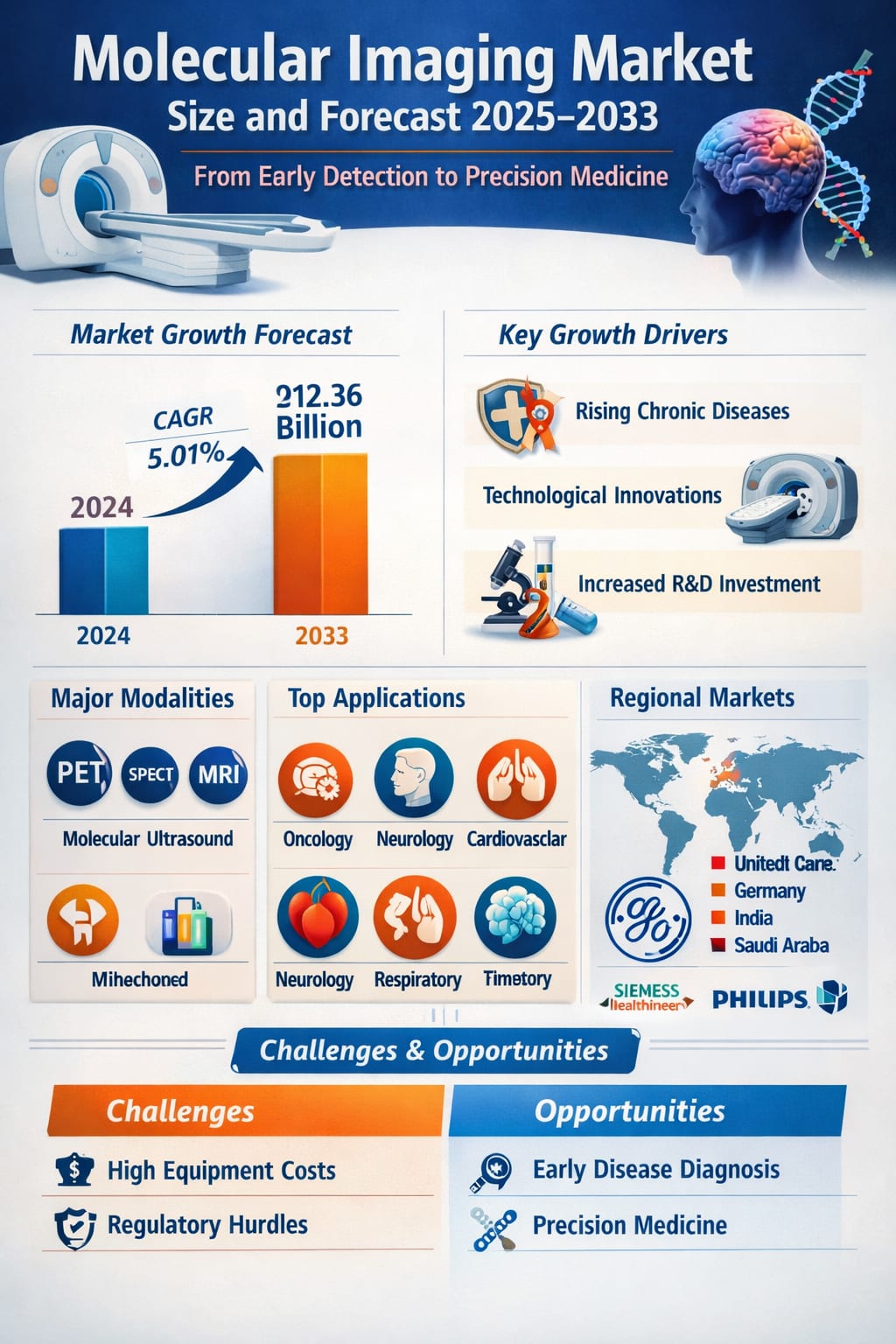
The global molecular imaging market is entering a decisive phase of growth as healthcare systems worldwide increasingly prioritize early diagnosis, precision medicine, and personalized treatment strategies. According to Renub Research, the Molecular Imaging Market is expected to grow from US$ 7.96 billion in 2024 to US$ 12.36 billion by 2033, registering a compound annual growth rate (CAGR) of 5.01% from 2025 to 2033. This expansion reflects not only technological progress but also a fundamental shift in how diseases are detected, monitored, and treated.
Molecular imaging represents a significant evolution beyond traditional anatomical imaging. While conventional techniques such as X-rays or standard CT scans focus mainly on structural changes, molecular imaging goes deeper—visualizing, characterizing, and measuring biological processes at the molecular and cellular levels within living organisms. By combining advanced imaging modalities such as positron emission tomography (PET), single-photon emission computed tomography (SPECT), magnetic resonance imaging (MRI), and optical imaging with targeted molecular probes and biomarkers, clinicians can observe how diseases develop and respond to therapy in real time.
This capability is transforming clinical practice. In oncology, cardiology, neurology, and other specialties, molecular imaging is enabling physicians to detect diseases earlier, select more appropriate treatments, and monitor therapeutic response with unprecedented precision. Its non-invasive nature and ability to deliver functional and biochemical information make molecular imaging a cornerstone of modern personalized medicine.
Market Size and Growth Outlook
The projected growth of the molecular imaging market is being driven by three powerful forces: the rising global burden of chronic diseases, rapid technological innovation in imaging modalities, and increased investment in research and development. Together, these factors are reshaping diagnostic pathways and expanding the role of imaging across the entire continuum of care—from early screening and diagnosis to treatment planning and long-term monitoring.
Renub Research’s forecast underscores how molecular imaging is moving from being a specialized tool used mainly in advanced research centers to a mainstream clinical technology adopted by hospitals, diagnostic imaging centers, and research institutes worldwide. As healthcare systems continue to emphasize value-based care and outcome-driven treatment, the demand for precise, data-rich diagnostic tools like molecular imaging is expected to remain strong through 2033 and beyond.
Growth Drivers in the Molecular Imaging Market
Rising Incidence of Chronic Diseases
One of the most important drivers of the molecular imaging market is the growing prevalence of chronic diseases such as cancer, cardiovascular disorders, neurological conditions, and respiratory illnesses. These diseases require early, accurate, and continuous monitoring—areas where molecular imaging offers clear advantages.
Globally, cardiovascular diseases remain the leading cause of death, accounting for around 18 million deaths each year. Cancer is responsible for approximately 9 million deaths annually, while chronic respiratory diseases such as asthma and COPD claim around 4 million lives, and diabetes contributes to about 2 million deaths. Beyond the human cost, these conditions place an enormous financial burden on healthcare systems, particularly in countries with aging populations.
Molecular imaging helps address this challenge by enabling clinicians to visualize disease processes at their earliest stages—often before structural changes become visible. This early insight improves disease staging, supports more informed treatment decisions, and enhances the ability to monitor progression or response to therapy. As the global burden of chronic disease continues to rise, the demand for such advanced diagnostic capabilities is expected to grow in parallel.
Advances in Imaging Modalities
Technological innovation is another major catalyst for market growth. The development of hybrid imaging systems such as PET/CT and PET/MRI has significantly improved diagnostic accuracy by combining functional and anatomical information in a single scan. These systems offer higher resolution, improved sensitivity, and better image quality, allowing clinicians to detect diseases earlier and characterize them more precisely.
A notable example of industry momentum came in June 2024, when Lantheus Holdings, Inc. announced its acquisition of global rights to Life Molecular Imaging’s RM2 program, targeting the gastrin-releasing peptide receptor (GRPR). This includes both a clinical-stage radiotherapeutic (177Lu-DOTA-RM2) and a radiodiagnostic (68Ga-DOTA-RM2). The deal, involving an upfront payment of US$ 35 million plus potential milestones and royalties, strengthens Lantheus’s focus on prostate cancer while expanding its pipeline into breast and other cancers—highlighting how innovation in imaging agents is closely tied to market expansion.
Innovation in Research and Development
Increased investment in research and development is further accelerating progress in molecular imaging. Governments, academic institutions, and private companies are channeling significant resources into the development of new imaging probes, contrast agents, and imaging platforms.
According to the American College of Radiology, the U.S. President’s 2024 budget included a substantial increase in discretionary funding for the National Cancer Institute (NCI), with US$ 716 million allocated—US$ 500 million more than in FY 2023. These funds are intended to advance research, prevention, diagnosis, and treatment efforts, all of which rely heavily on advanced imaging technologies. Such investments not only drive scientific discovery but also translate into new commercial opportunities for molecular imaging solutions.
Challenges in the Molecular Imaging Market
High Cost of Equipment and Procedures
Despite its clinical benefits, the high cost of molecular imaging equipment and procedures remains a significant barrier to wider adoption. Advanced scanners, radiopharmaceuticals, and supporting infrastructure require substantial capital investment. In addition, ongoing maintenance, regulatory compliance, and the need for highly trained personnel add to operational expenses.
These costs can be particularly prohibitive for smaller healthcare facilities and for institutions in developing regions, limiting access to advanced molecular imaging technologies. As a result, market growth in some regions may be constrained unless more cost-effective solutions and financing models become available.
Regulatory and Reimbursement Barriers
Navigating complex regulatory pathways and securing reimbursement for molecular imaging procedures also pose challenges. The approval process for new imaging agents and devices is often lengthy and rigorous, which can delay commercialization and limit patient access to innovative technologies.
Reimbursement policies vary widely across countries and healthcare systems, influencing both the availability and affordability of molecular imaging services. Inconsistent or inadequate reimbursement can discourage healthcare providers from investing in new imaging technologies, slowing market penetration in certain regions.
Market Segmentation Insights
By Modality
The molecular imaging market includes a range of modalities, each serving distinct clinical and research needs. SPECT and PET remain central to nuclear medicine, offering powerful tools for functional and metabolic imaging. Nuclear magnetic resonance spectrometry (MRI) continues to play a critical role, particularly when combined with PET in hybrid systems. Molecular ultrasound imaging is gaining attention due to its real-time imaging capability, favorable safety profile, and relatively lower cost. Other emerging techniques are also contributing to a more diverse and versatile imaging landscape.
Molecular ultrasound imaging, in particular, is attracting interest because it integrates traditional ultrasound with targeted contrast agents to visualize specific molecular markers. Its non-invasive nature, real-time results, and high spatial resolution make it valuable for early disease detection and therapy monitoring, especially in settings where cost and accessibility are key considerations.
By Application
Oncology remains the largest and most influential application area for molecular imaging. Techniques such as PET and SPECT enable visualization of tumor metabolism, receptor expression, and biological behavior, supporting early detection, accurate staging, treatment selection, and monitoring of response or recurrence.
In neurology, molecular imaging is playing an increasingly important role in diagnosing and managing conditions such as Alzheimer’s disease, Parkinson’s disease, and epilepsy. By visualizing neurotransmitter systems and pathological protein accumulations, clinicians can detect disease earlier and track progression more effectively.
Cardiovascular, respiratory, and gastrointestinal applications are also expanding. In respiratory medicine, for example, molecular imaging helps assess inflammatory processes, ventilation-perfusion mismatches, and tumor metabolism in conditions such as COPD, asthma, and lung cancer—supporting more personalized treatment strategies.
By End Use
Hospitals remain the primary adopters of molecular imaging technologies, thanks to their comprehensive diagnostic and therapeutic capabilities. The integration of advanced imaging into hospital workflows improves diagnostic accuracy and supports multidisciplinary, patient-centered care.
Diagnostic imaging centers are also important users, particularly in urban and high-demand regions where specialized imaging services are needed. Meanwhile, research institutes play a crucial role in advancing the field by conducting preclinical and clinical studies, developing new imaging probes, and collaborating with industry partners to translate innovation into clinical practice.
Regional Market Highlights
United States
The United States represents one of the largest and most dynamic markets for molecular imaging. High rates of chronic disease, a well-developed healthcare infrastructure, and strong investment in research and development create a favorable environment for advanced imaging technologies.
In November 2024, United Imaging installed the world’s first uMI Panvivo PET/CT at Pueblo Medical Imaging in Nevada. The system offers a best-in-class NEMA spatial resolution of 2.9 mm and an effective sensitivity of 181 cps/kBq, supported by AI-based 3D camera technology—illustrating how technological leadership continues to shape the U.S. market.
Germany
Germany’s molecular imaging market benefits from strong healthcare infrastructure, a high level of medical research, and supportive reimbursement policies. The country’s focus on precision medicine and early diagnosis encourages the adoption of advanced imaging technologies.
United Imaging has expanded its footprint in Germany through partnerships with Medical Imaging Electronics (MiE), equipping institutions such as Kliniken Essen-Mitte Evang and Nukmed with the uMI 550 digital PET/CT system—a move that highlights the growing role of international collaborations in driving market growth.
India
India’s molecular imaging market is on a strong growth trajectory, supported by rising healthcare awareness, increasing chronic disease prevalence, and expanding healthcare infrastructure. Government initiatives aimed at improving diagnostic capabilities and access to advanced technologies are further boosting market development.
In May 2025, Mahajan Imaging & Labs inaugurated North India’s first 128-Slice Digital PET-CT – Omni Legend by GE HealthCare in Gurugram, along with a state-of-the-art pathology lab. This milestone reflects the growing demand for integrated cancer care and advanced diagnostics in the region.
Saudi Arabia
Saudi Arabia is emerging as an important market for molecular imaging, driven by increasing chronic disease burden and significant government investment in healthcare modernization under the Vision 2030 initiative.
In December 2024, King Abdulaziz University launched a groundbreaking Alzheimer’s disease diagnosis service at its Molecular Imaging Center using combined PET/MRI technology—the first of its kind in the country. This development underscores the Kingdom’s commitment to adopting cutting-edge diagnostic solutions.
Competitive Landscape
The molecular imaging market is characterized by strong competition among global technology leaders and specialized innovators. Key players include GE HealthCare, Siemens Healthineers AG, Koninklijke Philips N.V., Shimadzu Corporation, United Imaging Healthcare, Bruker Corporation, FUJIFILM Holdings Corporation, and Cubresa Inc.
These companies compete across multiple dimensions, including technology innovation, product portfolios, strategic partnerships, and geographic expansion. Most leading firms focus on four key viewpoints: company overview, key personnel, recent developments and strategies, and revenue analysis—reflecting a highly structured and competitive industry environment.
Molecular Imaging Market Segmentation Snapshot
By Modality:
Single Photon Emission Computed Tomography (SPECT)
Positron Emission Tomography (PET)
Nuclear Magnetic Resonance Spectrometer
Molecular Ultrasound Imaging
Others
By Application:
Oncology
Cardiovascular
Neurology
Respiratory
Gastrointestinal
By End Use:
Hospitals
Diagnostic Imaging Centers
Research Institutes
By Geography:
North America (United States, Canada)
Europe (France, Germany, Italy, Spain, United Kingdom, Belgium, Netherlands, Turkey)
Asia Pacific (China, Japan, India, South Korea, Thailand, Malaysia, Indonesia, Australia, New Zealand)
Latin America (Brazil, Mexico, Argentina)
Middle East & Africa (Saudi Arabia, UAE, South Africa)
Final Thoughts
The molecular imaging market is steadily moving toward a future defined by precision, personalization, and early intervention. With Renub Research projecting growth from US$ 7.96 billion in 2024 to US$ 12.36 billion by 2033, the sector’s trajectory reflects both technological momentum and urgent clinical need.
While challenges such as high costs and regulatory complexities remain, continued innovation, rising investment in research, and expanding clinical applications are expected to sustain long-term growth. As healthcare systems worldwide seek smarter, more efficient ways to diagnose and manage disease, molecular imaging is poised to remain at the heart of next-generation medicine—bridging the gap between biology and technology, and transforming how care is delivered in the years ahead.
About the Creator
Understanding Forex Trading: A Beginner’s Guide to the Currency Market
Introduction Forex trading, also known as foreign exchange trading, is the buying and selling of currencies in the global market. With a daily trading volume exceeding $7 trillion, it is the largest financial market in the world. Forex trading offers opportunities for profit but also carries substantial risk, especially for beginners.
By Hammad Nawaz2 days ago in Trader
Global Beef Market Trends & Summary (2025–2033)
Global Beef Market Outlook: A Growing Industry with Strong Fundamentals The global beef market continues to hold a critical position in the world’s food and agriculture ecosystem, supported by steady demand, evolving consumer preferences, and continuous improvements in production and distribution. According to Renub Research, the Beef Market is expected to reach US$ 749.90 billion by 2033, rising from US$ 520.53 billion in 2024, growing at a compound annual growth rate (CAGR) of 4.14% from 2025 to 2033.
By Sakshi Sharma6 days ago in Trader



Comments
There are no comments for this story
Be the first to respond and start the conversation.