
S&P 500 Index Technical Analysis: Key Levels & Trading Signals
Key Support, Resistance, and Market Trend Insights

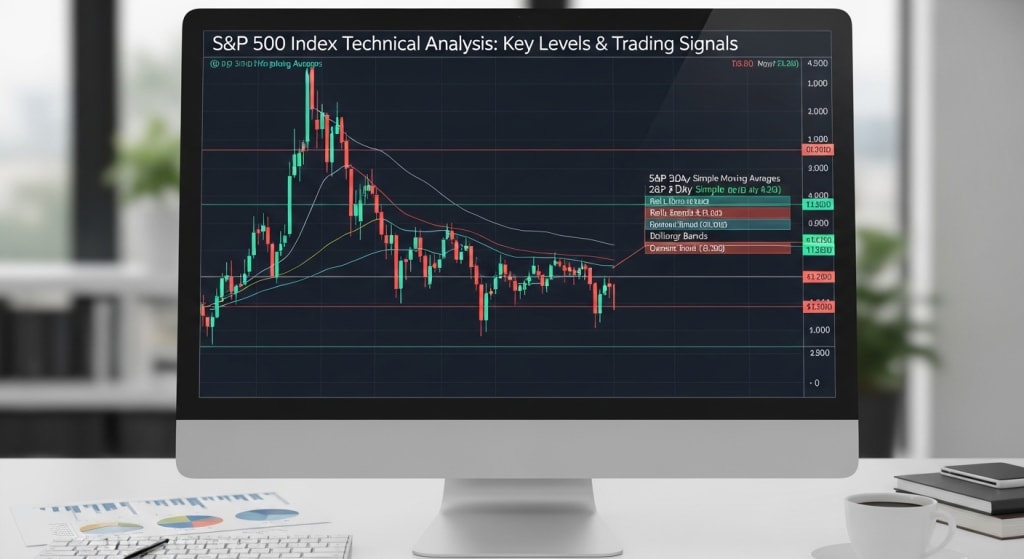
The S&P 500 Index is one of the most watched stock market indexes in the world, and many investors track it through Low cost S&P 500 funds to build long-term wealth.
When traders study price charts, they look for signals that show where the S&P 500 Index may move next. In this article, we will break down key levels, chart patterns, and trading signals in simple and clear terms.
If you want to understand how the S&P 500 Index behaves and how technical analysis works, this guide is for you.
What Is the S&P 500 Index?
The S&P 500 Index measures the performance of 500 large companies in the United States. These companies come from many sectors like technology, health, energy, and finance.
Because it covers many industries, the S&P 500 Index is often used as a snapshot of the U.S. stock market. When it rises, investors feel confident. When it falls, fear can spread quickly.
Why Technical Analysis Matters
Technical analysis is the study of price charts. It helps traders understand trends and possible turning points.
Instead of looking at company profits, technical traders focus on:
Price movements
Chart patterns
Support and resistance levels
Volume activity
The S&P 500 Index reacts strongly to news, interest rates, and earnings. These reactions create patterns that can be studied.
Market Trends
A trend shows the general direction of price movement. The S&P 500 Index can move in three main ways:
Uptrend – Higher highs and higher lows
Downtrend – Lower highs and lower lows
Sideways trend – Price moves within a range
In an uptrend, buyers are stronger than sellers. In a downtrend, sellers take control.
Spotting the trend early can help traders make better decisions.
Key Support Levels to Watch
Support is a price level where the S&P 500 Index often stops falling. It is where buyers step in.
Support levels are important because:
They show where demand increases
They often act as bounce points
They help manage risk
For example, if the S&P 500 Index falls to a previous low and holds steady, that level becomes strong support.
If support breaks, price may drop faster.
Major Resistance Zones
Resistance is the opposite of support. It is a level where price often stops rising.
At resistance:
Sellers become more active
Profit-taking increases
Momentum may slow down
If the S&P 500 Index breaks above resistance, it can trigger strong upward movement.
Traders often wait for confirmation before entering trades near resistance.
Moving Averages and Trend Signals
Moving averages smooth out price data. They help traders see the bigger picture.
Two common moving averages used with the S&P 500 Index are:
50-day moving average
200-day moving average
When the 50-day crosses above the 200-day, it is called a bullish signal. When it crosses below, it is seen as bearish.
These signals are not perfect, but they give clues about trend strength.
Relative Strength Index (RSI) Signals
The Relative Strength Index, or RSI, measures momentum. It shows whether the S&P 500 Index is overbought or oversold.
Above 70 = Overbought
Below 30 = Oversold
When RSI is above 70, a pullback may happen. When RSI is below 30, a bounce could occur.
Many traders combine RSI with support and resistance for better results.
Chart Patterns That Shape Market Moves
Price patterns repeat over time. The S&P 500 Index often forms clear chart patterns.
Common patterns include:
Head and shoulders
Double top
Double bottom
Triangles
For example, a double bottom may signal a reversal from a downtrend to an uptrend.
Patterns do not guarantee success, but they improve probabilities.
Volume and Market Strength
Volume shows how many shares are being traded. Strong moves in the S&P 500 Index are often supported by high volume.
If price rises with high volume, the move is strong. If price rises with low volume, it may not last.
Volume confirms trends and breakouts. Traders often check volume before entering a trade.
Breakouts and False Signals
A breakout happens when price moves above resistance or below support. Breakouts in the S&P 500 Index can lead to fast price changes.
However, false breakouts also happen.
To avoid traps, traders look for:
Strong volume
Clear candle closes above resistance
Momentum confirmation
Patience is key when trading breakouts.
Role of Market Sentiment
Market sentiment reflects investor emotions. Fear and greed move the S&P 500 Index more than logic at times.
When investors are too optimistic, markets may become overbought. When fear is extreme, markets may be oversold.
Sentiment indicators, news headlines, and volatility levels help traders understand mood shifts.
Low Cost S&P 500 Funds and Long-Term Strategy
Many investors choose Low cost S&P 500 funds instead of trading daily price moves. These funds track the S&P 500 Index and offer broad exposure.
Benefits of Low cost S&P 500 funds include:
Lower fees
Simple diversification
Long-term growth potential
Less stress from daily market swings
While traders focus on short-term technical signals, long-term investors often prefer steady growth.
Low cost S&P 500 funds allow investors to benefit from the overall strength of the S&P 500 Index over time.
Risk Management in Index Trading
Risk management protects capital. Even strong signals in the S&P 500 Index can fail.
Smart traders:
Use stop-loss orders
Avoid risking too much on one trade
Follow clear entry and exit rules
The market can be unpredictable. Managing risk is more important than predicting every move.
Combining Indicators for Better Results
No single indicator works all the time. The S&P 500 Index moves due to many factors.
Successful traders often combine:
Trend analysis
RSI
Moving averages
Volume
Support and resistance
When several signals align, the probability of success improves.
For example, if the S&P 500 Index breaks resistance with strong volume and RSI support, confidence increases.
Final Thoughts
The S&P 500 Index remains a powerful guide to the health of the U.S. stock market. By understanding support levels, resistance zones, moving averages, RSI signals, and volume trends, traders can make more informed decisions.
At the same time, long-term investors may prefer Low cost S&P 500 funds to build steady wealth without worrying about daily price swings. Whether you trade actively or invest for the future, understanding how the S&P 500 Index moves gives you an edge.
Study the charts, manage your risk, and stay patient. Over time, discipline and knowledge can lead to better results in the market.
About the Creator
Nuveen Agrees £9.9bn Acquisition of Schroders in Landmark Asset Management Deal
Introduction In a move that could reshape the global asset management landscape, US investment manager Nuveen has announced a £9.9 billion deal to acquire UK-based Schroders. The transaction represents one of the largest cross-border acquisitions in the financial services sector and highlights growing consolidation within the global asset management industry. The deal is expected to strengthen Nuveen’s global footprint while providing Schroders with enhanced scale and access to international markets.
By Hammad Nawaz7 days ago in Trader
Nasdaq Futures Climb as Strong Jobs Data Shifts Focus on Federal Reserve Rate Policy
Introduction Nasdaq futures moved higher in early trading after a stronger-than-expected US jobs report reshaped market expectations around Federal Reserve interest rate policy. The latest employment data signaled continued resilience in the US labor market, easing fears of an economic slowdown while prompting investors to reassess the timing and pace of potential rate cuts.
By Hammad Nawaz7 days ago in Trader



Comments
There are no comments for this story
Be the first to respond and start the conversation.