
Spectrum Analyzer Market Size and Forecast 2025–2033
How 5G, Defense Modernization, and High-Frequency Electronics Are Reshaping the Global Signal Analysis Industry

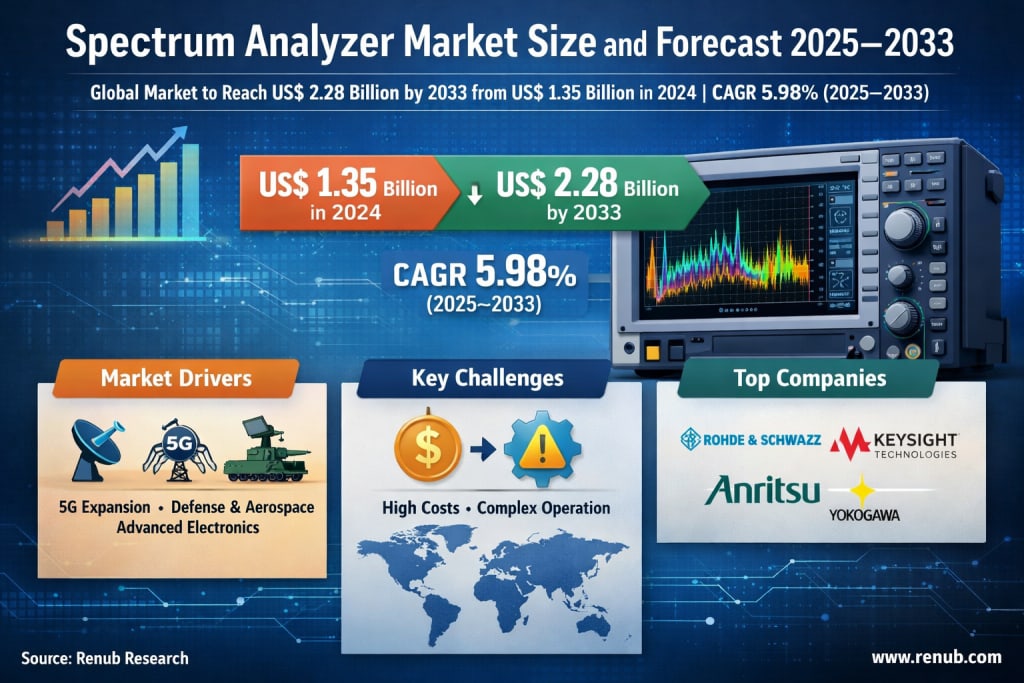
The global spectrum analyzer market is entering a phase of steady and strategic expansion, driven by the rapid evolution of wireless communication, defense modernization, and the growing complexity of electronic systems. According to Renub Research, the global spectrum analyzer market is expected to grow from US$ 1.35 billion in 2024 to US$ 2.28 billion by 2033, registering a compound annual growth rate (CAGR) of 5.98% during the period 2025 to 2033.
This growth reflects more than just rising sales of test and measurement equipment. It signals a deeper transformation in how industries design, test, secure, and optimize electronic and wireless systems. From 5G networks and IoT ecosystems to radar systems and aerospace communication platforms, spectrum analyzers have become indispensable tools for ensuring performance, compliance, and reliability in an increasingly crowded electromagnetic environment.
As industries move toward higher frequencies, faster data speeds, and more complex signal environments, the importance of accurate and real-time spectrum analysis continues to rise. The market’s momentum is being fueled by expanding telecommunications infrastructure, rising defense and aerospace investments, and the accelerating adoption of high-frequency electronic equipment across sectors.
Global Spectrum Analyzer Industry Overview
Spectrum analyzers play a critical role in modern electronics and communications by enabling engineers and technicians to measure, visualize, and analyze signal frequencies. These instruments help identify interference, verify signal integrity, test compliance with regulatory standards, and optimize overall system performance.
The global market for spectrum analyzers is benefiting from several long-term technology shifts. The rollout of 5G networks, the growth of Internet of Things (IoT) applications, and the increasing sophistication of consumer electronics and industrial systems are all creating a strong need for advanced testing and measurement solutions. As wireless environments become more complex, the ability to monitor and analyze spectrum usage accurately is no longer optional—it is essential.
Technological progress has also reshaped the product landscape. Modern spectrum analyzers are becoming more compact, more software-driven, and more capable of real-time analysis. Cloud integration, digital signal processing, and AI-assisted analytics are gradually enhancing how these instruments are used in both laboratory and field environments.
Geographically, North America and Asia-Pacific currently dominate the market, supported by strong telecom, electronics manufacturing, and defense sectors. However, emerging economies are also increasing their adoption of spectrum analyzers as digital infrastructure expands and regulatory frameworks for spectrum management become more rigorous.
Another important factor supporting market growth is the widespread use of electronic devices across industries. Manufacturing, automotive, healthcare, aerospace, and energy sectors all rely on advanced electronics, which in turn require precise testing and validation. Spectrum analyzers are widely used in production environments to detect faults, diagnose performance issues, and maintain high standards of quality and reliability.
Despite these positive trends, the market also faces certain constraints. The high cost of advanced spectrum analyzers and the technical complexity of operating them can limit adoption, especially among small and medium-sized enterprises and academic institutions. In addition, the growing use of software-defined radios and software-based signal analysis tools is expected to create long-term competitive pressure on traditional hardware-focused solutions.
Still, the overall outlook remains positive, supported by continuous innovation and the rising strategic importance of spectrum management across industries.
Key Factors Driving the Spectrum Analyzer Market Growth
1. Continuous Technological Developments
Ongoing innovation in spectrum analyzer technology is one of the strongest growth drivers for the market. Modern devices now offer higher resolution, wider frequency ranges, faster processing speeds, and real-time analysis capabilities, making them far more powerful than earlier generations.
Advancements in digital signal processing and software-defined radio technologies are also reshaping how spectrum analyzers are designed and used. These improvements allow for more flexible, accurate, and application-specific analysis, which is especially important in complex signal environments such as 5G networks and defense systems.
A notable example of this innovation trend was seen in June 2021, when Signal Hound introduced the BB60D, a six GHz real-time spectrum analyzer that significantly outperformed its predecessor and set new benchmarks for performance in its category. Such product launches highlight how competition and technological progress continue to expand the capabilities and use cases of spectrum analyzers.
2. Emergence and Expansion of 5G Networks
The global rollout of 5G networks is a major catalyst for the spectrum analyzer market. 5G introduces higher frequencies, wider bandwidths, and more complex modulation schemes, all of which require advanced testing and monitoring tools.
For instance, during 2023, 5G availability in India expanded rapidly, increasing from around 28% in the first quarter to approximately 52% by the fourth quarter of the year. This rapid deployment underscores the growing need for spectrum analyzers to test new equipment, optimize network performance, manage frequency allocation, and ensure signal integrity.
As 5G continues to expand worldwide—and as research into future generations like 6G accelerates—the demand for precise and reliable spectrum analysis tools is expected to remain strong throughout the forecast period.
3. Rising Defense and Aerospace Requirements
The defense and aerospace sectors represent some of the most critical and demanding users of spectrum analyzers. These industries rely heavily on accurate signal analysis to ensure the performance and security of communication systems, radar platforms, navigation systems, and electronic warfare equipment.
In military operations, even minor signal interference or degradation can compromise mission success. Spectrum analyzers are therefore essential for detecting interference, monitoring spectrum usage, securing communication channels, and optimizing system performance.
In aerospace applications, radar and navigation systems must operate reliably under a wide range of environmental conditions. As military technology becomes more sophisticated and as wireless communication plays a larger role in strategic operations, the need for advanced spectrum analyzers in these high-stakes sectors continues to grow.
Challenges in the Spectrum Analyzer Market
High Cost of Advanced Equipment
One of the most significant barriers to wider adoption is the high cost of advanced spectrum analyzers. Devices that offer wide bandwidth coverage, real-time analysis, and high resolution often come with premium price tags. Beyond the initial purchase, users may also face additional costs for software licenses, maintenance, and specialized training.
For small and mid-sized enterprises, startups, and academic institutions, these financial requirements can be difficult to justify, even when the technology would provide clear operational benefits. As a result, adoption in budget-sensitive segments can be slower than expected, despite the growing need for advanced signal analysis.
Complexity of Operation
Spectrum analyzers—especially high-end models—are technically complex instruments that require specialized knowledge to operate effectively. Proper setup, accurate interpretation of results, and effective troubleshooting all demand a high level of expertise.
In organizations without trained personnel, this complexity can become a serious obstacle. Incorrect usage can lead to inaccurate measurements, missed interference issues, and unreliable test results, which is particularly risky in sectors like telecommunications, aerospace, and defense.
Although manufacturers are working to improve user interfaces and simplify workflows, the learning curve remains a challenge for many end users.
Spectrum Analyzer Market Overview by Regions
North America
North America leads the global spectrum analyzer market, supported by a strong technology ecosystem and high demand from the telecommunications and defense sectors. The region benefits from advanced infrastructure, significant R&D investments, and the presence of major technology companies.
United States Spectrum Analyzer Market
The United States plays a central role in the global spectrum analyzer industry. Growth is driven by the expanding use of 5G, IoT, and advanced defense systems, all of which require precise and reliable signal analysis. The U.S. defense sector, in particular, depends heavily on spectrum analyzers for radar systems, electronic warfare, and secure communications.
The ongoing shift toward software-based and real-time analyzers is also shaping the market, reinforcing the country’s position as a leader in both innovation and adoption.
United Kingdom Spectrum Analyzer Market
In the UK, the market is growing steadily, supported by developments in telecommunications, defense, and electronics. The rollout of 5G networks and the increasing use of IoT devices are boosting demand for accurate spectrum analysis tools. Strict regulatory standards for spectrum management and a strong focus on R&D further support market growth, while the integration of AI is improving analytical accuracy and efficiency.
India Spectrum Analyzer Market
India’s spectrum analyzer market is expanding rapidly due to the fast-paced development of 5G networks, rising electronics manufacturing, and increased defense investments. Government initiatives such as Digital India and Atmanirbhar Bharat are encouraging local production and technological innovation, further strengthening demand for advanced testing equipment.
United Arab Emirates Spectrum Analyzer Market
The UAE market is also witnessing solid growth, driven by telecom expansion, defense modernization, and smart infrastructure projects. Strong regulatory oversight of spectrum usage and increasing investments in R&D are supporting the adoption of advanced spectrum analysis solutions across multiple sectors.
Recent Developments in the Spectrum Analyzer Industry
September 2024: Aaronia AG announced it would showcase waveguide-based real-time spectrum analyzers at European Microwave Week (EuMW) in Paris.
May 2024: Anritsu Corporation introduced the Site Master MS2085A Cable and Antenna Analyzer and the MS2089A with Integrated Spectrum Analyzer, expanding its portfolio of advanced test and measurement solutions.
Market Segmentation
By Offering
Hardware
Software
By Form Factor
Handheld Spectrum Analyzer
Portable Spectrum Analyzer
Benchtop Spectrum Analyzer
By Network Technology
Wired
Wireless
By Application
Telecom
Optical Communication
Radar & Radio Processing
Digital Signal Processing
Networks
Others
By Region
North America: United States, Canada
Europe: France, Germany, Italy, Spain, United Kingdom, Belgium, Netherlands, Turkey
Asia Pacific: China, Japan, India, Australia, South Korea, Thailand, Malaysia, Indonesia, New Zealand
Latin America: Brazil, Mexico, Argentina
Middle East & Africa: South Africa, Saudi Arabia, United Arab Emirates
Key Companies Covered
ADVANTEST CORPORATION
AVCOM
B&K Precision Corporation
Cobham Limited
Fortive Corporation
Rohde & Schwarz
Teledyne Technologies
Yokogawa Electric Corporation
(Each company is analyzed in terms of overview, key persons, recent developments & strategies, revenue analysis, and overall market positioning.)
Final Thoughts
The global spectrum analyzer market is on a clear and sustainable growth path, supported by the expansion of 5G, rising defense and aerospace investments, and the increasing complexity of modern electronic systems. With the market projected to grow from US$ 1.35 billion in 2024 to US$ 2.28 billion by 2033, spectrum analyzers are set to remain a cornerstone of the global test and measurement industry.
While challenges such as high equipment costs and operational complexity persist, continuous technological innovation—especially in software-defined, real-time, and AI-enhanced solutions—is steadily lowering barriers and expanding use cases. As industries move toward higher frequencies, smarter networks, and more connected ecosystems, spectrum analyzers will play an even more critical role in ensuring performance, reliability, and security across the global digital landscape.
About the Creator
Keep reading
More stories from shibansh kumar and writers in Trader and other communities.
Heart Pump Device Market Size and Forecast 2025–2033
The global healthcare landscape is undergoing a transformative shift as cardiovascular diseases (CVDs) continue to pose a formidable challenge. Against this backdrop, the Heart Pump Device Market is emerging as a critical lifeline for millions of patients worldwide.
By shibansh kumarabout 18 hours ago in Trader
Walmart Stock Analysis: Can Walmart Continue Winning in the Era of E-Commerce and Inflation?
Introduction Walmart stock is widely regarded as one of the most reliable investments in the global retail sector. As the world’s largest retailer by revenue, Walmart serves millions of customers daily through its vast network of physical stores and rapidly expanding digital platforms. Known for its low-price strategy and massive scale, Walmart plays a crucial role in consumer spending trends. For investors, the key question is whether Walmart stock can continue delivering stable returns while adapting to e-commerce growth, inflation, and changing consumer behavior.
By Hammad Nawaza day ago in Trader
infosys share price forecast: will it rebound or slide further?
The infosys share price is capturing attention again. Investors and market watchers are asking the same question: will it rebound, or is there more downside ahead? Recent fluctuations have created uncertainty, but careful analysis can reveal opportunities. They will explore the latest trends affecting infosys share price, the main reasons behind its movement, and insights from experts. If you want to invest wisely, understanding these factors is essential.
By hamza mirza2 days ago in Trader




Comments
There are no comments for this story
Be the first to respond and start the conversation.