
Stock Trading - Entry 44
How I am Investing Above the $20k Mark plus a Dividend Hack


[https://todaysurvey.shop/trader/stock-trading-entry-43%5D%3C/p%3E%3Cstyle data-emotion-css="14azzlx-P">.css-14azzlx-P{font-family:Droid Serif,Georgia,Times New Roman,Times,serif;font-size:1.1875rem;-webkit-letter-spacing:0.01em;-moz-letter-spacing:0.01em;-ms-letter-spacing:0.01em;letter-spacing:0.01em;line-height:1.6;color:#1A1A1A;margin-top:32px;}
My previous entry* ended with the realization that I had to figure out how my investment approach needs to change given that I have enough cash in my portfolio to invest in more than just a few shares in more than a few companies. Newsflash #23: When you have $20k in your portfolio, your investing approach will need a refresh. This article dives into that change for me - I am not dispensing financial advice.
First up is portfolio allocation. Until I buy more than 20% of the shares in one company, I will continue to reiterate that it is very important to me to recognize all the things I don't know. (You read that right.) While diversification continues to make up for my ignorance when it comes to weathering the market's ups and downs (so ways Warren Buffet - and I don't entirely disagree), having too much invested in one sector was starting to be the same as investing too much in only one company in which I have no direct role. When I had less than $15k in my portfolio, I was doing very few small trades based on my fundamental analysis - and those picks have done well. When my dingy got really big and found itself in a sea, I was no longer investing simply via small, calculated buys and sells coupled with patience.

In short, I found myself over-invested in industrials and financials com early 2025. Even with the tariff spat, I seem to have picked well so far, but I didn't want my boat to be at high risk for running aground. So, I diversified into select stocks in real estate funds, consumer stuff, healthcare, and tech (NOT nvidia). Looking at the right numbers in my own portfolio helped direct my research and purchases. The market dip in April made this diversification effort more affordable, although I missed out on a couple of food-related stocks. But, I remind myself that patience is still an ingredient on how I choose!
The second new ingredient was notification settings. For all the stocks in my portfolio, I have set price indicators on when to consider buying and when to consider selling. This makes whatever research (AKA fundamental analysis) I do in a company last for a few months because any significant change in stock price is easy for me to put in context. For example, the stock price dip in July-August 2025 for MTL does not correlate to the future prospects of the industries nor the two acquisitions impacting its financial statements. It's on a rock solid platform and it has extra engines for a lift-off I anticipate when it comes to transporting things across the western two-thirds of Canada (plus part of the arctic). In short, investor sentiment is off the mark as the share price should be a lot higher than what it is, IMO.
My notification spread I incorporate is at least 6% (I prefer double-digits, though). For dividend-paying stocks, I have decided to hold until it rises above the annual dividend rate (based on the price at the time I purchased shares). This works out to between 5% and 22% for the stocks I have invested in as at the date of publishing this article.
Why this spread? Because of patience and my day job. If my goal was to max out on annual ROI, the frequency of my trades would be very high. I have other things to do in life and what I invest in does not need to meet whatever indicator that some distant corporate office sets. That's stress I don't need. So, I make it easy on myself to make the returns I like (check out entry 42 that shows my ROI in 2024 and the first five months in 2025).
Take DeFi Technologies (DEFI) as an example. I wanted to add this to my portfolio in late spring 2025, but I waited for the share price to drop to well under $4 to give myself the runway to make an investment gain based on the research I did. It dropped well below $4 so I bought some. Then the stock price surged over 10% more than what I bought it for, so I sold (with a ~6% gain). Then it dropped to well below $4 again, so I bought some. Then it went up over 10%. So I sold again (with a ~10% gain). Then it dropped to well under $4 again, so I bought some. All of this happened in a couple of weeks. Honestly, I want to hold given what the company does, so that's enough yo-yoing for me for this stock for now.
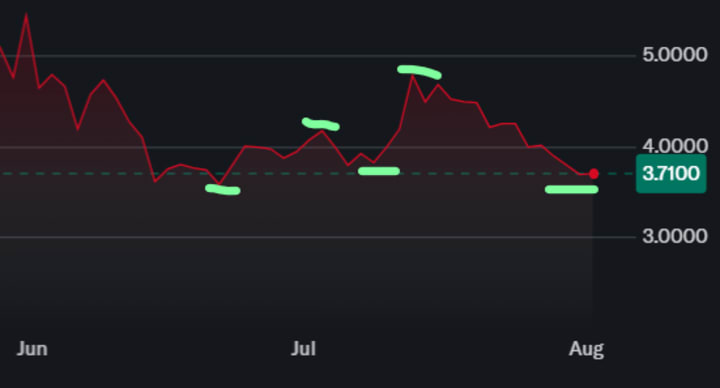
(In comparison, I setup a notification and, as at the date this article was published, am a shareholder of K-Bro Linen (KBL).)
This allows me to time my purchases in a way that works for me. Why does this matter? Yes, patience is a virtue and so is capping my greed (see entry 10 on how even a micro-investor can succumb or overcome that). When I saw some new ETFs from Hamilton (CWIN and CMVP), I looked at it as though someone suggested I eat an unpeeled orange. One of them seems all about dividend maximization, which I am sure means buy right before the qualifying date to be eligible to receive a dividend and sell shortly thereafter.
The only thing this approach is going to do is increase market volatility on dividend-paying stocks. Two can play that game. I can wait to buy a dividend-paying stock I want until after the ex-dividend date since that ETF will undoubtedly dump all its shares so it can free up its money to buy other shares just before their ex-dividend date.
The ex-dividend date is the day on which you need to own a stock in order to receive the corresponding dividend that has been announced. For example, on February 10th a company announces a 5-cent-per-share dividend that will be paid out on March 15th to shareholders on record on February 28th. The ex-dividend date is Feb. 28th, which means if I don't own any stocks on Feb. 28, then I won't get a dividend pay-out on March 15th. However, if I buy on Feb. 27th and sell on March 1st, then I will get the dividend pay-out on March 15th because I owned them on the critical date of Feb. 28th.
Will I sit around and try to figure out their algorithm? Nope, but if I see a significant dip shortly after an ex-dividend date that is way more than the dividend yield, it may make be worth my while to buy at a discount and hold. Again, I won't chase it, but I will start factoring that into the research I do when I receive a notification of the price of a stock I want being on the acceptably low side.
Will I miss out on opportunities? Yes. I don't care. I am not chasing after every penny to beat an ROI set by some distant office and I have other things to do in life. If you are greedy and want to earn 10% per month - not per year - then you probably have to trade like I did with DEFI all the time. (Good luck timing the market!!)
When I get a notice, I don't rush to check things out right away (although I have on occasion when time and interest permitted). I figure if the stock price continues to fall beyond the level set in my notification, good. I can either get a better deal than had I rushed or realize the company messed up and avoid a bad buy, depending on what my research reveals. If I miss out on a slight discount, oh well, there will be other opportunities in the future, including bigger highs and lows.
For now, I am doing what I need to do in order to build the future wealth I want and can. I mean, take a look at this passive income I receive on just one of the portfolios I have:

To find out what I do or don't invest in next, subscribe for free below to become notified right when I publish those articles. Alternatively, you can bookmark this page that contains a list of all my entries in my stock and blockchain trading journey I publish on Vocal Media.
About the Creator
Richard Soulliere
Bursting with ideas, honing them to peek your interest.
Enjoyes blending non-fiction into whatever I am writing.
Keep reading
More stories from Richard Soulliere and writers in Trader and other communities.
Stock Trading - Entry 43
While I am not dispensing financial advice in this article or any of my previous articles on Vocal.Media, what I am about to get into involves numbers that can lie to a micro-investor such as myself. I would be curious to know if any of these or other numbers have lied to other investors out there as well - so leave a comment at the very end of this page with a few details. Alrighty, let's get started.
By Richard Soulliere7 months ago in Trader
Australia CCTV Market: Surveillance Sector Accelerates Toward a $6B Future
The Australia CCTV market is entering a period of rapid transformation and expansion. According to the latest IMARC Group research, the market reached USD 1.16 billion in 2024 and is projected to grow to approximately USD 6.02 billion by 2033, representing a robust CAGR of 17.90% during the 2025–2033 period.
By Rashi Sharmaabout 23 hours ago in Trader



Comments
There are no comments for this story
Be the first to respond and start the conversation.