
United States Diabetes Devices Market Set for Strong Growth Through 2034
Rising diabetes prevalence, rapid digital innovation, and expanding access to monitoring and insulin delivery technologies are reshaping the future of diabetes care in America.

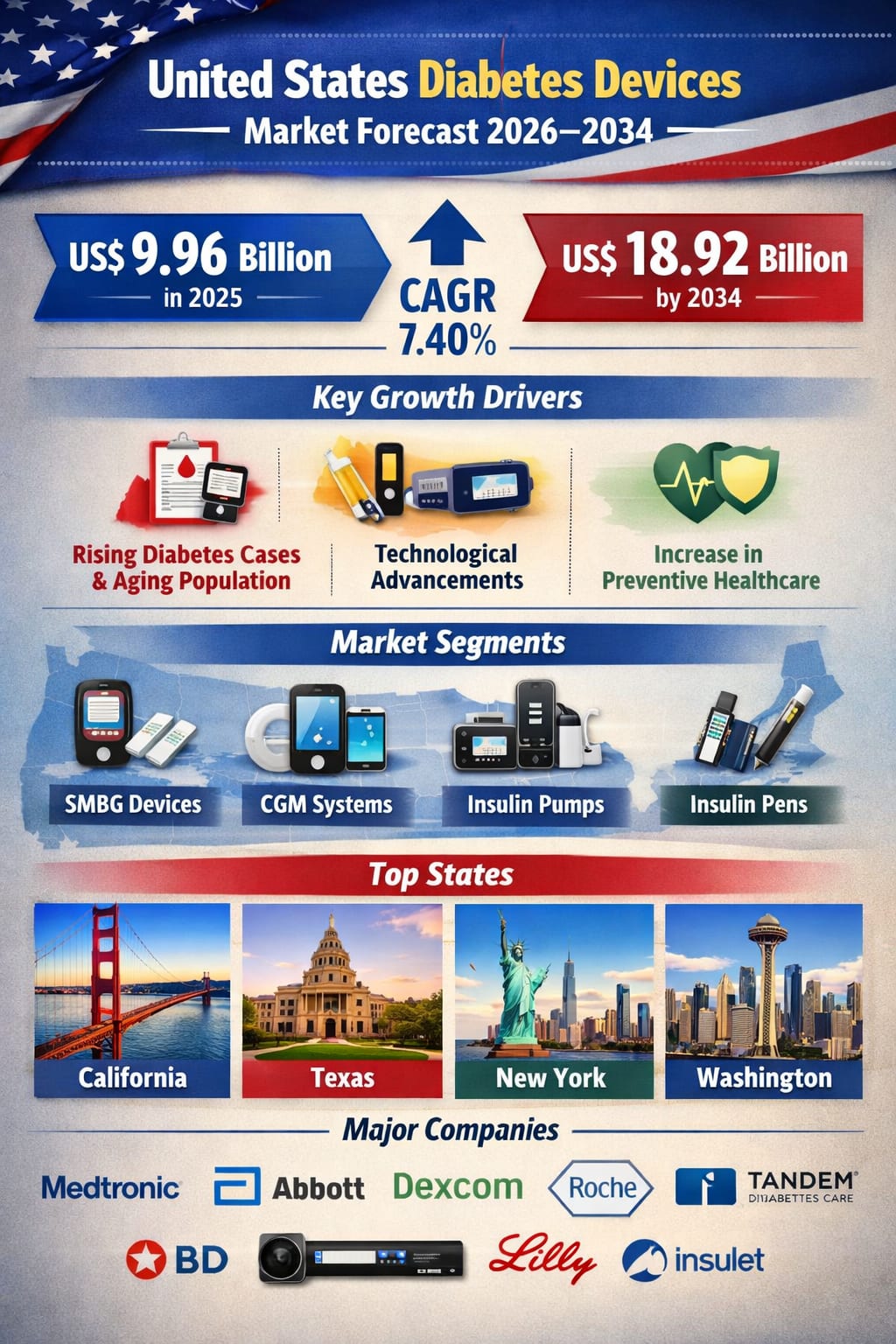
United States Diabetes Devices Market: Size & Forecast 2026–2034
The diabetes devices market in the United States is entering a decisive decade of transformation. According to Renub Research, the market is estimated to grow from US$ 9.96 billion in 2025 to US$ 18.92 billion by 2034, registering a compound annual growth rate (CAGR) of 7.40% from 2026 to 2034. This expansion is being fueled by a combination of demographic, clinical, and technological forces: the rising incidence of diabetes, increasing adoption of continuous glucose monitoring (CGM) systems, growing use of insulin delivery devices, and rapid innovation aimed at improving convenience, accuracy, and patient outcomes.
Diabetes is no longer viewed only as a condition to be managed episodically. In the U.S., it has become a central public health challenge that requires continuous monitoring, personalized treatment, and long-term lifestyle management. As a result, diabetes care devices are evolving from simple measurement tools into integrated digital health solutions that support both patients and healthcare professionals in making better, faster, and more informed decisions.
United States Diabetes Device Market Outlook
Diabetes care devices are biomedical instruments designed to measure glucose levels in the bloodstream and to support the administration of insulin or other therapies for effective disease management. Common devices include blood glucose meters, continuous glucose monitoring systems, insulin pens, insulin pumps, “smart” insulin delivery systems, and supporting mobile applications. Together, these tools play a critical role in helping people with both type 1 and type 2 diabetes maintain optimal glucose control and reduce the risk of long-term complications.
In the United States, the adoption of diabetes-related devices is particularly strong due to the high prevalence of the disease and growing awareness around proactive disease management. Patients and healthcare providers increasingly prefer devices that are accurate, easy to use, and capable of providing continuous or near real-time data. The country’s advanced healthcare infrastructure and relatively broad insurance coverage for many diabetes technologies have further supported the uptake of CGM systems and insulin pumps.
Another important trend shaping the market is the shift toward connected and data-driven care. With the rise of telemedicine, remote patient monitoring, and personalized treatment approaches, diabetes devices are no longer isolated tools. They are becoming part of broader digital ecosystems that connect patients, physicians, caregivers, and health systems. This evolution is accelerating demand for smart, connected devices across all age groups.
Key Growth Drivers in the U.S. Diabetes Devices Market
Rising Diabetes Prevalence and Aging Population
One of the most powerful growth drivers is the increasing number of people living with diabetes in the United States. Both type 1 and type 2 diabetes cases are rising, largely due to lifestyle factors such as physical inactivity, obesity, and unhealthy dietary habits. At the same time, the U.S. population is aging, and older adults are more vulnerable to diabetes and its related complications.
This demographic shift is significantly expanding the pool of patients who require long-term glucose monitoring and insulin therapy. Devices such as CGMs, insulin pumps, and self-monitoring tools help patients manage their condition more effectively, reduce hospital visits, and prevent serious long-term complications. With projections indicating that the number of people living with diabetes could more than double by 2050, the demand for diabetes management devices is expected to remain strong and resilient over the long term.
Technological Advancements and Digital Integration
The U.S. diabetes devices market is also being reshaped by rapid technological innovation. Continuous glucose monitoring systems, smart insulin pens, and automated or closed-loop insulin delivery systems are changing how diabetes is treated on a daily basis. These technologies reduce the burden of frequent finger-stick testing, improve dosing accuracy, and help patients maintain more stable glucose levels.
Integration with smartphones, cloud platforms, and wearable devices has further enhanced the value of these solutions. Patients can now track their data in real time, share it with healthcare providers, and receive personalized insights. Healthcare professionals, in turn, are increasingly relying on device-generated data for remote monitoring and therapy adjustments.
A notable example of this trend came in December 2024, when Dexcom announced the launch of a generative AI platform built using Google Cloud Vertex AI and Gemini models. The system analyzes individual patterns in glucose levels, activity, and sleep to provide personalized recommendations, highlighting how artificial intelligence is becoming a meaningful part of diabetes care.
Growing Awareness and Preventive Healthcare Focus
Rising awareness about diabetes prevention and management is another important catalyst for market growth. Patients are increasingly aware of the importance of regular glucose monitoring and early intervention. Preventive healthcare initiatives in the U.S. are focused on reducing long-term complications and controlling healthcare costs, and device-assisted self-management fits perfectly into this strategy.
Programs such as the U.S. National Diabetes Prevention Program have demonstrated that lifestyle interventions and continuous monitoring can significantly reduce the risk of disease progression. Although these programs still reach only a fraction of the at-risk population, they underline a broader shift toward proactive, patient-centered care. This shift is driving greater adoption of both monitoring and insulin delivery devices.
Challenges in the United States Diabetes Devices Market
High Cost of Advanced Technologies
Despite strong growth prospects, cost remains a significant barrier. Advanced devices such as CGMs, insulin pumps, and smart delivery systems involve substantial upfront and recurring expenses. While insurance coverage and reimbursement have improved, policies vary widely depending on the provider and the patient’s plan. For many individuals, out-of-pocket costs can still be high enough to delay adoption or limit long-term use.
This cost sensitivity is particularly relevant among uninsured or underinsured populations, and it continues to influence purchasing decisions, especially when lower-cost alternatives like traditional SMBG devices are available.
Device Complexity and User Adoption Barriers
Another challenge is the complexity of some advanced devices. Although technology has improved usability, many patients—especially older adults or those less comfortable with digital tools—can struggle with device setup, calibration, data interpretation, and troubleshooting. Connectivity issues or device malfunctions can also reduce patient confidence.
These challenges increase the need for training and support services, which adds to the overall cost burden on healthcare systems and providers. Simplifying device interfaces and improving user education will be essential for sustaining long-term adoption.
Segment Analysis: A Diverse and Evolving Market
United States SMBG Device Market
Self-monitoring of blood glucose (SMBG) devices remain a foundational part of diabetes management in the U.S. Glucometers, test strips, and lancets are widely used by patients with both type 1 and type 2 diabetes, particularly those who require insulin or oral medications. Their affordability, simplicity, and widespread availability continue to support steady demand, even as growth is slower compared to newer technologies.
United States CGM Device Market
The CGM segment is one of the fastest-growing areas within the diabetes devices market. CGMs provide real-time glucose readings, trend analysis, and alerts, significantly reducing the need for frequent finger-stick tests. Adoption is especially strong among people with type 1 diabetes and insulin-dependent type 2 diabetes patients. Integration with smartphones, insulin pumps, and digital health platforms has further accelerated uptake.
United States Insulin Pumps Market
Insulin pumps are increasingly preferred for their ability to deliver precise and continuous insulin doses. They offer greater flexibility and better glycemic control compared to multiple daily injections. The development of smart pumps and closed-loop systems, particularly when combined with CGM technology, has improved both safety and ease of use, strengthening demand in this segment.
U.S. Insulin Pen Devices Market
Insulin pens remain highly popular due to their convenience, portability, and dosing accuracy. Both disposable and reusable pens are widely used by patients with type 1 and type 2 diabetes. Recent innovations include smart insulin pens that record dosing data and connect to mobile apps, adding a digital layer to a well-established product category.
End-User and Distribution Dynamics
Diagnostic centers, hospitals, and homecare settings all play important roles in the diabetes devices ecosystem. Diagnostic centers are particularly important for early detection and therapy optimization, using a range of monitoring tools to assess glucose patterns and treatment responses.
Retail pharmacies remain one of the most prominent distribution channels in the U.S., offering easy access to SMBG devices, insulin pens, CGM sensors, and related supplies. Their widespread presence, combined with pharmacist support and insurance services, makes them a critical link between manufacturers and patients. Online pharmacies and diabetes clinics are also gaining importance as convenience and digital access become more central to healthcare delivery.
State-Level Market Insights
California
California represents one of the largest and most advanced markets for diabetes devices in the U.S. A large population, high diabetes prevalence, and strong focus on preventive care drive consistent demand for both monitoring and insulin delivery technologies. The state’s role as a healthcare and technology innovation hub supports rapid adoption of CGMs, smart pens, and insulin pumps.
Texas
Texas is driven by a large and growing diabetic population, with strong demand across both urban and rural areas. While cost-effective solutions remain important, awareness and adoption of advanced technologies are steadily increasing. Retail pharmacies and diagnostic centers play a major role in expanding access across the state.
New York
New York benefits from strong healthcare infrastructure, high awareness levels, and a focus on prevention. Urban populations, in particular, show strong demand for advanced and connected glucose monitoring solutions. The market remains stable and innovation-driven, with usage spanning hospitals, specialty clinics, and diagnostic labs.
Washington
Washington’s market is shaped by an emphasis on preventive care and digital health adoption. Wearable CGMs and smart insulin pumps are especially popular among younger, tech-savvy patients. A focus on early detection and chronic disease management supports sustained growth across device categories.
Competitive Landscape
The U.S. diabetes devices market is highly competitive and innovation-driven. Major players include BD, Roche, Medtronic, Insulet Corporation, Abbott Laboratories, Dexcom Inc., Tandem Diabetes Care, Ypsomed AG, Novo Nordisk A/S, and Eli Lilly. These companies compete on technology, usability, accuracy, ecosystem integration, and service support. Their strategies increasingly focus on digital platforms, data analytics, and patient-centric solutions, reflecting the broader shift toward connected healthcare.
Market Segmentation Overview
By Type:
Self-Monitoring Devices (Test Strips, Lancets, Blood Glucose Meters)
Continuous Glucose Monitoring Devices (Sensors, Transmitters, Receivers)
Insulin Pumps (Patch Pumps, Tethered Pumps, Consumables)
Insulin Pens (Disposable, Reusable)
By End User:
Hospitals
Diagnostic Centers
Homecare
By Distribution Channel:
Hospital Pharmacies
Retail Pharmacies
Diabetes Clinics/Centers
Online Pharmacies
By Geography (Top States):
California, Texas, New York, Florida, Illinois, Pennsylvania, Ohio, Georgia, New Jersey, Washington, North Carolina, Massachusetts, Virginia, Michigan, Maryland, Colorado, Tennessee, Indiana, Arizona, Minnesota, Wisconsin, Missouri, Connecticut, South Carolina, Oregon, Louisiana, Alabama, Kentucky, and the Rest of the United States.
Final Thoughts
The United States diabetes devices market is on a clear growth trajectory, supported by rising disease prevalence, rapid technological progress, and a healthcare system that is increasingly focused on prevention and long-term management. With the market projected to nearly double from US$ 9.96 billion in 2025 to US$ 18.92 billion by 2034, the coming years will be defined by smarter, more connected, and more patient-centric solutions.
While challenges related to cost and complexity remain, ongoing innovation and expanding digital health ecosystems are steadily lowering barriers to adoption. For patients, providers, and industry players alike, diabetes devices are no longer just tools—they are becoming central pillars of modern chronic disease management in the United States.
About the Creator
Mobile Application Market Size and Forecast 2025–2033
Mobile Application Market Overview The global mobile application market has become one of the most dynamic and influential segments of the digital economy. What began as simple tools for communication and basic utilities has evolved into a vast ecosystem powering entertainment, finance, education, healthcare, retail, and enterprise productivity. Today, mobile applications are not just software products; they are the primary interface between businesses and consumers in an increasingly mobile-first world.
By shibansh kumar2 days ago in Trader




Comments
There are no comments for this story
Be the first to respond and start the conversation.