
Waterjet Cutting Machine Market Size and Forecast 2025–2033
Precision Without Heat: Why Waterjet Cutting Is Becoming a Backbone of Modern Manufacturing

Global Waterjet Cutting Machine Market: An Industry in Motion
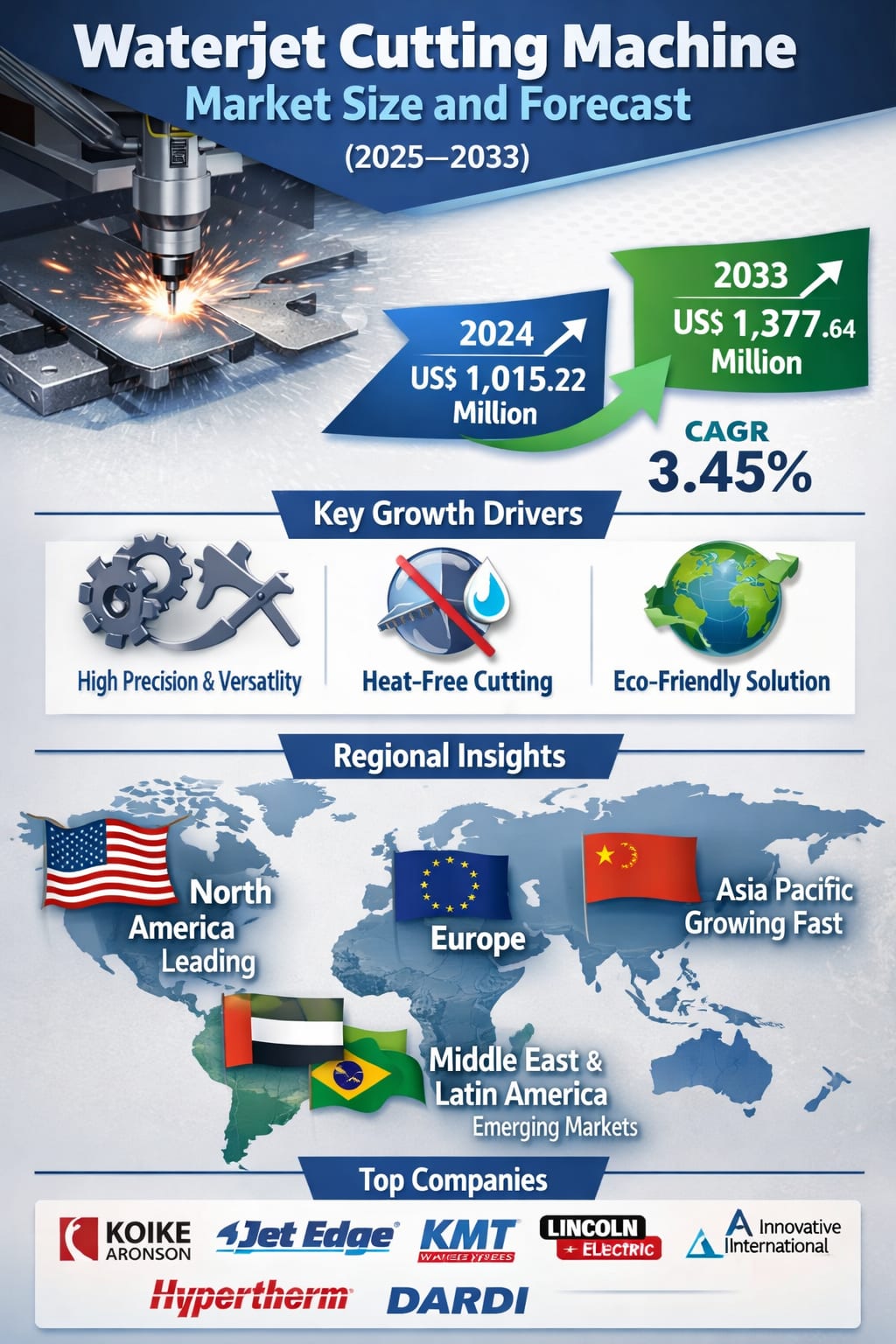
The Waterjet Cutting Machine Market is steadily carving out a stronger position within the global industrial machinery landscape. According to Renub Research, the market is expected to grow from US$ 1,015.22 million in 2024 to US$ 1,377.64 million by 2033, expanding at a CAGR of 3.45% from 2025 to 2033. While this growth may appear moderate compared to some high-tech segments, it reflects a deeper and more structural shift in how industries approach precision cutting, material preservation, and sustainable manufacturing.
Waterjet cutting technology has earned a reputation for doing what many traditional cutting methods struggle with: delivering high-precision cuts without heat. By using ultra-high-pressure water streams—sometimes mixed with abrasives—these machines can slice through metals, glass, composites, ceramics, stone, and even sensitive materials without altering their physical properties. That single advantage has made waterjet cutting indispensable across sectors such as automotive, aerospace, electronics, mining, metal fabrication, and construction.
As manufacturers worldwide push for higher accuracy, cleaner cuts, and more flexible production lines, waterjet cutting machines are increasingly viewed not as niche tools, but as core assets in modern factories.
What Is a Waterjet Cutting Machine?
A waterjet cutting machine (WCM) is an industrial system that cuts and shapes materials using a high-pressure stream of water, sometimes combined with abrasive particles. Unlike laser or plasma cutting, waterjet cutting does not generate heat, which means there is no heat-affected zone, no warping, and no change in the material’s internal structure.
This cold-cutting process is especially valuable when working with heat-sensitive materials such as aluminum, titanium, composites, and certain plastics. The technology also stands out for its material versatility—a single machine can cut metals, glass, stone, rubber, foam, and layered composites with equal effectiveness.
Beyond precision, waterjet cutting offers several operational benefits:
Minimal material waste
High dimensional accuracy
Clean edges that often reduce the need for post-processing
The ability to cut complex shapes and intricate designs
These advantages explain why waterjet machines are now widely used not only in heavy industries like mining and metal fabrication, but also in aerospace components, automotive parts, electronics housings, and even decorative architectural elements.
Key Drivers Fueling Market Growth
1. Rising Demand for Accuracy and Flexibility
Modern manufacturing is no longer about mass production alone—it is increasingly about customization, tight tolerances, and complex geometries. Waterjet cutting machines excel in exactly these areas. They can cut a wide range of materials without requiring specialized tooling for each one, which helps manufacturers reduce setup times and tooling costs.
In industries such as aerospace and automotive, where precision and reliability are non-negotiable, waterjet cutting has become a preferred solution. The ability to switch between materials and designs with minimal reconfiguration gives manufacturers a level of production flexibility that traditional cutting methods often cannot match.
As product designs become more complex and customers demand higher quality finishes, the role of waterjet cutting in ensuring consistent, high-precision output continues to expand.
2. The Advantage of Heat-Free Cutting
One of the most compelling features of waterjet cutting is its non-thermal process. Traditional cutting techniques like laser or plasma generate intense heat, which can lead to warping, micro-cracks, or changes in material properties. For industries working with high-value or heat-sensitive materials, this risk is simply unacceptable.
Waterjet cutting eliminates the heat-affected zone entirely. This means:
The original material properties are preserved
There is less need for secondary finishing processes
The overall quality and reliability of components improve
This makes waterjet cutting especially attractive for sectors such as aerospace, defense, and high-end automotive manufacturing, where even minor material distortions can lead to performance or safety issues.
3. Environmental and Sustainability Considerations
Sustainability is no longer a side conversation in manufacturing—it is a strategic priority. Waterjet cutting aligns well with modern environmental goals because it uses water and natural abrasives rather than chemical coolants or high-energy thermal processes.
Many systems are designed to recycle water and abrasives, reducing waste and lowering the overall environmental footprint. Compared to some traditional methods, waterjet cutting produces fewer harmful emissions and less hazardous waste.
As governments and industries worldwide tighten environmental regulations and adopt greener manufacturing practices, waterjet cutting technology is increasingly seen as a future-ready solution that balances performance with responsibility.
Challenges Facing the Market
High Capital and Operating Costs
Despite its advantages, waterjet cutting is not a low-cost investment. Depending on specifications and capabilities, machines can cost between US$ 100,000 and US$ 350,000 or more. For small and medium-sized enterprises (SMEs), this upfront expense can be a significant barrier.
Operational costs also add up over time. Consumables such as garnet abrasives can cost up to US$ 30 per operating hour, and regular maintenance further increases the total cost of ownership. When compared to alternatives like plasma or laser cutting—often perceived as cheaper to run—waterjet cutting can seem like a premium option.
However, many manufacturers justify the investment by focusing on long-term value, including reduced material waste, fewer rejected parts, and lower post-processing costs.
Maintenance and Downtime Concerns
Waterjet cutting machines rely on components such as intensifiers, seals, and nozzles that operate under extremely high pressure. These parts require regular maintenance to ensure consistent performance. If maintenance schedules are neglected, the risk of breakdowns, unplanned downtime, and costly repairs increases significantly.
For production environments where uptime is critical, this can be a real concern. Companies adopting waterjet technology must invest not only in the machines themselves, but also in preventive maintenance programs and skilled technicians to keep operations running smoothly.
Regional Market Overview
North America: Technology-Driven Leadership
North America currently leads the global waterjet cutting machine market, supported by its advanced manufacturing ecosystem and strong presence in aerospace, automotive, and metal fabrication industries. The United States, in particular, is a major adopter of precision cutting technologies.
American manufacturers are increasingly integrating automation and smart manufacturing systems into their production lines, and waterjet cutting fits well into this trend. The focus is not just on cutting materials, but on optimizing workflows, reducing waste, and improving safety standards.
As industries continue to prioritize precision and efficiency, waterjet cutting is expected to remain a key part of the North American manufacturing landscape.
Europe: Precision Engineering at the Core
Europe’s market is shaped by its strong tradition of precision engineering and advanced manufacturing, especially in countries like Germany, France, and the United Kingdom. Germany, in particular, stands out due to its powerful automotive and industrial machinery sectors.
German manufacturers value waterjet cutting for its ability to handle complex materials and designs without compromising structural integrity. Environmental considerations also play a role, as European industries increasingly seek non-thermal, sustainable cutting solutions.
Trends such as energy-efficient systems, automation, and CAD/CAM integration are shaping the future of the European market, making it both competitive and innovation-driven.
Asia Pacific: Rapid Industrialization and Expansion
The Asia Pacific region is emerging as a major growth engine for the waterjet cutting machine market. Countries like China, Japan, India, and South Korea are witnessing rapid industrialization, infrastructure development, and expansion of manufacturing capacities.
China, in particular, is seeing strong demand from sectors such as electronics, automotive, metal fabrication, and aerospace. The government’s focus on industrial upgrading and high-end manufacturing technologies is further accelerating adoption.
With cost-effective manufacturing, a growing skilled workforce, and increasing investments in advanced machinery, Asia Pacific is expected to narrow the gap with North America and Europe over the coming decade.
Middle East & Africa and Latin America: Gradual but Promising Growth
Regions such as the Middle East & Africa and Latin America are showing steady, if slower, growth. In the United Arab Emirates, for example, investments in infrastructure, oil & gas, aerospace, and advanced manufacturing are driving demand for high-precision cutting solutions.
The UAE’s role as a regional trade and logistics hub also makes it easier to import and distribute advanced machinery, supporting market expansion. Similarly, countries like Brazil and Mexico in Latin America are gradually adopting waterjet cutting as their manufacturing sectors modernize.
Recent Developments in the Industry
The waterjet cutting industry continues to evolve through technological upgrades and strategic partnerships.
In July 2024, WECJet announced the installation of a state-of-the-art Mach 500 waterjet cutting machine following an investment of EUR 350,000. Featuring a 90,000 psi Dynamic head-cutting technology, this system is considered one of the fastest waterjets currently available. With a larger cutting bed and the ability to handle materials up to 300 mm thick, the machine significantly expands production capabilities.
Earlier, in November 2023, TriMech began selling and supporting WAZER, the world’s only desktop CNC waterjet cutter. This move effectively democratized waterjet cutting, bringing a technology once limited to large industrial setups into smaller workshops and prototyping environments. The WAZER system supports a wide range of materials, including carbon fiber, glass, steel, aluminum, and plastics, making it ideal for rapid prototyping and low-volume production.
Market Segmentation Snapshot
By Type:
Pure Waterjet
Abrasive Waterjet
By Product Type:
3D Waterjet Cutting
Micro Waterjet Cutting
Robotic Waterjet Cutting
By Horsepower:
0 to 50 HP
51 to 100 HP
Others
By Machine Size:
Small
Medium
Large
By Application:
Automotive
Electronics
Aerospace and Defense
Mining
Metal Fabrication
Others
Competitive Landscape
The global waterjet cutting machine market features a mix of established industrial giants and specialized technology providers. Key players include:
Koike Aronson Inc.
A. Innovative International Limited
Jet Edge Inc.
Colfax Corporation
KMT GmbH
Lincoln Electric Holdings Inc.
Jekran Ltd.
Hypertherm Inc.
Dardi International Corporation
These companies compete on technology innovation, machine reliability, after-sales service, and global distribution networks. Continuous R&D investments and product upgrades remain central to maintaining a competitive edge in this precision-driven market.
Final Thoughts: Precision as a Long-Term Investment
The Waterjet Cutting Machine Market, projected to reach US$ 1,377.64 million by 2033, reflects more than just steady financial growth—it signals a strategic shift in global manufacturing priorities. Precision, material integrity, sustainability, and flexibility are no longer optional features; they are essential requirements in modern production environments.
While challenges such as high initial costs and maintenance demands remain, the long-term benefits of waterjet cutting—superior quality, reduced waste, and unmatched versatility—continue to attract manufacturers across industries. As automation, smart manufacturing, and sustainable practices gain momentum worldwide, waterjet cutting machines are well-positioned to remain a cornerstone technology in the factories of the future.



Comments
There are no comments for this story
Be the first to respond and start the conversation.