
Tinkertown's Carnival World:
Eccentric Vision of Ross Ward (1940-2002)
By Brian D'Ambrosio
Tucked into the ponderosa pines of the Sandia Mountains east of Albuquerque, New Mexico, Tinkertown Museum is a hand-built labyrinth of imagination, humor, and eccentricity. More than a roadside attraction, it is a folk-art environment—part carnival, part curiosity cabinet, and part autobiography—created by one man with an inexhaustible drive to turn ordinary junk into wonder. That man was Ross J. Ward, a carnival painter, sculptor, and tinkerer whose restless creativity produced one of the most enchantingly eccentric places in America.
The Carnival Never Ended
Walking into Tinkertown feels like stepping into a toy chest that someone forgot to close. Its twisting halls and glass-bottle walls enclose more than two decades of Ward’s handiwork: whirring dioramas, mechanical sideshows, miniature Old West towns, and quirky treasures rescued from yard sales and forgotten barns. More than fifty thousand glass bottles form the walls, each one cemented by hand, shimmering with desert light.
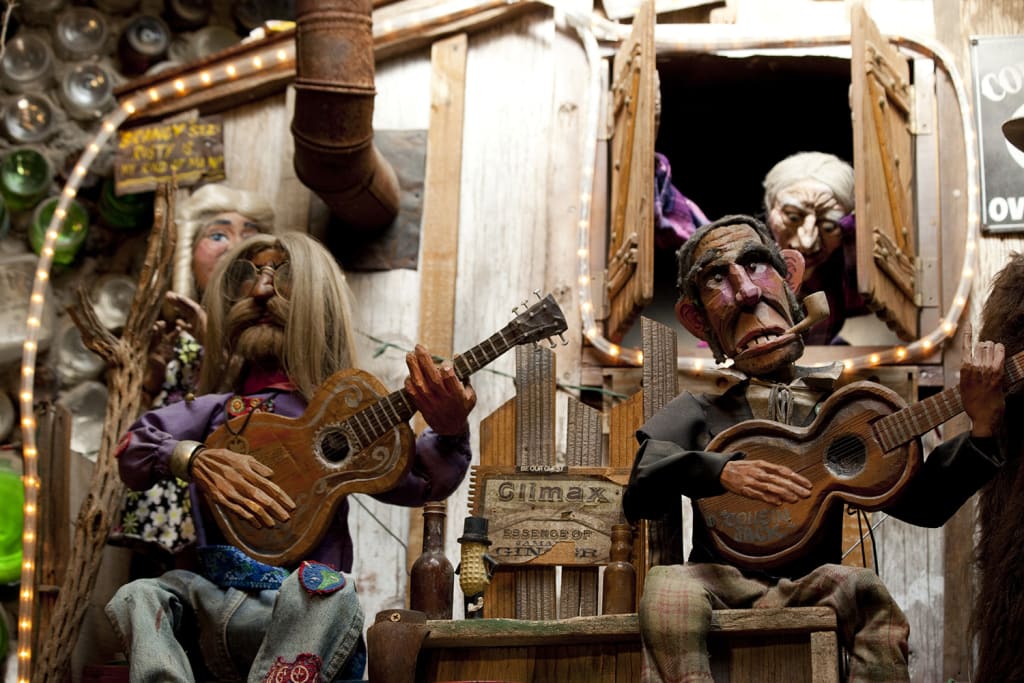
At the entrance stands Esmeralda the Fortune Teller, a coin-operated oracle who dispenses prophecies with a tinny mechanical flourish. Nearby, Otto the One-Man-Band clanks into motion, his limbs and instruments rattling in rhythm. Around the next bend lies Ward’s greatest creation—a sprawling miniature frontier town first begun in 1962. Within it, hundreds of hand-carved figures go about their tiny lives: blacksmiths hammer, gamblers play cards, and saloon doors swing as though moved by invisible wind.
Each quarter dropped into a slot awakens another corner of Ward’s imagination. One moment, a circus erupts under a hand-painted big top, complete with jugglers and trapeze artists; the next, a skeletal mariachi band performs beside a devil-and-angel duel. The museum’s narrow corridors are crammed with thousands of small oddities—wedding-cake toppers, bottle caps, wagon wheels, antique tools, and chipped figurines—every one of them a relic of someone’s former life given new purpose.
Even among this tiny menagerie stands one giant outlier: Theodora R., a full-sized sailboat that once circumnavigated the globe before coming to rest among Tinkertown’s dioramas. The vessel seems to belong here, like another improbable chapter in Ward’s lifelong voyage through whimsy.
The Man Behind the Miniatures
Ross Ward was born in 1940 in Aberdeen, South Dakota, and even as a boy he was drawn to the tactile magic of making things. While other children played ball, he built tiny towns, carved figures, and painted sideshow banners. His early fascination with the Old West and traveling carnivals carried into adulthood. In the 1960s and 1970s, he worked as a carnival show painter, crafting the vibrant banners and backdrops that promised thrills to midway crowds.
Between shows, Ward tinkered endlessly, creating small carved scenes he would haul from fair to fair. Eventually, after settling in the Sandia foothills, he began to imagine a permanent home for his whimsical world. What started as a few rooms behind his house grew organically into the 22-room wonderland now known as Tinkertown. Every beam, bottle, and brick bears evidence of Ward’s labor. A sign inside reads, with impish humor, “I did all this while you were watching TV.”
Ward’s art reflected his playful defiance of convention. He saw beauty in castoffs, rhythm in rust, and imagination in imperfection. The result was not a polished gallery but a living artwork that celebrated the handmade and the humble. His motto seemed to be: if it’s broken, decorate it; if it’s useless, give it character.
The Mind That Wouldn’t Quit
In 1998, at the age of fifty-seven, Ward was diagnosed with Alzheimer’s disease. For a man whose life revolved around intricate detail and constant invention, the diagnosis was devastating. Yet, true to form, he continued creating as long as he could—decorating his Jeep with coins, trinkets, and bottle caps, transforming even the vehicle that carried him to doctor’s appointments into a rolling sculpture.
Ward passed away in 2002, but his spirit saturates every creak and flicker of Tinkertown. After his death, his wife, Carla Ward, became the museum’s caretaker and storyteller, preserving his legacy with love and tenacity. She has described the museum not as a memorial but as “a place that’s still alive,” where visitors participate in the same sense of discovery that animated Ross’s imagination.
The Art of Eccentricity
To walk through Tinkertown is to glimpse the peculiar alchemy of one man’s mind. Ward’s creations blend humor and melancholy, nostalgia and absurdity. His miniatures are playful, yet they possess a haunting quality—as if they remember the transient world of carnivals and sideshows from which he came. There’s a sense that every figure and artifact, no matter how small, carries its own story and spirit.
Unlike many folk-art environments, Tinkertown does not aspire to tidy moral lessons or grand statements. It invites laughter, confusion, even disbelief. It is an argument for eccentricity as a virtue—a living example of how obsession can evolve into art, and how art can redeem the discarded.
In the words that once hung at its entrance, “We did all this while you were watching TV,” Ward left behind not only a testament to industrious creativity but a gentle challenge to the rest of us: to look closer, to build, to tinker, to turn the forgotten into the extraordinary.
The eccentric characters of Tinkertown—Esmeralda, Otto, the circus troupe, the skeletal band—are mirrors of their maker: quirky, tireless, and animated by curiosity. Even decades after his passing, they continue to move, sing, and grin in perpetual motion, proving that Ross Ward’s whimsical world is far from silent.
To visit Tinkertown is to wander through someone else’s dream—one made of glass, dust, and laughter—and to be reminded that the line between madness and genius, between junk and joy, is thinner than we think.
Brian D’Ambrosio is the author of New Mexico Eccentrics.
About the Creator
Brian D'Ambrosio
Brian D'Ambrosio is a seasoned journalist and poet, writing for numerous publications, including for a trove of music publications. He is intently at work on a number of future books. He may be reached at [email protected]
Keep reading
More stories from Brian D'Ambrosio and writers in Wander and other communities.
Chocolate Maker Steve Prickett
By Brian D’Ambrosio Steve Prickett, owner and founder of Eldora Chocolate in Albuquerque, is among a small group of culinary artists escalating the prestige of craft chocolate and the integrity with which it is made. A chocolate maker, as opposed to a chocolatier, Prickett purchases unrefinedcacao beans and then processes, roasts, treats, and mills them into chocolate. Most people who work with chocolate do not start directly from the cacao bean in the way that he does.
By Brian D'Ambrosio about a year ago in Wander
Seattle Nightlife Report: Pony
Mid-winter Friday night. Early but already so dark. The days are getting longer but 6 PM is still pitch black. “Firepit!” You declare things after just a few seconds of solemn thought – not a request or suggestion, not a demand. Last week you walked around saying, “Hot tub?” to anyone who would listen. Or one afternoon you pointed at two men holding hands as they crossed 12th Avenue, looked me in the eyes and said, “Boyfriends.”
By Joe Nasta | Seattle foodie poet29 days ago in Wander
10 Countries You Probably Didn’t Know Existed (But Absolutely Should!)
We all dream about visiting iconic destinations like France, Italy, or tropical paradises like Hawaii and Bali. But what if I told you there are countries and territories most people have never even heard of?
By Areeba Umair4 days ago in Wander


Comments
There are no comments for this story
Be the first to respond and start the conversation.