
A Mystery of Nature and Belief
The Thunder Tree: Between Science and Belief

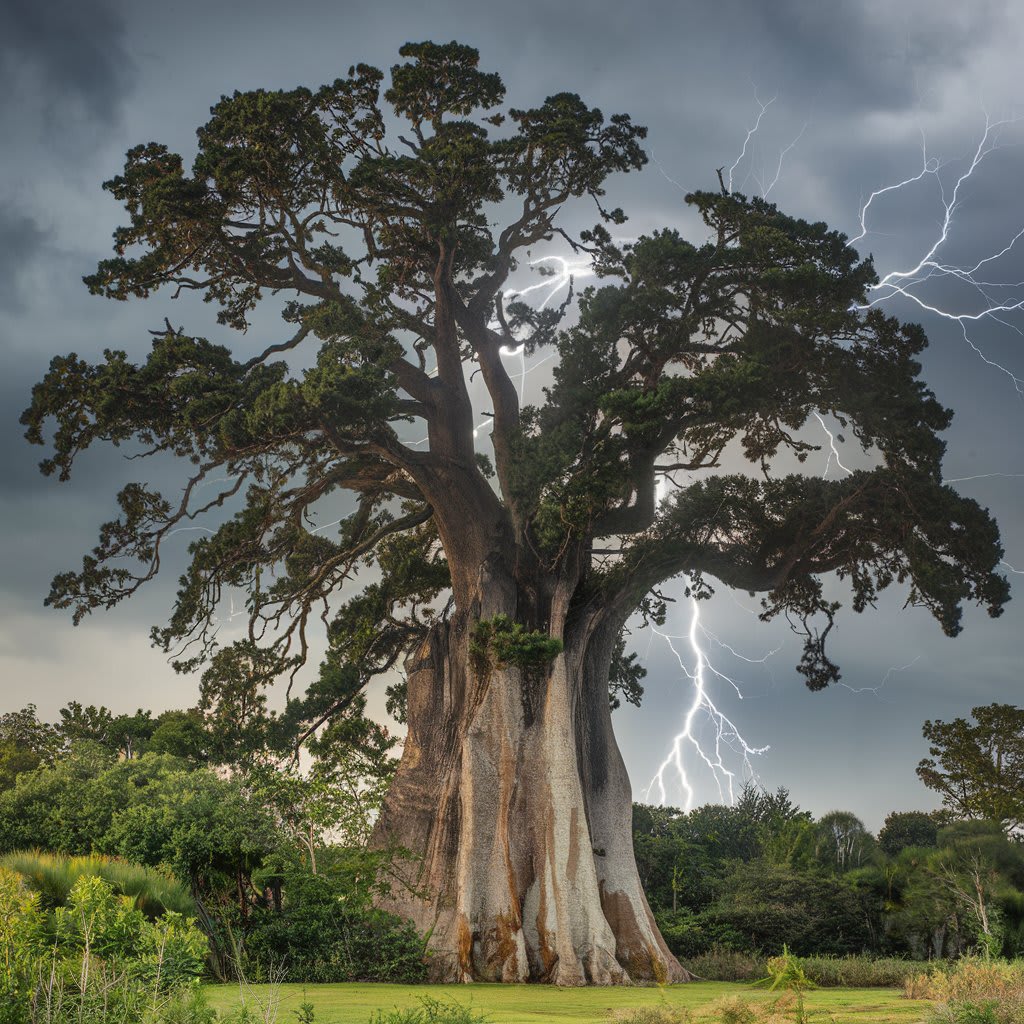
It was a bright blue morning, but the sky held a strange mystery deep within. At the edge of the village stood an ancient, massive tree from the Moraceae family. Its branches, leaves, and roots seemed to whisper a tale different from any other tree. The tree had no known name, for around it swirled countless stories of curiosity and fear, passed from one villager to another.
An astonishing phenomenon surrounded this tree: on a specific day during each monsoon season, lightning would strike it—but, strangely enough, the lightning never harmed the tree or anything nearby. Instead, the tree seemed to glow with an unfulfilled energy, as if it absorbed the power of the strike.
I am Rahim, a young scientist driven by curiosity. For a long time, I was eager to uncover the truth behind this mystery. My days in the city, lost in the silence of science and technology, often left me with lingering questions—why was this particular tree always the target of lightning? What secret lay hidden in its unmatched resilience?
The village was small, but its people held beliefs older than modern science. The village elders would say, "This tree was born by the grace of the Creator. The lightning comes to it as a divine command—an unresolved mystery, a reflection of the Creator’s will." Others believed, "Natural phenomena like lightning force us to think about the depths of our existence and confidence in life."
One day, I decided to see this mystery with my own eyes—both from a scientific and an unexplained perspective. After attending a recent scientific conference in the city, I was convinced that there was a link between the tree’s characteristics and the natural causes of lightning. As the monsoon season approached, I set out for the village.
Walking through the village, I was greeted by the scent of damp earth, the laughter and tears of its people, and the sight of farmers preparing their fields for the jolly Aman rice crops. It was as if reality and imagination were connected by an invisible bridge.
Finally, I reached the tree. This unknown tree carried a thousand years of history, its sturdy roots and sprawling branches appearing to tremble with time. Surrounding it were smaller plants and cultivated land, yet this one tree seemed to hold nature’s special attention.
Observing the tree closely, I noticed a shimmering airflow around its bark, and tiny crystalline droplets falling from its leaves—an unusual trait. I opened my laptop and searched for scientific data. According to my research, lightning occurs due to electrical discharge between clouds and the ground. But why did this tree become the target every time, and why was it never harmed?
Nearby, an old village teacher, Master Babu, sat down beside me. His face held a touch of mystery, his eyes filled with deep, silent memories. He said, "Son, this tree won’t match any formula in your science books. Every branch, every leaf carries an old story—a divine sign. Nature’s rules are strict, but here, it seems as if nature itself has taken a pause."
His words surprised me, but deep within, I had a question—could science truly answer all mysteries? I knew modern scientific explanations might link this to the tree’s chemical composition, its biological properties, or the arrangement of its deep-rooted structure. Some researchers suggest, "The tree’s sap increases its electrical conductivity, allowing the lightning’s energy to dissipate quickly." But can such explanations capture the essence of faith, fear, and wonder that surrounded this phenomenon?
As days passed, the sky began to darken one evening. The air grew dense, as if nature was making a solemn decision. I set up my scientific instruments near the tree, balancing between data on my laptop and the village’s folklore. My mind was torn—one side drawn to the sharp light of logic, the other to the deep shadows of belief.
As night fell, a sudden flash of lightning tore across the sky. The atmosphere froze in awe and fear. Right before my eyes, a blazing light struck the unknown tree—yet, astonishingly, the tree bore no signs of damage. Instead, it shone brighter, its roots seemingly embedding deeper into the earth, tracing patterns of mystery.
I quickly examined my instruments to analyze the effects of the strike. Scientifically, the tree’s structure possessed properties that dispersed electrical flow evenly. Its wide-reaching root system, high water-retention capacity in its leaves, and unique chemical composition all worked together to neutralize the intense power of the lightning. Scientific principles stated, "The tree acts like a natural electrical conductor, dissipating the energy harmlessly."
Yet, my research also raised unresolved questions. Even if science could explain the mechanics, why did nature choose this specific day? Why only this tree, while everything else around it remained untouched? Was it merely a coincidence, or was there something more—something beyond equations and theories?
The next day, I sat at the village tea stall, discussing with both young and elderly villagers. Their words carried a mix of belief and ancient memories.
One said, "This tree is a divine blessing to our ancestors. When lightning touches it, it shields us from harm and brings new hope."
Another added, "Perhaps nature itself sends us warnings from time to time. Maybe this tree is a messenger of such signals."
For some, this was not just a natural event—it was a manifestation of a higher power, reminding us of the wonders of nature and the insignificance of human life in its vastness.
Science would say, "Ionized particles in the ionosphere reduce electrical intensity."
The villagers believed, "This is a blessing from the Creator, protecting us."
That day remained etched in my memory, an unsolved chapter of life. A question lingered—"What if science cannot explain everything?" When I looked deeper, I realized that many of life’s questions remain unanswered—nature, human existence, faith, and doubt all blending into an infinite mystery.
That night, sitting on the rooftop, I gazed at the sky and wondered, "Is lightning merely a scientific occurrence, or does it carry a spiritual message that stirs the human soul?" Science could describe how a tree withstands lightning, how its roots absorb the charge—but could it capture the silent awe, the deep faith, the unspoken wonder?
Some mysteries lie beyond human intellect. When I stood beneath that tree, I felt as if my own unanswered questions merged into its shadow. Perhaps, behind nature’s transformations and the recurring lightning strikes, there was more than just scientific principles. Maybe, woven into these events were human hope, fear, belief, and wonder.
The next morning, I returned to the tree with my scientific notes and the villagers' words echoing in my mind. I saw delicate water droplets forming patterns on its leaves, like soft traces of electricity. Science told me, "This beauty is an expression of natural conductivity." The villagers would say, "It is the Creator’s mercy, protecting us."
One day, Jashim, a young scientist from the village, joined me in my research. Together, we conducted experiments—testing electrical conductivity, analyzing the tree’s chemical makeup, and studying its root structure. The results confirmed that the tree’s sap and wood formed a natural conductive system that absorbed and dispersed lightning energy. Science concluded, "This tree naturally resists lightning damage by distributing the charge."
But deep down, I felt an uncertainty. I asked Jashim, "Do you think this explanation can truly answer the deeper questions of belief and wonder?" He smiled and replied, "Science explains causes and processes, but it may never fully grasp the mysteries of the human heart."
His words stirred a gentle conflict within me—on one side was science, which sought to define every phenomenon; on the other was human belief, which led us to explore life’s deeper meanings, beyond formulas and facts.
For centuries, the tension between science and spirituality has persisted. Perhaps one day we will uncover the full truth of nature’s mysteries—or perhaps, some secrets are meant to remain, bound by time and faith.
Even today, when dark clouds gather, lightning flashes over that unknown tree, sending shivers through the villagers. Some see it as divine mercy, others as a natural rule. But deep inside, I hold a strange conflict—can science truly answer everything, or will some mysteries forever remain part of nature’s untamed power?
As I pass by that tree, I feel that every event—scientific or spiritual—is part of a vast, endless poem. Our task is to read its verses, seek its meaning, and pursue the unanswered questions that may never fully reveal themselves.
Thus, the Thunder Tree was not just a scientific anomaly, but a symbol of human belief, fear, curiosity, and life’s profound contradictions—a bridge between science and faith, shaping our understanding of the world and our place within it.
About the Creator
Md. Iqbal Hasan
Md. Iqbal Hasan. A passionate writer exploring diverse topics. Simplifies complex ideas with engaging narratives. His work is thought-provoking, informative, and always invites readers to think deeper.
Keep reading
More stories from Md. Iqbal Hasan and writers in Writers and other communities.
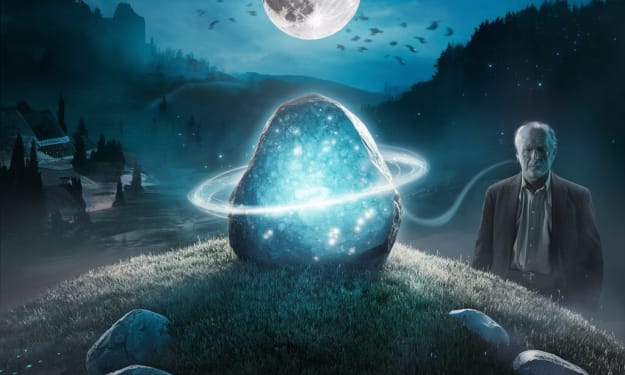
The Moonstone: A Cosmic Enigma Beyond Time
The night was calm, the sky painted in deep shades of blue, illuminated by the full moon’s silver glow. At the highest peak of the village, far away from modern civilization, lay an ancient stone—one that had baffled people for centuries. The villagers called it "The Moonstone," for on every full moon night, it radiated a strange, ethereal glow. Some believed it was a fragment of the moon itself, while others whispered tales of divine power hidden within.
By Md. Iqbal Hasan12 months ago in Writers
When Amazon Says You’re a Disappointment
Yesterday, for the first Wednesday in months, I didn’t publish a piece on Vocal. Believe me, I wanted to. I had it all written up and ready to go. I was going to share the news that I had officially become a published author.
By Sandy Gillmana day ago in Writers
How to Empower Your Writing
“The morning pages will teach you to stop judging and just let yourself write. So what if you’re tired, crabby, distracted, stressed? Your artist is a child, and it needs to be fed. Morning pages feed your artist child. So write your morning pages.” ― Julia Cameron
By Chantal Christie Weiss7 days ago in Writers
I Don't Need My Phone... Wait, Is That Actually True?
My parents gave me my first cell phone when I was twelve years old. It wasn't a fancy iPhone or anything, not even close. Just a simple black flip phone for when I needed to call or text them after school.
By Madison "Maddy" Newton7 days ago in Humans


Comments
There are no comments for this story
Be the first to respond and start the conversation.