
How to Choose the Right AI SEO team for Your Business?
My personal guide for separating real AI-driven SEO capability from automation noise, and choosing partners that improve visibility, and revenue.

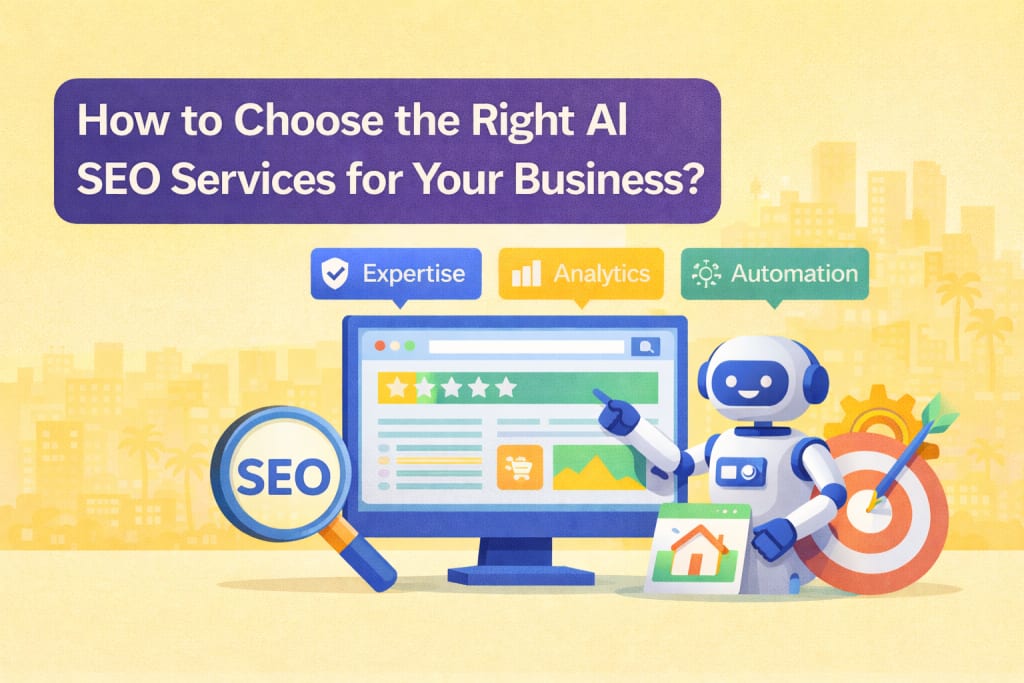
The first pitch usually sounds convincing. Charts showing traffic curves. Screenshots of dashboards filled with scores and predictions. Promises of faster rankings driven by automation. For many businesses, this is where confusion begins. AI has entered SEO quietly and then all at once, and the line between genuine capability and surface-level tooling has become hard to see.
Choosing the right partner now requires a different mindset. This is no longer about who can publish more content or pull more keywords. It is about who understands how search behavior, machine learning systems, and business outcomes intersect in a world where algorithms adapt faster than static strategies.
This article explains how to evaluate that difference clearly, without hype, and without betting your organic growth on tools alone.
Why AI has fundamentally changed SEO decision-making
Search engines no longer operate on fixed rules. Ranking systems learn, adjust, and re-weight signals continuously. User intent is inferred, not declared. Context matters more than exact phrasing. As a result, SEO has moved away from manual optimization and toward pattern recognition at scale.
According to Statista, the global AI software market continues to grow at a strong double-digit rate year over year, with marketing and analytics among the largest application segments. That growth reflects adoption, but it also reflects rising expectations. Businesses assume AI will make SEO easier. In reality, it makes poor decisions more expensive.
AI accelerates whatever strategy it is attached to. If the strategy is weak, automation magnifies the damage.
The first mistake businesses make when evaluating AI-driven SEO
Most companies start by asking what tools a provider uses. That question is understandable, but incomplete.
Tools do not create advantage on their own. Every serious SEO team now has access to similar models, APIs, and automation layers. The difference lies in how those tools are governed, interpreted, and corrected when they drift.
McKinsey research on AI adoption across business functions shows that companies extracting the most value from AI combine automation with strong human oversight and clear decision frameworks. SEO follows the same pattern. AI identifies signals. Humans decide which signals matter.
If a provider cannot explain where human judgment intervenes, you are not buying intelligence. You are buying speed without control.
What “AI-powered” SEO actually means in practice
Real AI-driven SEO operates across three layers.
First, pattern discovery. Models analyze large volumes of search behavior, content performance, and competitive movement to surface opportunities humans would miss.
Second, prioritization. Not every opportunity is worth pursuing. Strong providers use AI to score impact against business goals, not vanity metrics.
Third, adaptation. Search systems change. AI helps detect early shifts in rankings, intent clusters, or content decay so strategies can adjust before performance drops.
Many vendors stop at the first layer. That is where dashboards look impressive. Growth, however, happens in the second and third layers.
Statistics that should shape your evaluation criteria
Several data points help frame what matters.
Industry studies show that organic search remains one of the highest ROI digital channels over time, but also one of the slowest to recover from strategic mistakes. That makes risk management critical.
Research from BrightEdge has consistently shown that a majority of web traffic for many industries still originates from organic search, underscoring its long-term value compared to paid channels.
Separately, surveys of marketing leaders indicate that while AI adoption is widespread, fewer than half believe their teams are using it effectively. The gap is not access. It is execution discipline.
These numbers point to the same conclusion. The upside is real. So is the downside.
The questions that reveal whether an AI SEO provider understands your business
How do you define success beyond rankings?
Rankings fluctuate. Revenue and qualified demand matter more. A capable provider ties AI insights to conversion paths, not just visibility.
How do you prevent model drift and outdated assumptions?
Search behavior changes. Content ages. Providers should have processes for retraining, validation, and human review.
How do you handle false positives?
AI surfaces patterns, not truth. Ask how insights are verified before execution.
How does this integrate with our existing data?
SEO does not live in isolation. The best outcomes come when search data informs product, content, and sales decisions.
If answers stay at a tool level, strategic depth is missing.
Why content volume is no longer the primary growth lever
For years, scale meant publishing more. AI makes scale cheap, which changes its value.
Search engines now evaluate usefulness, depth, and satisfaction signals more heavily. Flooding the index with similar content can dilute authority rather than build it.
A Forrester analysis on search and content strategy noted that brands focusing on fewer, higher-quality assets supported by continuous optimization outperform those relying on volume alone.
AI helps identify where depth is missing, where intent is misunderstood, and where consolidation improves performance. That requires restraint as much as output.
Expert perspectives that clarify the shift
“AI changes the speed of insight, not the responsibility for judgment,” said Jim Yu, founder of BrightEdge, in discussions around AI and enterprise SEO. His point reflects a broader industry reality. Automation without accountability creates volatility.
From another angle, Lily Ray, a respected SEO strategist, has emphasized publicly that search engines reward trust signals that cannot be automated easily, such as demonstrated expertise, consistent quality, and real user value. AI can support these goals, but it cannot fake them sustainably.
These views converge on one idea. AI is a multiplier, not a shortcut.
Common failure patterns when businesses choose poorly
One pattern appears repeatedly.
A company hires a provider promising rapid gains through automation. Content output increases. Initial metrics look positive. Then rankings stagnate or decline. Cleanup takes longer than progress ever did.
This happens because AI was used to execute faster, not to think better.
Another failure pattern is over-reliance on predictive scores without understanding their assumptions. When the model is wrong, no one notices until performance drops.
Strong providers expect these risks and design around them.
How to evaluate transparency and accountability
Ask for clarity on three areas.
- Decision logic. How are recommendations generated and approved?
- Feedback loops. How does performance data refine future actions?
- Failure handling. What happens when predictions miss the mark?
Providers confident in their process welcome these questions. Those selling mystery boxes avoid them.
The role of AI in long-term business growth
Used correctly, AI-driven SEO improves focus. It helps businesses invest where impact compounds and pull back where effort is wasted.
It also improves resilience. When algorithms shift, early signals surface sooner. When competitors move, patterns emerge faster. When content decays, intervention happens before revenue drops.
This is how AI SEO services support growth in mature organizations. Quietly. Continuously. With discipline.
Closing thought
Choosing the right SEO partner in the age of AI is not about finding the smartest model. It is about finding the clearest thinking.
AI will continue to evolve. Search systems will continue to change. The businesses that win will be those that combine automation with judgment, speed with restraint, and insight with accountability.
That is the standard you should hold when selecting AI optimization team, because in a system that learns constantly, strategy is the only thing that does not scale automatically.
About the Creator
Jane Smith
Jane Smith is a content writer and strategist with 10+ years of experience in tech, lifestyle, and business. She specializes in digital marketing, SEO, HubSpot, Salesforce, web development, and marketing automation.
Keep reading
More stories from Jane Smith and writers in Writers and other communities.
Preservation for Eternal Impact
It is easy to feel as though most of what is said disappears. Words are spoken, written, posted, argued over, and then quickly buried beneath the next wave of noise. Attention moves on. Platforms refresh. What once felt urgent becomes invisible. In that environment, a quiet but persistent question emerges. What actually lasts. And more uncomfortably, what is worth preserving when so much seems to vanish without consequence.
By Peter Thwing - Host of the FST Podcast5 days ago in Writers



Comments
There are no comments for this story
Be the first to respond and start the conversation.