
Ugly Drafts
Why the Messy Version of Your Work Is the Only One That Tells the Truth

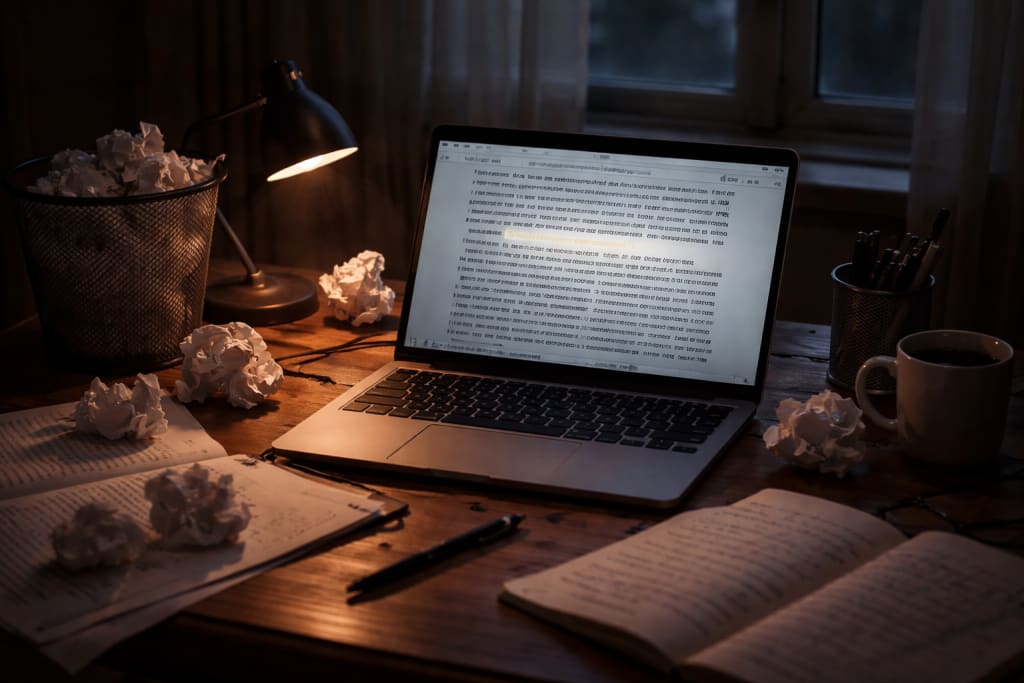
The first version was ugly.
Not charming-ugly. Not raw but promising.
Just ugly.
The sentences tripped over themselves. The opening didn’t know where it was going. The ending arrived too early, like a guest who misunderstood the invitation. I stared at the screen the way you look at a mirror under bad lighting—too honest, too exposed, impossible to ignore.
I almost deleted it.
That’s usually where the story ends for most people. The delete key. The quiet relief of erasing proof that you tried and didn’t impress yourself. We’re taught to curate, to polish, to only show the world what looks intentional. Drafts aren’t meant to be seen. Drafts are mistakes wearing your voice.
So I told myself the lie I’ve used a hundred times before: I’ll come back to it when it’s better.
But better never comes first.
The second version was ugly too.
Different ugly, but still unmistakable.
This time the words were clearer, sharper even—but they were scared. I could feel it. Every sentence hedged its bets. Every paragraph tried to sound like something I’d already read somewhere else. It was technically improved and emotionally hollow, like a perfectly framed photo of a place you never actually visited.
That one hurt more.
Because when the first draft fails, you can blame ignorance. When the second fails, you have to confront intention. You tried. You knew better. And still, it wasn’t right.
I leaned back, rubbing my eyes, wondering why I kept doing this to myself. Why sit alone in a room arguing with blank space? Why fight something that doesn’t fight back? Nobody was waiting for these words. No one had demanded them. The world would continue just fine without my small attempt at meaning.
That’s when I noticed something strange.
Buried beneath the clumsy phrasing and uneven rhythm, there were moments that felt… real. A line that didn’t flinch. A sentence that didn’t apologize for existing. They were easy to miss, like wildflowers growing through cracks in concrete, but once seen, they couldn’t be unseen.
Honesty lived there.
Not the polished kind. Not the version that performs well in bios or captions. This was inconvenient honesty—the kind that doesn’t ask if it’s welcome before showing up. The kind that admits confusion. That leaves questions unanswered. That doesn’t rush to sound wise.
I realized something uncomfortable then:
The ugliness wasn’t a flaw. It was evidence.
Evidence that I wasn’t copying a template. Evidence that I hadn’t sanded down every edge to make the work harmless. Evidence that I was still inside the writing instead of hovering safely above it.
Perfection never tells the truth first.
Honesty does—awkwardly, messily, without guarantees.
So I kept going.
I wrote versions no one will ever read. Paragraphs that contradicted themselves. Metaphors that collapsed under scrutiny. Pages that existed only to teach me what I didn’t mean. Some nights I closed the laptop convinced I’d wasted my time. Other nights I caught a glimpse of something truer than clarity—a sense that I was circling the right idea, even if I hadn’t landed yet.
Slowly, almost without permission, the drafts got quieter. Not prettier. Quieter. Less eager to impress. Less afraid of being misunderstood. The writing stopped reaching for applause and started reaching inward instead.
And that’s when it clicked.
The goal was never to write something beautiful.
The goal was to write something honest enough to survive being seen.
Ugly drafts are where that honesty hides. They’re the only place you’re not performing yet. The only place where you don’t know the ending, so you can’t fake the journey. They’re uncomfortable because they haven’t learned how to lie for approval.
Most people quit there.
Not because they lack talent—but because they mistake discomfort for failure.
But honesty lived there.
And that mattered.
It mattered more than elegance. More than timing. More than the fantasy of getting it right the first time. Because honesty is the one thing that can’t be added later. You can edit structure. You can refine language. You can cut and rearrange and polish until it shines.
But if the truth isn’t present at the start, no amount of revision will summon it.
So now, when a draft looks ugly, I don’t flinch.
I lean in.
Because I’ve learned that ugliness is often the sound of something real trying to take shape. And real, given enough patience, eventually learns how to speak.
About the Creator
LUNA EDITH
Writer, storyteller, and lifelong learner. I share thoughts on life, creativity, and everything in between. Here to connect, inspire, and grow — one story at a time.
Keep reading
More stories from LUNA EDITH and writers in Writers and other communities.
Should We Not Try to Get Too Political?
Here's something you often hear people say, "I try not to get too political." I understand the sentiment and I sympathize with it... while at the same exact time, I completely disagree with the notion. Whether it's referring to social media or wherever, it's kind of unavoidable. You can attempt to sidestep it, not engage, leave the less important things for actual politicians to discuss... you can want it to not take over your life, your conversations, your relationships, and that makes perfect sense.
By Stephen Kramer Avitabileabout 10 hours ago in Writers
One Story Below Is True
Anne Bernays and Pamela Painter — What If? Writing Exercise for Fiction Writers prompts The Exercise — In two or three sentences, write down three unusual, startling, or amusing things you did or that happened to you. One thing must be true; the other two must be lies. Use details. Read them to a group, and they may ask questions to help them guess which one is and which ones are not. The Objective - To understand how we can exaggerate events in our lives, appropriate the lives of others - friends, enemies, strangers - or just plain out and out lie. All these are ways of using what we see and experience to produce fiction.
By Denise E Lindquista day ago in Writers
A Letter to the Firestarter
Dear Firestarter, We can all see you, we've been watching you since you began. In case you didn't know we were here before you and we will be here after. We witnessed your rise, your setbacks, your guilt and your lies. We witnessed you start the fire.
By Donny Foley6 days ago in Poets


Comments
There are no comments for this story
Be the first to respond and start the conversation.