
Why You Hate Your Draft While You're Still Writing It
And what I do to stop myself from giving up.

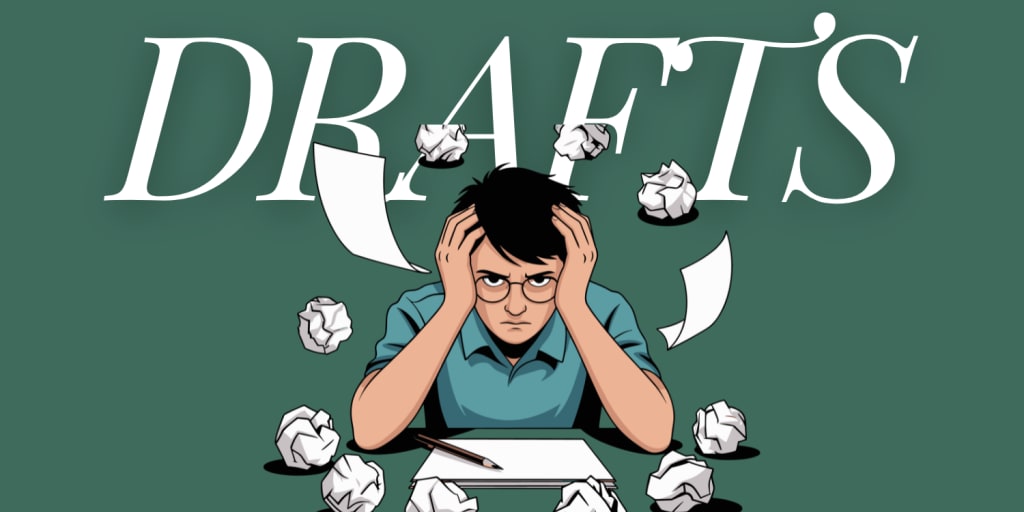
I deleted 800 words from my new novel yesterday.
I didn't go on a deletion spree because they were unsalvageable. And it wasn't because I'd taken the wrong approach.
I deleted them because I was convinced, in the moment of writing them, that they were the worst sentences ever committed to a Google Doc.
I gave myself a big, fat, writing "F".
Today, I wish I had those 800 words back. They probably weren't that bad. But I'll never know because I murdered them in a fit of mid-draft self-loathing that felt completely justified at the time.
If you've ever sat in front of your screen thinking "this is garbage" while you're still actively writing the thing you think is garbage (but not so garbage because you decided to write it in the first place), you know exactly what I'm talking about.
It's a special kind of creative hell; the words are flowing, but so is your certainty that they're all worthless and that you're wasting your time.
Here's what nobody tells you: hating your draft while you're writing it isn't a sign that the draft is bad. It's a sign that you're a writer.
The Gap Between Taste And Ability
Ira Glass (he's a podcaster and radio veteran known for the best storytelling) said something that haunts every creative person who's ever heard it: we get into creative work because we have good taste, but there's a gap between our taste and our current ability. We know what good writing looks like. We can identify it when we see it. We just can't produce it yet.
That gap he's talking about? It's where the self-hatred lives.
When you're writing a first draft, you're simultaneously creating and judging. Your brain is trying to generate ideas while also measuring them against every brilliant thing you've ever read.
It's like trying to paint while an art critic stands behind you, pointing out every brushstroke that isn't perfect.
No wonder you hate it. That's my idea of creative hell.
The real problem isn't that your draft is bad. The problem is that you're expecting your rough draft to compete with someone else's published, edited, and polished final version.
(And even when your logical mind says, "I'm not doing that, it's silly!", there is a part of every writer who does this…)
You're comparing your behind-the-scenes to everyone else's highlight reel, and you're doing it in real-time while the work is still half-complete.
Your Brain Is Lying to You
When I self-published my book (the one that absolutely flopped), I rewrote the first chapter eleven times. Each time, I was convinced the previous version was unreadable trash.
Each rewrite felt urgent, necessary, like I was fixing something fundamentally broken.
Looking back at those eleven versions now? They're basically the same chapter with different sentence structures. The first version wasn't broken. I just couldn't see it clearly because I was too close to it.
What I've discovered is that mid-draft hatred is your brain's way of protecting you from putting something imperfect into the world. It's a defense mechanism, a way of avoiding pain and failure, and not an accurate assessment.
The voice that says "this sucks" isn't your editor. It's your fear.
And fear is a terrible judge of writing quality.
The Myth Of The Effortless First Draft
We've all seen those writers on social media who casually mention writing 3,000 words in a sitting and who talk about their creative process like it's a gentle flow state where brilliant prose just appears.
They're lying. Or at least seriously editing the story they're telling. Or if that's their geniune experience, they're unicorns.
Nobody's first draft is good. Hemingway's wasn't. Toni Morrison's wasn't. That person whose newsletter you love and envy? Their first draft wasn't good either. (I am guessing here, but come on, of course they were bad!)
The difference is they didn't let their bad first drafts stop them from finishing.
The writers who succeed aren't the ones who write perfect first drafts. They're the ones who write terrible first drafts and keep going anyway. They've made peace with the fact that creating anything worthwhile requires first creating something mediocre.
You're not supposed to love your draft while you're writing it. You're supposed to finish it despite not loving it.
The Two-Brain Problem
Here's what's actually happening when you hate your draft mid-writing: you're trying to use two completely different parts of your brain at the same time.
The creative brain generates ideas, follows tangents, makes connections and plays with language. It's messy and associative and doesn't care about structure or polish.
The editorial brain organizes, refines, cuts, evaluates and fixes. It's analytical and critical and absolutely essential, but later.
I often joke before I begin work about which side of my brain to turn on. Swapping between the two sides of the brain in one day can also be a challenge for me. It's like the muscles won't fire.
When you're drafting, you need the creative brain running the show. But mid-draft hatred happens when the editorial brain crashes the party early, pointing out every flaw before the creative brain has finished building the thing.
And of course it's Murphy's Law when that happens to me. I can't get the logical side of my brain to do anything when I need it. When it should stay silent, that's when it begins to play an orchestra of doubt in my head.
Permission To Write Badly
The best advice I never followed with my failed book: give yourself permission to write complete garbage.
I was so obsessed with making every sentence a masterpiece that I paralysed myself. I'd write a paragraph, hate it, rewrite it, hate it slightly less and move on. Each sentence was a battle. The book took two years to write because I refused to embrace the suck.
If I could go back and give my past self one piece of advice, it would be this: write the bad version first. Get it all out. Let it be clunky and repetitive and full of placeholder sentences like "insert better metaphor here."
Finish the draft even when - especially when - you're convinced it's the worst thing you've ever written.
You can't fix what doesn't exist. But you can absolutely fix a bad first draft.
Here's what I've also realised. The writers who finish books aren't better than you. They're just more willing to temporarily tolerate work they don't like.
How I Write Through The Hatred
I know hating my draft is part of the process. Best to embrace the inevitable, I reason.
Separate "creation" from "evaluation". Draft with editing features turned off if you have to (it's what I do). Cover your screen with a sticky note. Do whatever it takes to stop yourself from reading and judging while you're still generating.
Set a "no deleting" rule. Strikethrough text if you hate it, but don't delete it until the draft is done. You'd be shocked how often the sentence you thought was terrible at 9pm looks perfectly fine at 9am. Or a month later. I leave it to remind myself of the sentiment, even if the execution was poor.
Remember that revision exists. Your first draft doesn't need to be good. It needs to be complete. Everything can be fixed later, unless you never finish because you're stuck perfecting page one.
Recognise the feeling as progress. If you hate your draft, it means you're engaged enough to have an opinion. Apathy is the real enemy. Hatred means you care, and caring is what makes you revise until it's right.
Write a "vomit draft" with zero expectations. Call it your "zero draft" if that helps. This isn't even your first draft, it's the thing you'll use to write your first draft. Permission to be terrible is easier when it's not even the "real" version yet.
The Draft You Hate Might Be Better Than You Think
I have a folder on my computer called "stuff I thought was garbage." It's full of drafts I almost deleted, pieces I was convinced were unsalvageable and ideas I thought were too stupid to pursue.
Some of them actually are garbage. That happens the more you write. But more than a few became my best-performing pieces after I stopped hating them long enough to finish and edit them.
You know that draft you're writing right now, the one you're convinced is terrible? You probably won't have any objective perspective on it for at least a week. Maybe longer. The feeling of "this sucks" while you're writing it tells you absolutely nothing about whether it actually sucks.
So write it anyway. Hate it if you need to. Feel the full force of creative self-loathing. Then keep writing. Don't make any permanent decisions on temporary emotions.
Because the only draft that's truly worthless is the one you never finish.
The Real Difference
Every writer hates their draft while they're writing it. The difference between writers who publish and writers who don't isn't talent or inspiration or some magical ability to produce clean first drafts.
It's the willingness to finish the thing they hate.
The successful writers aren't the ones who love every word as it appears on screen. They're the ones who write "this is terrible" in the margins and keep going anyway. They finish the bad draft. Then they make it better.
You will hate your current draft. That's fine. Expected, even. Write it anyway.
The hatred is temporary. The blank page is forever.
---
I write about the emotional and practical reality of being a writer - drafting, doubt, discipline, and publishing while still figuring it out.
Mostly for people who write because they have to, need to, want to | https://linktr.ee/ellenfranceswrites
About the Creator
Ellen Frances
Daily five-minute reads about writing — discipline, doubt, and the reality of taking the work seriously without burning out. https://linktr.ee/ellenfranceswrites
Keep reading
More stories from Ellen Frances and writers in Writers and other communities.
My Novel Died in the Query Trenches, So What’s Next?
At the beginning of last year, I attempted to query a speculative novel. The story was queer and discussed themes of depression and isolation. By the time I went through my final reread, I thought for sure this would be the project that’d land me a literary agent.
By Kera Hollow4 days ago in Writers



Comments
There are no comments for this story
Be the first to respond and start the conversation.