
Writing About Writing: The Rainbow Trap
When Genre and Representation collide



The good thing about living in modern times is that LGBTQ representation in media is increasing.
Not just in niche and Independant media, either, but also in mainstream media. Books, movies, TV shows, comics... they're finally catching on that LGBTQ+ people form a significant part of their audience, and deserve to see themselves on screen and in fiction, not just as victims in documentaries and true crime shows.
Yet, at the same time, there is still the temptation to cram all the representation into a few characters. The loud, outspoken feminist or the quiet, artistic guy is also the Queer Rep. Racial minorities can't just be minorities, they also have to fill some other kind of representation gap at the same time.
Not everyone writing to a stereotype is aware that they're being stereotypical. For a lot of people, it's just that most of the diversity they saw in media was based on stereotypes, and they rarely saw anything else. They don't have a frame of reference for what the minority they're trying to portray looks like, but were too scared to ask or try and find out.
So they went with what they "knew".
(My Primary School was shockingly diverse for an inner-city suburb in the 80s and 90s, but it was still majority-White. Six of the first-gen students were Britsh, Belgian and German, plus two white South Africans. There was also an Argentinian, two Chinese student, one Pacific Islander, and one guy who said he was mixed-race but refused to elaborate. We were pretty unique for even knowing Immigrants, at that point, but it was still a very limited sample size.)
Queer representation is extra-tricky, because while there may be broad similarities, everyone is an individual. Rather than being lumped together by race or culture, which has the implication of broadly-shared values, it's sexuality that marks them as Other, and sexuality is a broad, broad spectrum.
There's also the double-edged sword that is Past Queer Representation. For decades, it was actually written into the Motion Picture Production Code, commonly known as the Hays Code, that governed Hollywood, that LGBTQ+ people were not permitted to be depicted on screen. At all. Ever.
If there was a "sexually deviant" character, they had to be killed off early, usually in particularly graphic ways.
Studios got around this by "Queer-Coding" characters, usually villains, by way of usually negative stereotypes. If the Queer-coded character wasn't a villain, they had to be killed off to serve the plot in some way. There's a trope for that, too: "Bury Your Gays"
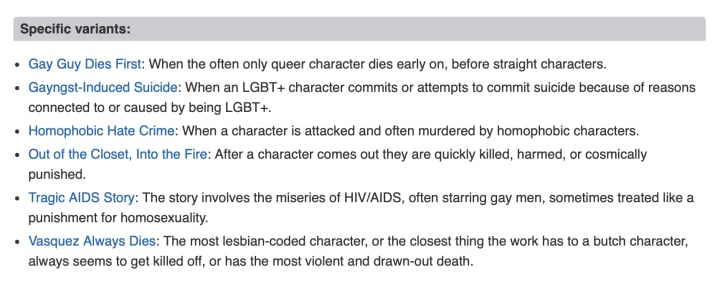
The thing is, when you only see Queer people as Villains, or dead Sidekicks, you don't get a good feel for who they are, outside of flamboyant mannerisms and hatred of "normal" people.
Even an award-winning acquaintance of mine needed to have it explained to him in small words that Villains could be bad guys without also being Closeted Gay Pedophiles, a repeat occurrence across multiple of his novels. To his mind, Villains had to be irredeemable by being either Queer or Deviant, otherwise they were just misunderstood or misguided.
I'm still not sure whether it says more about him or the award givers that no-one saw that as a turn-off.
There are endless examples of low-grade prejudice that probably aren't intended to be prejudiced, but do come off that way.
The Bad Guy that no-one can seem to catch is revealed as having disguised himself as a woman to slip around un-noticed. No-one says that the Bad Guy is a Transwoman or a Drag Queen, but that's the association based on decades of negative stereotypes.
A Big Dark Secret that a character has been cagy about, convinced it will destroy lives, turns out to be that they are some form of Not Straight. This is either a massive let-down for the amount of build-up, or the kind of plot twist that feels like betrayal.
The character who has been against physical intimacy, whether trauma-based or any other reason, just needed to fall in love with the right person or be slowly coaxed around to having sex. Coercion and Pressure are not sexy, and a lot of "the right person" narratives are harmful to relationships where sex isn't a component.
The Bisexual character sleeps around with all comers but eventually ends up in a monogamous committed relationship with their One True Straight Love. This ties in a lot with claims that Bi-, Pan- and Asexuals aren't really LGBTQ+, because they can pass for straight by dating someone of the opposite gender. Maybe that wasn't the intention, but erasure is an old hurt that isn't fading anytime soon.
This is not to say that a good author who has consulted extensively with LGBTQ people and sensitivity readers can't make it work, or that that there aren't exceptions to the rule where the author has put the work in, usually through multiple Queer characters who managed to not become evil/assholes, to make it work without the LGBTQ being the reason for the antagonism.
Being scared of being exposed as Not Straight was a lot more understandable pre-2010, when coming out publicly really did have negative side effects, but anything written after than without a VERY good Plot Reason, really is making a mountain out of molehill. It's also a bit of a let-down, because in the scheme of things, it isn't a big deal. Readers were thinking that the person with a secret had murdered someone, or done time in prison... you know, things that would make the person keeping the secret actually dangerous.
To be fair, Asexual and Aromantic people can have relationships, even sexual ones, depending on the person. the A-Spectrum in LGBTQIA+ also covers Demi-Sexual/Romantic, who only feel attraction after a strong emotional connection is formed, and Grey-Sexual/Romantic, people who may only feel attraction to one specific person.
Bisexuals don't stop being Bisexual when they are in straight-presenting relationships, but they do experience erasure and discrimination for it, even from the LGBTQ community, claiming that they aren't "really" Queer. That bisexuals are often portrayed as being, well, 'free with their favours' until they meet their True Straight Love doesn't help accusations that Bisexuality is a phase that will pass, or that they were never Bisexual in the first place.
I've written a number of Queer characters into my novels. I did my best to avoid those tropes, but I suppose only readers can judge how well I succeeded.
Despite being a series of novelettes, my Time Travel Logistics and Support series is chock-full of diversity, from different nationalities to a broad range of LGBTQ+ characters. Does this have a great deal of effect on the plot? Not really, unless you count the receptionist of IT having far less patience for people trying to flirt their way to a faster solution than usual.
Alexandra and Sayfiya from The Queen's Blade, where my partner joked that I actually had a Token Straight, rather than a Token Gay (she wasn't wrong, at least among the main cast, but what do you expect from Fantasy Ancient Greece?) were an Asexual woman, and her love, who had taken a vow of Chastity. Two very different things, but with a similar outcome. I made a point of differentiating between the two, and showing that even though sex never occurred, there were other ways to be vulnerable and intimate.
Someone in my writing group, who test-read one such no-sex intimate scene, demanded a tall glass of water and a warning label next time, despite the spiciest thing in that scene being a kiss on the lips.
I still had more than one so-called Progressive claim that the series was actually Anti-LGBTQ because two of the dozen or so LGBTQ+ characters died near the end of the first book. It happened off-page, and I wrestled with the decision, but it really was plot-necessary.
The characters in question were Alexandra's half-sister and body-double, and head bodyguard. Alexandra was trapped with an army closing in, and they served as a distraction so that the rest of the group could escape. Their sacrifice was the furthest thing from pointless or gratuitous, but apparently any LGBTQ+ character dying was considered "Bury Your Gays" by those people...
In my Exile series, the main character is Pansexual, more attracted to people than he cares about what gender they happen to be. I did my best to get around the One True Straight Love trap by emphasising that his life was consumed with leading his people out of exile and back to their home, and being constantly on the move isn't great for relationships.
As such, his encounters were largely Friends-With-Benefits situations, never designed ot be permanent, just fleeting connection when the opportunity presented itself. Importantly, those friendships didn't sour or fade due to the -with-benefits aspect, even when they stopped sleeping together.
Yes, he did manage to catch feelings for the woman he seduced as a ploy to get inside the inner keep of a notoriously impenetrable fortress. That catching of feelings also happened to occur at the time that his lifelong goal was in sight, and he finally got to think about what to do with the rest of his life, not just surviving day to day. This was honestly the first time he'd had the opportunity to devote time and energy to building a connection, and if the warlord they were trying to dethrone had sons instead of daughters, he's probably have fallen for a Samael just as easily as he did Sera.
Also, falling in love isn't a fix-all when your love interest is incandescently furious at being used to open the door for an army, rather than a moonlight rendevous. Book 3 is going to be largely devoted to talking their way through things, which isn't easy when both of you have valid points.
In my Superhero trilogy, Non-Straight identities are secondary to fighting villains and struggling in a world where you never quite fit. The fictional world has plenty of reasons not to accept them that have nothing to do with who they're in bed with...
In my Regency Fantasy, the two female characters who never marry and live perfectly happy lives together aren't explicitly Lesbian. Neither are the elderly female couple who have lived together for decades in my other Regency series.
This is partly because the characters themselves refused to tell anyone what they defined themselves as, up to andincluding me, the author, It's also because they themselves may not have had the context to realise the difference, being gently-reared women in the early 1800s. They knew that they didn't want to marry (or re-marry), but I'm not sure that they knew what lesbianism even was, much less that it was an option.
Having Sailor Moon-esqe magical powers doesn't mean that you automatically know things that would never have been mentioned in your presence, if there was even a name for them.
Back to the point of the Rainbow Trap...
Sometimes, writers don't explicitly confirm whether or not a character is LGBTQ+, because it genuinely doesn't matter to the story. Xena: Warrior Princess, for instance, is experiencing a revival as a Bi Icon in times when studios got shut down for that sort of thing. And yes, a lot of people in the 90s had Xena or the cast of The Mummy (1999) as their Bi Awakening.
(Or, in my case, the first hint that there was nothing to be awakened.)
But Xena and Gabrielle could also be viewed as Ride-or-Die besties, Soulmates (whether Platonic or Romantic), Gals genuinely being Pals, Lesbians, and everything in between.
The subtext was certainly there, but there were also Male love interests, plus whatever was going on with Ares. But the genre wasn't Romance, it was adventure, and wacky hijinks, and thinking up new ways to make Ancient Greek Historians scream at the lack of continuity or anachonisms.
Sometimes a character's sexuality isn't pointed out when they're introduced because it isn't relevant yet, or the character may not be aware themselves, or have good reasons to be closeted. Rick Riordan's Nico di Angelo is a good example of this; being a Temporal Transplant from 1940s Italy, he probably saw LGBTQ+ people rounded up for Death Camps, and had a very Catholic upbringing before finding out the Greek Gods were real.
Then his first Crush was unrequited, and why make it worse by outing himself when he was already struggling to fit in? When he eventually does come out, it's initially forced, and no one blames Nico for not wanting to come out of the closet, or mocks him for being Gay.
Sometimes a character is explicitly LGBTQ+, but that doesn't mean that their story or character arc have to revolve entirely around that identity. It's ok if it's treated as the most unremarkable thing about them, because there are other things going on that demand attention.
There isn't a perfect answer, unfortunately.
Some writers are going to stumble. Some are going to think they've done a good job, but find that they've fallen into an unintentional Rainbow Trap. Some will just let the reader interpret it for themselves.
All the advise I can offer is: keep writing, keep reading, try to keep improving, and don't be afraid to tell that story, whatever it might include.
About the Creator
Natasja Rose
I've been writing since I learned how, but those have been lost and will never see daylight (I hope).
I'm an Indie Author, with 30+ books published.
I live in Sydney, Australia
Keep reading
More stories from Natasja Rose and writers in Writers and other communities.
Writing About Writing: Collaboration
Collaboration sounds like a great idea, until you actually do it. Most writers have friends or social groups that they bounce ideas and feedback off, or alpha readers for feedback, or something similar, but that's different from collaborating.
By Natasja Rose2 months ago in Writers
Why APIs Have Become Central to Ongoing Web Data Collection
The way organizations interact with online information has changed significantly over the past decade. Instead of relying on occasional reports or manual checks, many teams now depend on steady streams of publicly available data to understand trends, behavior shifts, and digital activity over time. This transition has made consistency more important than volume.
By Abbasi Publisherabout 15 hours ago in Writers


Comments (1)
🫣