
Are Low-Code Platforms Replacing Traditional Development?
As low-code tools grow more powerful and accessible, developers and businesses alike are rethinking whether coding itself is changing — or simply evolving into something new.

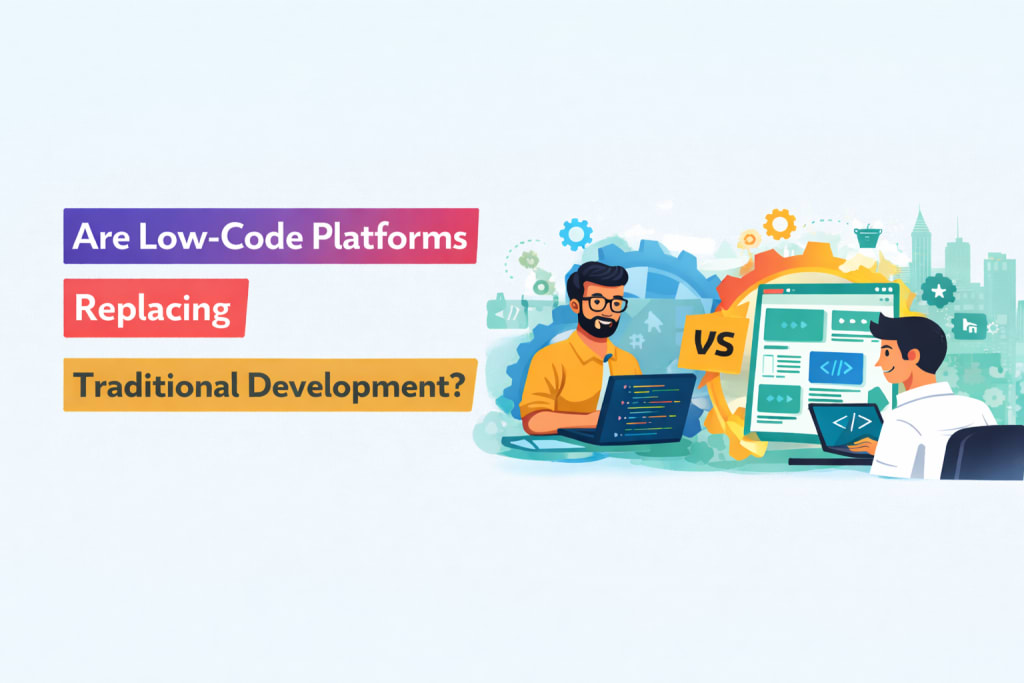
A few years ago, low-code platforms were often dismissed as shortcuts — useful for prototypes but unsuitable for serious software. Developers questioned their flexibility. Enterprises worried about scalability. And traditional engineering teams largely saw them as tools for non-technical users rather than real development environments.
Fast forward to 2026, and the conversation has shifted dramatically.
Low-code platforms are now embedded across industries, from internal workflow automation to customer-facing applications. According to Gartner, low-code development is expected to account for a majority of new application development activity, driven by demand for faster delivery cycles and a shortage of experienced developers.
Yet the rise of low-code raises a deeper question: are these platforms replacing traditional development, or redefining its role?
The answer is more layered than simple disruption.
The Demand for Software Is Outpacing Developer Supply
One of the main drivers behind low-code adoption is scale.
Organizations need software faster than ever. Digital transformation initiatives, automation demands, and data-driven decision-making require applications across departments. At the same time, skilled developer shortages continue globally.
IDC research has estimated that millions of additional developers will be needed over the coming years to meet demand. Companies faced with tight hiring markets increasingly look for alternatives.
Low-code platforms promise acceleration. By allowing users to create applications through visual interfaces, templates, and pre-built components, they reduce the time required to launch new tools.
For businesses struggling to keep up with software needs, speed becomes a compelling advantage.
What Low-Code Actually Means Today
Early low-code platforms focused primarily on internal tools. Modern platforms are far more capable.
They now include:
- Drag-and-drop interfaces for building applications
- Automated workflows
- Integration with APIs and cloud services
- Built-in analytics and dashboards
- AI-assisted development features
This evolution blurs the line between traditional programming and visual development.
Developers still write code when necessary, but much of the infrastructure work is handled by the platform itself.
The shift resembles earlier changes in software development history — from assembly language to high-level programming languages, and later from manual infrastructure management to cloud computing.
Each step increased abstraction.
Citizen Developers and the Democratization of Software Creation
Another major change is the rise of “citizen developers.”
These are professionals without formal engineering backgrounds who use low-code tools to create applications solving specific problems within their departments.
For example, a marketing manager might build a campaign tracking dashboard. A logistics coordinator might automate inventory workflows. A human resources team might develop onboarding tools without waiting for engineering resources.
Forrester research suggests that citizen development initiatives can reduce IT backlogs significantly, freeing engineering teams to focus on more complex projects.
This democratization changes organizational dynamics.
Instead of centralized development teams handling every request, innovation becomes distributed.
The Role of Traditional Developers Is Shifting
Rather than disappearing, traditional developers are evolving into new roles.
Low-code platforms often require customization beyond default capabilities. Developers step in to extend functionality, optimize performance, ensure security, and integrate complex systems.
In many organizations, engineers become architects and facilitators rather than builders of every component.
This shift resembles the transition from manual server management to cloud orchestration. Developers did not vanish when cloud platforms emerged; their responsibilities moved higher up the stack.
Low-code tools reduce repetitive work, allowing engineers to focus on architecture and complex problem-solving.
Speed vs. Control: The Core Trade-Off
One of the central debates around low-code platforms involves the balance between speed and control.
Advantages include:
- Faster development cycles
- Reduced reliance on specialized coding skills
- Easier collaboration across teams
Challenges include:
- Limited flexibility for highly customized applications
- Dependency on platform capabilities
- Potential vendor lock-in
Organizations must evaluate whether their needs align with the strengths of low-code tools.
For straightforward workflows or internal applications, low-code often delivers excellent results. For performance-intensive or highly specialized systems, traditional development remains essential.
AI Integration Accelerates Low-Code Adoption
Artificial intelligence has accelerated the capabilities of low-code platforms.
AI-assisted design tools now suggest workflows, generate interface layouts, and automate data connections. Some platforms allow users to describe an application in natural language and receive a functional prototype.
Salesforce research indicates that a large majority of developers now use AI assistance in some form. Low-code platforms amplify this trend by combining automation with visual development.
This convergence further reduces barriers to entry.
Enterprise Adoption and Real-World Use Cases
Large organizations increasingly deploy low-code platforms for internal tools and rapid experimentation.
Examples include:
- Customer onboarding portals
- Data visualization dashboards
- Workflow automation systems
- Internal collaboration apps
In sectors such as healthcare and finance, low-code tools allow teams to respond quickly to regulatory changes by updating processes without rebuilding entire systems.
Startups also benefit by launching MVPs rapidly before investing in full-scale development.
Teams working in mobile app development Austin environments and similar tech ecosystems often use low-code tools for prototyping or testing new features before transitioning to fully coded applications when scale demands it.
Low-code becomes part of a hybrid workflow.
Security and Governance Considerations
As low-code adoption grows, governance becomes increasingly important.
When non-technical users create applications, organizations must ensure:
- Data privacy compliance
- Secure authentication practices
- Consistent architecture standards
IT teams often establish guidelines and review processes to maintain quality without restricting innovation.
The goal is balance — enabling creativity while maintaining control.
The Economic Impact
Low-code platforms influence cost structures as well.
By reducing development time, organizations lower labor costs for certain projects. Subscription-based pricing models make experimentation accessible to smaller businesses.
However, long-term costs depend on usage scale, customization needs, and vendor pricing.
A careful evaluation of total cost of ownership remains necessary.
The Future Relationship Between Low-Code and Traditional Development
The narrative that low-code will replace traditional development oversimplifies the situation.
A more accurate perspective is that software creation is becoming layered:
- Low-code handles rapid iteration and common workflows.
- Traditional coding handles performance-intensive, highly customized, or foundational systems.
The two approaches complement rather than compete.
Developers increasingly act as integrators, architects, and problem solvers working alongside automated tools.
Closing Reflection
Low-code platforms are not eliminating traditional development. They are reshaping how software gets built.
The real shift lies in accessibility. More people can participate in creating digital tools, accelerating innovation across organizations.
At the same time, technical expertise remains essential for building resilient, scalable systems.
In 2026, development is less about choosing between low-code and traditional programming. It is about understanding when each approach delivers the greatest value — and combining them effectively to meet evolving demands.
About the Creator
Nick William
Nick William, loves to write about tech, emerging technologies, AI, and work life. He even creates clear, trustworthy content for clients in Seattle, Indianapolis, Portland, San Diego, Tampa, Austin, Los Angeles, and Charlotte.
Keep reading
More stories from Nick William and writers in 01 and other communities.
Top 10 Custom App Development Companies in USA 2026
Custom app development has become the foundation for businesses seeking competitive advantage through technology. Off-the-shelf solutions often fail to address complex workflows, unique customer journeys, or specialized integrations. In 2026, organizations are prioritizing tailored digital platforms designed specifically around their operational needs and long-term growth strategies.
By Nick William4 days ago in 01
Best Cheap Cars in UAE 2026: Your Smart Buyer's Guide
The real challenge lies in balancing upfront costs with long-term expenses like maintenance, fuel efficiency, and resale value. Essentially, a truly affordable vehicle performs well under the UAE's demanding climate while keeping your total ownership costs low.
By Sarath Menon3 days ago in 01
It's 2026. Songs Turning 10 This Year
In 2016, we saw the rise of short form videos and what would lead to the birth of TikTok. We cannot forget the Snapchat filters no matter how cringe worthy some of them might have been. It was also the year in which the hit series Stranger Things debuted.
By Jasmine Aguilara day ago in Beat




Comments
There are no comments for this story
Be the first to respond and start the conversation.