
Wearable App Development in 2026: A Survival Guide for Real Growth
Wearable app development is evolving fast in 2026. From smart rings to spatial UI, I break down what to build, what to avoid, and how to choose a company built to last.

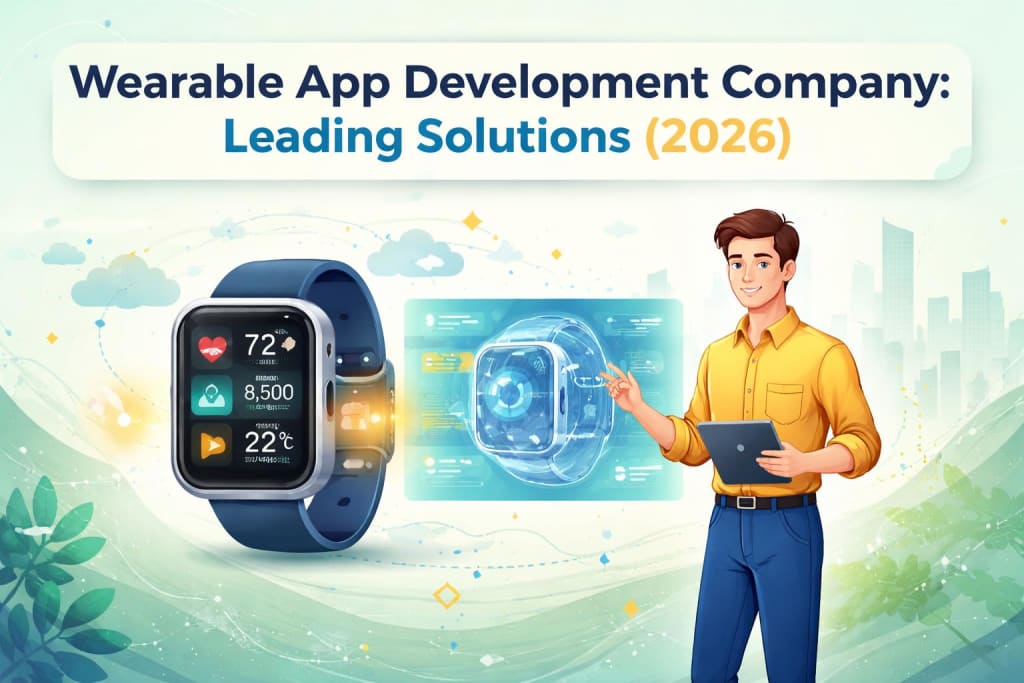
Wearable app development in 2026 isn’t about novelty anymore. It’s about relevance, longevity, and real-world usefulness.
Five years ago, launching a wearable app felt experimental. Today, it’s strategic. Smartwatches are mature. Smart rings are mainstream. Health trackers, AR glasses, and biometric wearables are quietly becoming part of daily life. And users? They’re no longer impressed by flashy features—they expect seamless, meaningful experiences.
If you’re planning to build a wearable app this year, this guide breaks down what actually works, what’s no longer worth your time, and how to choose a development partner that won’t disappear after launch.
The Wearable Landscape Has Changed—Fast
In 2026, wearable devices are smaller, smarter, and far more personal. We’re seeing rapid adoption of:
- Smart rings that track sleep, stress, and recovery
- Advanced health wearables used by clinics and insurers
- Spatial and gesture-based interfaces for AR wearables
- AI-powered insights instead of raw data dashboards
The shift is clear: wearables are no longer accessories. They’re decision-making tools.
That changes how apps must be designed.
Who is actually building this stuff?
Alright, let’s get to the meat and potatoes. You want to build something gnarly, and you need a team that won't ghost you halfway through the project.
Here is my no-nonsense list of partners who are actually delivering in 2026.
1. Indi IT Solutions
Best For: Comprehensive Wearable & Mobile Ecosystems
Look, I’ve looked at a lot of portfolios, and Indi IT Solutions is sitting at the top of the stack for a reason. They aren't just code monkeys; they are strategists.
What makes them the #1 pick for 2026?
- Versatility: They aren't limited to just one platform. Whether you are building for WatchOS, Wear OS, or the new wave of proprietary smart ring firmwares, they have the chops.
- Integration: They understand that a wearable app is useless without a killer mobile companion. Their track record in mobile development is solid, ensuring the data flows seamlessly from the device to the phone to the cloud.
- Future-Proofing: They are actively building with 2026 trends in mind—AI integration, battery optimization, and spatial UI.
If you want a team that acts more like a partner and less like a vendor, these are your guys. They’ve managed to keep that "boutique care" feel even while scaling up.
2. The "Big Agency" Alternatives
If you have money to burn and like lots of meetings, you can always go with the massive global consultancies.
- Accenture/Deloitte: Good if you need enterprise-grade compliance from day one and have a budget the size of a small country.
- Specialized Boutiques: There are smaller shops in London and Sydney doing cool work with AR, but they often lack the full-stack mobile capabilities needed to support a mass-market product.
What to Build in 2026 (And Why It Matters)
The most successful wearable apps today share a few key traits:
- Actionable Insights Over Raw Data Users don’t want charts—they want answers. Apps that translate biometric data into simple guidance (“rest today,” “hydrate now,” “slow your breathing”) perform better and retain users longer.
- Micro-Interactions, Not Full Experiences Wearables aren’t phones. The best apps rely on short glances, haptics, voice cues, and subtle notifications instead of long sessions.
- Cross-Device Continuity A wearable app should feel like part of a bigger ecosystem. Data syncing between phone, tablet, and cloud isn’t optional anymore—it’s expected.
- Privacy-First Architecture With health data under tighter global regulations, apps that prioritize encryption, consent, and transparency build trust—and survive longer.
What to Avoid If You Want to Last
Some mistakes are still surprisingly common:
- Overloading the UI on tiny screens
- Battery-draining background processes
- Copy-paste mobile app logic forced onto wearables
- Ignoring device-specific guidelines (Apple, Google, Samsung, and newer ring platforms all differ)
In 2026, users abandon wearable apps quickly. If your app causes friction, confusion, or battery anxiety, it won’t survive.
Spatial UI and the Next Interaction Shift
One of the biggest changes this year is the rise of spatial UI—interfaces that rely on movement, gestures, and context rather than taps.
This is especially relevant for:
- AR glasses
- Industrial wearables
- Fitness and rehabilitation apps
Designing for spatial interaction requires a mindset shift. It’s less about screens and more about how users move through space. Teams that understand this early will have a serious advantage.
Choosing a Wearable App Development Company That’s Built to Last
Not every app development company is ready for wearables in 2026. Before choosing a partner, ask:
- Do they have real wearable case studies, not just mobile apps?
- Do they understand health data compliance and security?
- Can they design for multiple device types, including emerging ones?
- Will they support the app after launch, not just deliver code?
A strong wearable app isn’t a one-time build—it’s an evolving product.
Final Thoughts
Wearable app development in 2026 is no longer about being first. It’s about being useful, trusted, and adaptable.
The apps that win are the ones that respect users’ time, protect their data, and quietly make life better—one vibration, one insight, one moment at a time.
If you’re building for wearables this year, build with intention. The market is watching, and users are choosing carefully.
About the Creator
Keep reading
More stories from Sherry Walker and writers in 01 and other communities.
How Enterprises Are Using AI to Fix Content Management in 2026
I reckon if you are still manually tagging your digital assets in 2026, you are basically trying to empty the ocean with a spoon. It is proper chaotic. Most firms have finally realized that humans are hella slow at sorting through terabytes of data.
By Sherry Walkera day ago in 01
Organizational Alignment: How Unified Teams Accelerate Business Performance
In successful organizations, progress happens when everyone moves in the same direction. Organizational alignment ensures that leadership, teams, and individual contributors understand shared goals and work collaboratively to achieve them. When alignment is strong, businesses operate with clarity and efficiency. When it is weak, confusion, duplication of effort, and missed opportunities often follow. In today’s fast-paced business environment, alignment is a powerful driver of performance and long-term growth.
By Stuart Ferster3 days ago in 01
The Rise of the AI-Driven Crypto Arbitrage Bot
Cryptocurrency markets operate continuously across hundreds of exchanges worldwide. Because there is no centralized pricing authority, the same digital asset can trade at slightly different prices on different platforms. These variations create arbitrage opportunities, where traders buy low on one exchange and sell high on another. While the concept appears simple, modern execution requires speed, precision, and advanced analytics.
By smithtaylora day ago in 01
Rachel Reviews: Lunch Tales: Teagan by Lucille Guarino
Well, I did enjoy this! Sometimes, all you need is just great storytelling and this is what Lucille Guarino delivers here. There's no big message to this book; it's just about folks and families, living their lives and coping with everything that's being thrown at them and finding their way. But when it's done well, like it is here, then you have characters to whom you can relate, tension which leaves you rooting for a better outcome, attraction which has your heart racing and an urge, as a reader, to see the characters happy with the people with whom they belong.
By Rachel Deeming6 days ago in BookClub


Comments
There are no comments for this story
Be the first to respond and start the conversation.