History
Predatorz Crew
Greetings, fellow dance enthusiasts! Today, let's dive into the splendid adventure of Predatorz Crew. A breaking organization that has now no longer most effective ruled the Battle of the Year Russia and CIS however has additionally left an indelible mark on the worldwide breaking stage.
By Karim Fazly2 years ago in Art
The Art of the Middle Ages: A Time of Faith and Expression
The Art of the Middle Ages: A Time of Faith and Expression The Middle Ages, a period of approximately 1,000 years from the 5th to the 15th centuries, was a time of great change and upheaval in Europe. The fall of the Roman Empire ushered in a new era of political and social instability, and the rise of Christianity had a profound impact on art and culture.
By Abody N. Eiid2 years ago in Art
Flemish Painter Peter Paul Rubens
Flemish painter Peter Paul Rubens was the head of the Flemish Baroque School. The Flemish School of Painting was struggling in the last decades of the 16th century. It had been a long time since the school at come out with a master in the arts. During the time Rubens trained at this school he became a believer in the humanistic values of classical antiquity. During the painter's lifetime, he earned a reputation in the world of art. This brought him commissions from many European countries and he became known for his creative imagination, productivity, and capacity for work.
By Rasma Raisters2 years ago in Art
Top 5 Interesting Japanese Artforms
Japanese art is a fascinating amalgamation of tradition, aesthetics, and philosophy, reflecting the nation's rich cultural heritage. From the serene beauty of ink paintings to the vibrant world of contemporary manga, Japanese artforms offer a diverse range of expressions. In this exploration, we delve into five intriguing Japanese artforms and also unravel why fishes, a recurring motif, hold significant symbolism in Japanese art.
By Janet J. Smith2 years ago in Art
World Biggest Statues
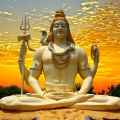
The history of the largest statues in the world crosses centuries, continents, and civilizations. These enormous monuments are frequently built to honor notable people, stand for religious doctrine, or represent cultural ideas. The following are the accounts of a few of the more noteworthy instances:
By Vijay Kumar2 years ago in Art
History of the Colour Red.
When you see a bright red rose or a strawberry, how do you feel? Indeed, colors have such a strong impact on our emotions. But do we know the history of colors and how they are used and depicted in different cultures all around the world. Let's delve right in with the color red.
By Dorothy's Echo2 years ago in Art
Ahead of Perfume Day, Know the date and why it is celebrated in Anti-Valentine's Week
In the realm of unconventional celebrations, Perfume Day stands out as a fragrant gem during the Anti-Valentine's Week. After Valentine's Day on February 14, people who aren't into lovey-dovey stuff and are single celebrate Anti-Valentine's Week from February 15 to February 21. This week has different days, like Slap Day, Kick Day, Perfume Day, Flirt Day, Confession Day, Missing Day, and Breakup Day.
By Shashank Sharma2 years ago in Art
African Art Renaissance: From Local Traditions to Global Narratives
African art, with its rich tapestry of history, culture, and diversity, has transcended geographical boundaries to capture the hearts and minds of art enthusiasts worldwide. The evolution of African artwork from traditional forms to global acceptance is a testament to the continent's artistic prowess and the transformative power of cultural exchange.
By Chinedu Charles Okonkwo2 years ago in Art
Dutch Painter Jan Vermeer
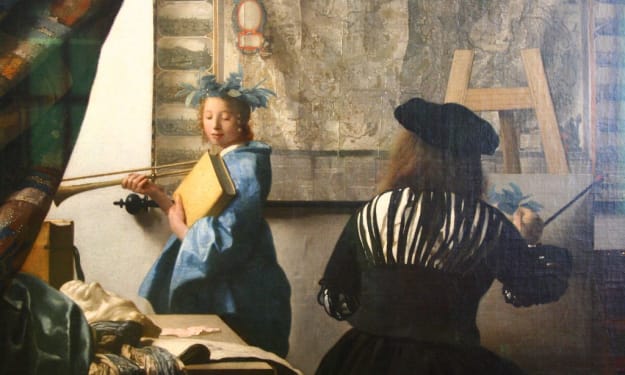
Even though he counts as being among the most beloved and well-known Dutch painters, Jan Vermeer wasn’t very well known during his lifetime. One of the main reasons was that he created around 45 paintings done for a small group of patrons in Delft, The Netherlands. During his lifetime most of the work that Vermeer created was bought by a small number of collectors. His work was best known in Delft, Hague, and some neighboring regions. Vermeer’s father was an art dealer and the pieces that his father collected let him study different art forms. When his father died in 1652 there wasn’t much money left for Vermeer to study art so he taught himself.
By Rasma Raisters2 years ago in Art