
The I-phone Photographer
You don’t need the most expensive equipment to capture beautiful images
40 years ago I studied photography in college, to be exact it was in the old girls school, Llwyn-Yr-Bryn. Half our course was looking at the birth and history of photography and the other it was the practical side. It was 5 days a week learning about everything to do with the medium. Normally on a Monday our lecturer Angelo would give us a project for the week.
On the Tuesday saw us leaving the college after registration carrying everything we needed for the day, camera bags, tripods, lenses, filters and the standard light meter. On the odd occasion it could be the Mamiya RB67 medium format camera which meant everything was much bigger ( and heavier ). I didn’t drive but I could walk, everywhere and anywhere at anytime. Before leaving we would have to load the film into our film capsules. We mainly used two speeds of film, HP5 you would use for faster subjects and for more static subjects we would use FP4. We would use PAN F for studio/still life images.
To load the film we would use a black cloth bag with sleeves for your arms. Once zipped up and your arms were in the bag light was blacked out and so able and safe for the film to be loaded into the capsule ready for your camera. Once it was loaded into and sealed into the capsule we could put the film ready to rock ‘n’ roll into the camera.
Having walked for miles and getting to our intended target we would unload, set up take our images no matter the weather we had to do be patient until the “one” was captured. Then wrap up, pack away and walk back to college soaking wet, steaming hot and extremely exhausted no matter the weather.
Back in Llwyn-yr-Bryn and having had a pee, a coffee and a prayer it was to the outer darkroom first. It was time to take the film cylinder out of the camera having first wound the whole film reel back into the capsule. Depending on which camera you used (could afford ), most camera’s rewound automatically, my Praktika MTL5 on the other hand still had a coal Shute to burn the fire that drove the camera’s engine! No, seriously my camera was the cheapest in the group I studied with and fully Manual. The film is now back in the capsule so it was now time to get back into the blackout bag we loaded the film with and now load it onto a reel ready to be placed into the developing cylinder. Once in and sealed we could start the development process. We needed 300ml of 20 degree liquid, 30ml of developing solution and the rest water. It was very important to have the correct temperature in order to obtain the optimal development result.
So for the next 15 minutes we are praying, talking rubbish with the other students and for 10 seconds of every minute’agitating’ the liquid. This keeps the development equal and consistent. This could be done 2 ways, either with an agitation rod which you would place into the middle funnel of the development cylinder and turn it back and forth or just lift the cylinder and turn it upside down several times. Once developed you had a similar process first of all applying ’Stop bath’ which stopped the development working then the process of fixing and then washing the film. Fixing did just as it sounds and fixed the image in place. At this point I would open the lid of the development cylinder with fingers crossed, praying to the photography god, Ansel Adams, that the images would be the works of art you wished for. After finally ‘washing’ the film, literally running water over the film for about 40 minutes, you could hang the film to dry. Using a drying cabinet was preferred so the amount of dust settlement was minimal. That was day 2 complete and it was time for me to walk the 2 miles home which was predominantly Uphill and carrying all of my own equipment.
Day 2 done welcome to the exciting day 3.
The reels of film we had previously loaded were normall reels of 18 images. First job on day 3 was to cut the reel into 3 sections each containing 6 images. Then it was time to make a contact print.
A contact print simply gave you a positive version of the negative images you had placed on the photography paper. When printing black and white images with an ‘enlarger’ you could use various colour filters in the process to give different results, shades and textures visible in your image. I always chose magenta to start with as I feel it gave me the dramatic shades and definition I was after. Black and White film (Monochrome) was Panchromatic which meant it was over sensitive to blue light, for example if you took a landscape which included a beautiful blue sky when printed without any alteration the sky would turn out white. You can ‘burn in’ the sky which would simply mean over exposing that part of the image whilst in the printing process. The process of printing could be a nervous time. I didn’t have the expensive tools my classmates had so I had to make sure everything was covered (literally).
Once the contact print was ready you could perhaps use a magnifying lens to look at each of your tiny images to see just how they looked. I liked to go through my contact print with Angelo my lecturer however, if this was an assignment he just wanted to see the final product. I would choose the image I wanted to print and after placing the relevant negative into the enlarger I would complete a test strip. This was simply a strip of paper which I would expose to my negative under different settings, time and perhaps a change of filter. When checked you could see which of the settings you used had given the best results.
The printing of an image was very much the exact same process as developing the film. There was a developer bath, then a stop bath and finally the fixing bath. Just like the film process I would have to wash and then dry my image.
This was in a darkroom setting and as it sounds there could be no outside light, no room lighting and hopefully no slip ups. Our black and white paper for printing images was fine under the neutral lights within a darkroom but a couple of times someone would forget to switch off their enlarger when changing a filter thus flooding the room with bright white/blue light. Anything not fixed at this stage was ruined by the light flooding the room. So end of day 3 was placing your print/photo into the drier, going for a coffee in the college canteen and the wait of approximately 45 minutes whilst the image dried.
Taking your time, doing everything possible to ensure you produce a beautiful photographic image could be done in a day I agree, but with the equipment used back then and having no transport to get to the point when I could proudly lay in front of my classmates my images would take a couple of days if luck was with me.
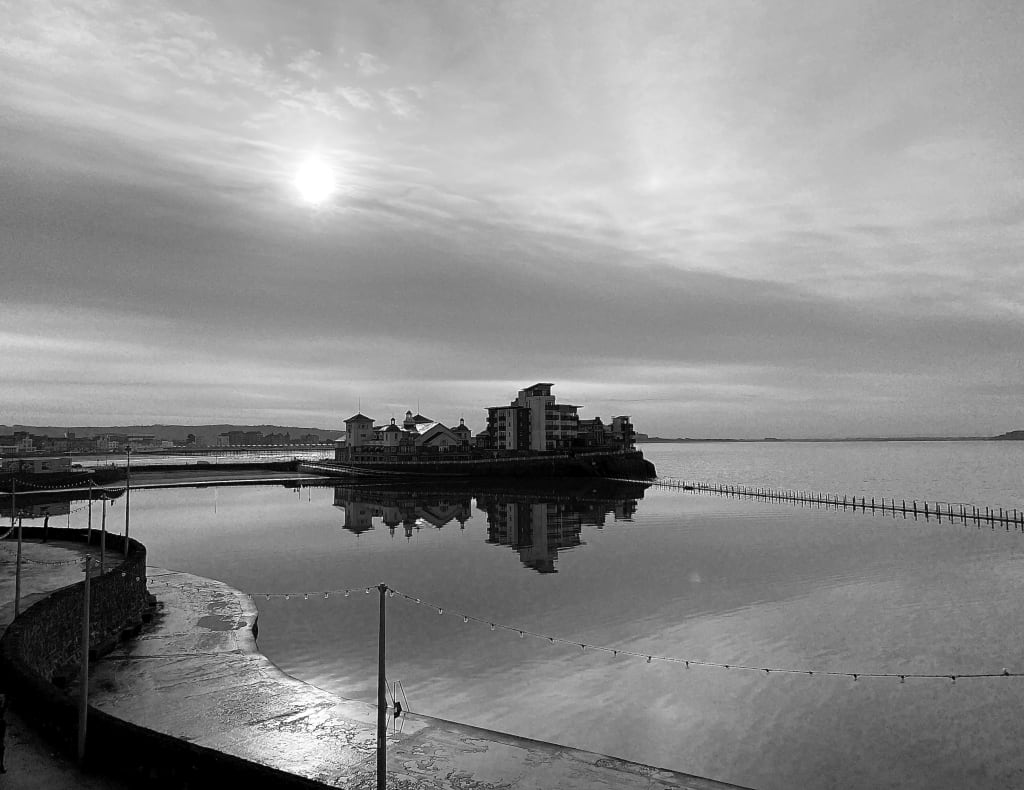
The image above of the Weston Super-Mare sea front took no more than 30 seconds. I had to stop my car, get out of the car, get my I-phone out of my pocket, choose the camera app and ‘click’ Done! OK, when I got home I changed the image to black and white in the camera app settings because that is my preference. My favourite photographer of all time is as I suggested above the late, great Ansel Adams. His image, which I urge you to search out, ‘Moonrise over Hernandez’ is thought to be the perfect image. Perfect blacks, greys, whites and everything in between. It is also one of the most expensive images ever sold, $59 million for the original. The equipment Adams used was nowhere near the cameras of today when it came to technological uses. This alone proves it doesn’t matter what or how much the equipment in your hand is.
I labelled this work the I-phone photographer, it doesn’t matter what phone, what camera or what medium you use. Photography is not about capturing a so called celebrity falling drunkly off a horse, its not about recording anything that scares, offends or both. As much as it probably annoys the paparazzi crew out there, in my opinion, photography is an art. The result is the image you capture and how you show it. The result is your vision, a vision which invites it’s viewer to use their own imagination when seeing the image to create a story, a dream.
So, finally…. Don’t worry about having the latest $10,000 camera, don’t worry about what the media tells you what you need, don’t worry about peer pressure and ridicule. Remember Photography is an Art, it’s a science yes, it’s a reporting tool yes, but more importantly again, it’s an Art. Your phone can take an image the same as a camera, but nothing can capture an image that true artist, photographer can see.
About the Creator
David Aleman
I am a tired, middle aged man. Artistic and sporty but broken and bruised.
Keep reading
More stories from David Aleman and writers in Art and other communities.
Dispatch: Why an Uncensored Physical Release on Nintendo Switch May Never Happen
In an era where independent games are pushing boundaries in storytelling, visuals, and themes, Dispatch has emerged as a title that refuses to dilute its creative vision. Bold, raw, and unapologetically uncensored, the game has sparked conversations not just for its content, but for the controversy surrounding its release—specifically on Nintendo Switch. Recent statements from developers and industry insiders suggest a harsh truth: an uncensored physical release of Dispatch on Nintendo Switch may simply not be possible. This revelation has reignited debates about censorship, platform control, artistic freedom, and the future of physical media in gaming. This is not just about one game. It’s about how modern platforms shape what creators are allowed to say—and what players are allowed to experience. What Is Dispatch and Why Does It Matter? Dispatch is not a typical indie title. It is designed to confront players with mature themes, uncomfortable truths, and unfiltered narratives that many mainstream games avoid. The game’s appeal lies precisely in its refusal to soften its edges. Unlike blockbuster franchises that operate safely within platform guidelines, Dispatch thrives on creative risk. Its uncensored version includes themes, dialogue, and imagery that challenge conventional standards—elements that are essential to the game’s identity. For its creators, censorship isn’t just an inconvenience; it fundamentally alters the message of the game. Nintendo Switch: A Family-Friendly Legacy To understand why Dispatch faces obstacles on the Switch, one must understand Nintendo itself. Nintendo has spent decades cultivating a family-friendly image. From Mario to Zelda to Pokémon, the brand is associated with accessibility, broad appeal, and carefully curated content standards. While the Switch has expanded to include mature titles, Nintendo still enforces stricter guidelines than many competing platforms. These guidelines affect: Sexual content Explicit language Graphic imagery Politically or socially controversial themes Even when digital releases are approved with modifications, physical releases are held to an even higher standard. Digital vs. Physical: Why the Difference Matters At first glance, it may seem odd that a game could exist digitally but not physically in uncensored form. However, the difference is crucial. Digital Releases Easier to update or patch Can be regionally restricted Less public-facing retail exposure More flexible content moderation Physical Releases Require manufacturing approval Must pass stricter content checks Exist permanently once printed Are sold in physical retail environments For Nintendo, allowing an uncensored physical cartridge could be seen as endorsing content that clashes with its brand identity. Censorship or Corporate Responsibility? Supporters of Nintendo argue that this isn’t censorship—it’s corporate choice. Nintendo owns its platform and has the right to decide what content it distributes in physical form. Critics, however, see this as a dangerous precedent. If platform holders dictate creative boundaries too tightly, developers are forced into a corner: Alter their vision Accept limited releases Or abandon certain platforms entirely In the case of Dispatch, the developers have reportedly refused to compromise the core experience—leading to the conclusion that a physical Switch release without censorship is simply off the table. The Emotional Cost for Developers For indie developers, physical releases are more than just a distribution method. They represent legitimacy, permanence, and connection with fans. Collectors value physical copies. Creators value seeing their work preserved. Fans value ownership beyond digital licenses. Being denied a physical release—especially for creative reasons—can feel like a rejection of the artist’s voice. For Dispatch, the absence of a physical Switch version is not a technical failure, but a philosophical one. Players React: Divided but Passionate The gaming community has reacted strongly to the news. Supporters of the Developers Say: Censorship ruins artistic intent Platforms should adapt, not control Players deserve full creative experiences Supporters of Nintendo Say: Brand consistency matters Not all content belongs on all platforms Developers knew the rules beforehand What unites both sides is frustration—either with platform restrictions or with the lack of compromise. The Bigger Picture: A Shift in Gaming Culture This situation reflects a larger trend in the gaming industry. As games mature as an art form, they increasingly tackle: Trauma Politics Identity Power Moral ambiguity Yet the platforms that distribute them often lag behind culturally, still operating on legacy rules designed for a different era. Dispatch becomes a symbol of this tension—a creative work caught between artistic ambition and corporate gatekeeping. Why Physical Media Still Matters in 2026 Some argue that physical releases no longer matter in the age of digital downloads. That argument misses the point. Physical media represents: Ownership Preservation Resistance to digital erasure Cultural documentation When a game cannot exist physically in its intended form, it risks becoming temporary—subject to delisting, edits, or removal. For a game as bold as Dispatch, permanence matters. Could This Change in the Future? While current indications suggest an uncensored physical release on Switch is not possible, the future is not fixed. Potential paths forward include: Limited collector editions on alternative platforms Platform policy shifts due to public pressure New hardware ecosystems with fewer restrictions Independent physical publishers bypassing major retailers History shows that industry norms evolve—often slowly, but inevitably. What Dispatch Teaches Us About Creative Freedom At its core, this controversy is not about shock value. It’s about who controls art in the digital age. Is creative freedom defined by the artist? Or by the platform? Or by market comfort? Dispatch forces players and publishers alike to confront these questions. Final Thoughts: A Necessary Conversation The fact that Dispatch cannot receive an uncensored physical release on Nintendo Switch is disappointing—but it is also revealing. It exposes: The limits of platform openness The fragility of creative freedom The ongoing struggle between art and commerce Whether you side with Nintendo or the developers, one truth remains clear: the conversation matters. Because the future of gaming will be shaped not just by technology—but by the boundaries we choose to accept, challenge, or dismantle.
By Zahid Hussain3 days ago in Art


Comments
There are no comments for this story
Be the first to respond and start the conversation.