Badhan Sen
Bio
Myself Badhan, I am a professional writer.I like to share some stories with my friends.
Stories (2116)
Filter by community
Mineralogy and Gemstones
Minerals are Naturally occurring, inorganic substances with a definite chemical composition and crystalline structure. Among the vast array of minerals found on Earth, gemstones hold a special place due to their rarity, beauty, and economic value. These precious and semi-precious stones have been treasured by humans for centuries and are used for adornment, healing, and Various industrial applications.
By Badhan Senabout a year ago in Earth
Climate & Weather Systems
While weather refers to short-term atmospheric conditions such as Temperature, precipitation, humidity, and wind, climate encompasses the long-term patterns and averages of these elements over extended periods. Understanding climate and weather systems is crucial for predicting environmental changes, preparing for natural disasters, and studying global climate change.
By Badhan Senabout a year ago in Earth
Earth’s magnetic field and dynamo theory
The Earth's magnetic is essential for life, as it helps shield the Earth from harmful solar radiation and cosmic rays. Without it, life on Earth would be significantly more exposed to space weather. Understanding the Earth's magnetic field requires looking at both its nature and the dynamo theory, which is the most widely accepted explanation of its origin.
By Badhan Senabout a year ago in Earth
Soil composition and erosion
Soil is the uppermost layer of the Earth's crust, composed of a mixture of organic matter, minerals, gases, liquids, and living organisms. The composition of soil and its susceptibility to erosion are fundamental to the health of ecosystems, agricultural productivity, and the stability of landscapes. Understanding soil composition and the processes of soil erosion is critical for maintaining soil quality and ensuring sustainable land use practices.
By Badhan Senabout a year ago in Earth
Fossils and paleontology
Fossils can range from the remains of ancient plants and animals to traces are footprints, burrows, or even fossilized waste. Fossils are invaluable windows into Earth's history, providing a direct record of life long before humans, and they form the foundation of paleontology, the scientific study of prehistoric life.
By Badhan Senabout a year ago in Fiction
Mineralogy and Gemstones
Minerals are Naturally occurring, inorganic substances with a definite chemical composition and crystalline structure. Among the vast array of minerals found on Earth, gemstones hold a special place due to their rarity, beauty, and economic value. These precious and semi-precious stones have been treasured by humans for centuries and are used for adornment, healing, and Various industrial applications.
By Badhan Senabout a year ago in Earth
Mountain formation (orogeny, folding, faulting)
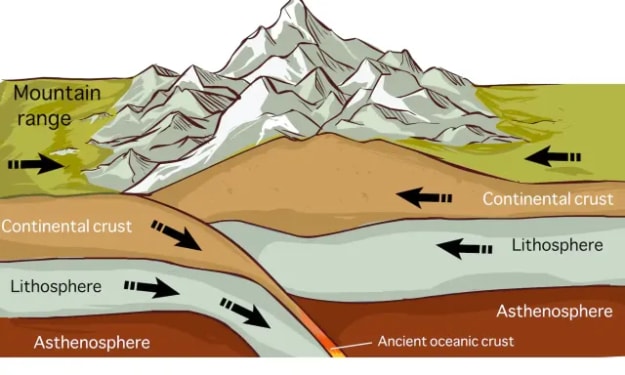
The primary mechanisms behind mountain formation include orogeny, folding, and faulting. These processes are driven by plate tectonics and the Earth's internal forces, leading to the creation of various mountain types such as fold mountains, fault-block mountains, and volcanic mountains.
By Badhan Senabout a year ago in Earth
Volcanoes: Types, eruptions, and Geothermal energy
They play a crucial role in shaping the planet’s surface and influencing its climate. While volcanic eruptions can be destructive, they also contribute to the formation of new land and the production of geothermal energy, a valuable renewable resource. This article explores the different types of volcanoes, the nature of their eruptions, and the potential of geothermal energy.
By Badhan Senabout a year ago in Earth
Earthquakes: Causes, measurement, and impacts
When the Earth's tectonic plates suddenly shift, releasing energy in the form of seismic waves. These seismic waves travel through the Earth, causing the ground to shake. Earthquakes can lead to severe consequences for both human populations and the natural environment. Understanding the causes, how earthquakes are measured, and their impacts is vital for disaster preparedness and response.
By Badhan Senabout a year ago in Earth
Types of rocks (igneous, sedimentary, metamorphic)
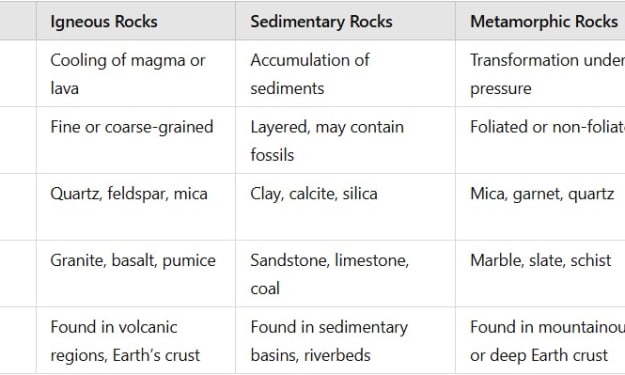
They are classified into three main types based on their formation processes: igneous, sedimentary, and metamorphic. Each type of rock tells a unique story of how it came to be, and their differences are crucial for understanding the Earth's geological history. Below is an overview of each rock type, their formation processes, characteristics, and examples.
By Badhan Senabout a year ago in Earth
Plate tectonics and continental drift
While both theories are interconnected, they are distinct in their focus and history. The theory of continental drift was proposed first, followed by the more comprehensive theory of plate tectonics, which explains not only continental movement but also the dynamics of the Earth’s lithosphere.
By Badhan Senabout a year ago in Earth
Layers of the Earth (crust, mantle, core)
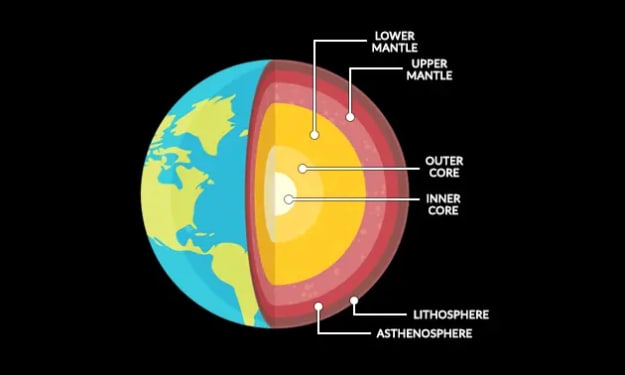
These layers, starting from the outermost to the innermost, include the crust, mantle, and core. Each of these layers has unique properties, composition, and behavior that contribute to the Earth’s overall functioning. Understanding these layers is crucial to grasping how our planet behaves, from the generation of volcanic eruptions to the creation of Earth's magnetic field.
By Badhan Senabout a year ago in Earth