Muhammad yaseen
Stories (11)
Filter by community
The River That Carried My Questions
The river appeared where the forest ended, wide and patient, reflecting the pale light of early morning. Its surface moved slowly, as if reluctant to disturb the silence that rested over the valley. Imran stood on its bank, hands in his pockets, watching the water carry fragments of leaves and sky toward a destination no one could see. He had come here after many restless nights. In the city, time ran fast and loudly. Clocks ruled walls, phones ruled hands, and thoughts ruled sleep. Even when Imran closed his eyes, the world continued speaking inside him — about plans, regrets, deadlines, and choices he feared he had made too late. So he escaped, carrying nothing but questions. The path to the river wound through tall trees whose branches filtered sunlight into trembling patterns on the ground. Birds sang without urgency, as if music itself were a form of rest. Imran walked slowly, uncertain whether he sought answers or simply silence. When he reached the water, he sat on a smooth stone, letting the river speak first. At first, he heard only motion — the soft collision of currents, the whisper of water sliding over hidden rocks. But as minutes stretched into stillness, the sound became something deeper. Not noise, but rhythm. Not chaos, but order. He remembered stories his grandfather once told: that rivers were old teachers, that they carried memories of mountains, rain, and time itself. As a child, he had believed them without question. As an adult, he had forgotten how to believe at all. Imran picked up a small pebble and tossed it into the water. Circles spread outward, widening until they vanished. “Everything leaves a trace,” he murmured. His thoughts drifted back to the crossroads of his life — the job he accepted when his heart hesitated, the relationships he left unfinished, the dreams postponed in the name of safety. He had told himself these were sacrifices, but lately they felt more like abandonments. The river did not argue. Instead, it showed him something simple: every leaf, no matter how torn or twisted, kept moving. Some spun in small circles, trapped briefly by eddies, but eventually they found the main current again. Perhaps, he thought, confusion was not failure. Perhaps it was only a pause before direction. A fisherman appeared upstream, casting his line with slow precision. Each movement seemed deliberate, free from hurry. Imran watched him in quiet admiration. The man waited without impatience, as if time were an ally rather than an enemy. For the first time in weeks, Imran stopped checking his watch. He closed his eyes and listened — not to the river alone, but to himself. Beneath layers of worry, he found a gentler voice, one he had ignored for years. It spoke of curiosity, of unfinished ambitions, of a desire not for success, but for meaning. The river flowed on, unconcerned with human hesitation. When Imran opened his eyes, the light had changed. The sun now climbed higher, painting gold across the water’s surface. He realized that hours had passed unnoticed. Strangely, he did not feel he had lost time. He felt he had recovered it. Before leaving, he dipped his hand into the river. The water was cold, alive, undeniable. It reminded him that motion was natural, that stagnation was the true danger. As he stood, a thought settled gently in his mind: answers were not destinations. They were directions. He did not leave with a plan. He left with something better — clarity without pressure. Walking back through the forest, Imran noticed how light filtered through leaves, how insects traced invisible paths in air, how life continued patiently in every corner. He understood then that wisdom rarely arrived as thunder. More often, it came as water. When the city finally rose again before him, tall and restless, he did not feel the familiar tightening in his chest. The noise would return, yes. The responsibilities too. But now, somewhere beyond schedules and expectations, a river continued to flow — carrying not his answers, but his courage to keep asking. And that, he realized, was enough to begin again.
By Muhammad yaseen9 days ago in Families
The Clock That Forgot to Hurry
In the heart of an old marketplace stood a tiny watch-repair shop that almost no one noticed anymore. Bright digital billboards flashed above it. Smart stores sold devices that measured time with perfect precision. People hurried past the shop every day, glancing only at their phones, trusting machines to tell them when to run, when to stop, when to breathe. Inside that narrow shop lived an elderly watchmaker named Kareem. Kareem had repaired clocks for more than fifty years. His hands were thin, steady, and remarkably gentle. He treated every broken watch not as a machine, but as a small life that had lost its rhythm. What made his shop unusual was a sign hanging above the door: “Time repaired here. Hurry not included.” Most customers smiled at the line and ignored it. Only a few understood. Among them was a young woman named Sara. Sara worked in a fast-growing technology firm across the city. Her days were filled with deadlines, meetings, notifications, and endless planning. She measured life in tasks completed and emails answered. Success followed her closely — promotions, bonuses, praise — yet sleep avoided her, and peace had become a stranger. One evening, after a long day that refused to end, Sara noticed her wristwatch had stopped. Annoyed, she searched for the nearest repair shop and found herself standing before Kareem’s quiet door. The bell above it rang softly as she entered. Clocks covered every wall — large wooden ones, tiny silver ones, antique pocket watches, all ticking at different rhythms, like a choir that refused to sing in perfect unison. Kareem looked up and smiled. “My watch stopped,” Sara said quickly. “I need it fixed. Urgently.” Kareem nodded. “Of course. Please sit.” He examined the watch carefully, opening it with slow, deliberate movements. “You seem in a hurry,” he observed. “I always am,” Sara replied. “Time is expensive.” Kareem smiled gently. “No. Time is generous. We are the ones who are wasteful.” She frowned, uncertain whether he was joking. “Come back tomorrow,” he said. “It will be ready.” “Tomorrow?” she protested. “It’s a simple battery change.” “Not this one,” Kareem replied calmly. “This one has forgotten how to rest.” Something in his tone made her pause. The next evening, she returned. While Kareem worked, Sara noticed a large antique clock in the corner that had no hands. “How do you know the time on that one?” she asked. “I don’t,” Kareem replied. “It reminds me to look at life instead.” She laughed politely, though uneasily. Over the following weeks, her watch failed repeatedly — mysteriously, always after particularly stressful days. Each time, she returned to the tiny shop. Slowly, conversations replaced urgency. Kareem told her stories — of clocks that survived wars, of watches passed through generations, of people who came not to fix timepieces, but to escape time itself. One evening, he said, “Do you know why clocks break more often now than before?” “Because they’re cheap?” Sara guessed. “Because people force them to run faster than they were made to,” Kareem replied. The sentence followed her home. Gradually, Sara began to linger. She arrived earlier, sat longer, listened more. In the ticking chorus of the shop, her thoughts slowed. Her breathing softened. For the first time in years, she felt minutes pass without panic. One night, after a particularly quiet repair, Kareem handed her the watch and said, “This one is fixed. But you are not.” She smiled weakly. “I know.” He hesitated, then reached beneath the counter and placed a small brass pocket watch in her hand. “This was my wife’s,” he said softly. “She died young. For years, I blamed time for taking her too soon. Then I realized — time did not steal her. I simply forgot to cherish her while she was here.” Sara’s eyes filled with tears. “Keep this,” he said. “Not to count minutes. To remember them.” From that day, something changed. Sara stopped checking her phone during meals. She walked home instead of driving. She called her parents more often. She refused meetings that stole her nights. Her success did not disappear. But her life returned. Months later, she found the shop closed. The sign still hung there, but the door was locked. A neighbor told her quietly, “The watchmaker passed away last week. Peacefully. In his sleep.” Sara stood there for a long time. That night, she opened the small brass watch. Inside, engraved faintly, were the words: “The best moments are not measured. They are lived.” Years later, when Sara opened her own small café near the river, she placed that pocket watch above the counter. Beneath it, she hung a sign: “Time welcome here. Hurry left outside.” And people, without knowing why, always felt calmer when they entered
By Muhammad yaseen10 days ago in Education
The Bridge He Never Crossed
The river had always divided the town into two halves. On one side lay the old neighborhoods — narrow streets, familiar faces, small shops where owners still remembered names and stories. On the other side rose the new city — glass buildings, bright lights, offices, opportunities, and futures that promised more than memory. Between them stood a narrow iron bridge. People crossed it every day without thinking. Buses rattled over it. Motorcycles rushed across it. Students walked laughing, lovers paused to take photographs, workers hurried with phones pressed to their ears. Only one man rarely crossed it. His name was Saad. Saad lived his entire life on the old side of town. He taught mathematics at a small school, returned home before sunset, drank tea on his veranda, and spent evenings reading while the world beyond the river glittered in the distance. His life was calm, predictable, and quietly safe. Too safe. Years ago, after finishing university with excellent grades, Saad had received an offer from a large firm in the new city. The salary was generous, the future promising, the path clear. But it required crossing the bridge. Not physically — he had crossed it many times before. But emotionally. It meant leaving familiar streets, aging parents, comfortable routines, and the quiet certainty of knowing where every road led. It meant risking failure, loneliness, and change. So Saad declined. He told himself he valued simplicity. He told others he preferred teaching. He convinced everyone — except himself — that he had chosen wisely. Yet every evening, as the sun dipped behind the glass towers across the river, a strange restlessness stirred inside him. One autumn afternoon, while walking home from school, Saad noticed an old painter standing near the bridge. The man had placed a small wooden stool by the railing and was painting the river with slow, deliberate strokes. His canvas showed neither the old town nor the new city — only the bridge itself, stretching quietly between them. Saad stopped to watch. “You paint only the bridge?” he asked. “Yes,” the painter replied without looking up. “It is the most honest subject here.” “How so?” “Because it belongs to neither side,” the man said. “Yet it connects both.” Saad visited the bridge more often after that. Sometimes the painter was there, sometimes not. When present, he spoke little, but his words lingered. One day, Saad confessed, “I have spent my life avoiding this bridge.” The painter smiled faintly. “Many people live beside their destiny without ever touching it.” Saad frowned. “Is crossing always destiny?” “No,” the painter said. “But refusing to cross is always a decision.” Those words followed Saad home. Memories returned — the ambition he once carried, the excitement he felt when imagining life in the new city, the disappointment he quietly buried when he chose safety instead. Weeks passed. One morning, Saad found a letter waiting on his desk at school. It was from an old university professor. A new training institute across the river was opening. They needed an experienced educator to design curriculum and mentor young teachers. The position was temporary — six months. The pay was modest. The risk, however, was real. Saad folded the letter carefully and placed it in his bag. All day, numbers blurred before his eyes. That evening, he stood at the bridge as traffic rushed past. Lights flickered on across the river, reflections trembling in the water like uncertain thoughts. The painter was there again. “I received an invitation today,” Saad said slowly. “From the other side.” “And?” “I am afraid.” The painter nodded. “Good. Fear means the road matters.” Saad laughed bitterly. “What if I fail?” “Then you return wiser,” the painter said. “But what if you never go?” Saad did not answer. That night, he could not sleep. He imagined two futures. In one, he remained — respected, comfortable, quietly wondering what might have been. In the other, he crossed — uncertain, challenged, but alive with possibility. At dawn, he rose, dressed carefully, and walked toward the bridge. The river whispered below, patient and indifferent. For the first time in years, Saad placed his foot on the iron surface. Halfway across, doubt struck fiercely. He stopped. The old town lay behind him, warm and familiar. The new city waited ahead, bright and unknown. He closed his eyes. And stepped forward. The months that followed were not easy. The institute demanded long hours, new methods, constant learning. Younger colleagues questioned his ideas. Administrators pressured results. Twice, Saad considered quitting. But slowly, something changed. He rediscovered the joy of growth. His lessons improved. His confidence returned. His mind awakened. Students respected him not only for knowledge, but for patience. Teachers sought his guidance. Ideas he had buried for years found voice again. Six months ended. The institute offered him a permanent position. Saad accepted without hesitation. One evening, long after settling into his new life, he returned to the bridge. The painter was gone. In his place, a small unfinished canvas leaned against the railing. It showed a man standing midway across a bridge — paused between worlds — eyes closed, heart steady. On the back, written simply: “Courage is not crossing without fear. Courage is crossing despite it.” Saad smiled. For the first time, the bridge no longer divided his life. It had united it.
By Muhammad yaseen10 days ago in Education
The Letter That Was Never Sent
In the quiet corner of an old town, where houses leaned gently toward one another as if sharing secrets, lived a man named Hamza. Hamza was known as a disciplined man — punctual, responsible, respected. He worked as an accountant in a private firm, kept his papers neat, his words measured, and his emotions carefully hidden behind polite smiles. People trusted him with money, deadlines, and serious matters. Yet no one knew what he trusted himself with. Regret. Every evening, after returning from work, Hamza unlocked a small wooden drawer beside his bed. Inside lay a bundle of letters tied with a faded blue ribbon. The paper had yellowed with time, the ink softened, but the words remained painfully clear. They were letters he had written to a woman named Ayesha. And never sent. Ayesha had once been the brightest chapter of his life. They met during university — in libraries, in corridors, in whispered conversations between lectures. She believed in him before he believed in himself. She read his early writings, encouraged his ambitions, imagined a future where their dreams walked side by side. But Hamza had been afraid. Afraid of commitment. Afraid of failure. Afraid of choosing love before security. When his family arranged a proposal from another household — practical, respectable, convenient — he did not protest strongly enough. He told himself that emotions fade, that stability matters more, that love is a luxury for the brave. Ayesha never argued. She only said quietly, “Some choices do not break hearts immediately. They break them slowly.” Then she left the city. Years passed. Hamza married, built a career, earned praise. His wife was kind, his life orderly, his future predictable. From the outside, everything looked successful. But inside him lived a persistent ache — not loud, not dramatic, just constant. Sometimes, late at night, he reread the unsent letters. I should have told you that you made me less afraid of the world. I should have said that loving you felt like coming home. I should have chosen courage once in my life. He never posted them. Not because he no longer cared — But because he cared too much. One winter evening, while organizing old files at the office, Hamza found a newspaper clipping folded carefully inside a forgotten folder. It announced a literary event in a nearby city. Among the invited speakers was a familiar name. Ayesha Rahman — Author and Educator. His breath paused. That night, sleep avoided him. Memories returned uninvited — her laughter, her patience, the way she listened as if every word mattered. After days of hesitation, Hamza decided to attend the event. Not to speak. Not to explain. Only to see whether time had softened what he never healed. The hall was modest but warm with voices and books. When Ayesha finally appeared on stage, Hamza almost failed to recognize her. She looked calmer now. Stronger. The same thoughtful eyes, but steadier, wiser. She spoke about writing, about loss, about how some experiences shape us silently for years before revealing their meaning. Her words were gentle, yet powerful — as if she had made peace with old wounds. Hamza listened with a tightening throat. After the session ended, people gathered around her. He waited at a distance, heart beating like a nervous student’s. When the crowd thinned, he stepped forward. “Ayesha,” he said quietly. She looked up. For a brief second, surprise crossed her face. Then recognition. Then something softer — acceptance, perhaps. “Hamza,” she replied calmly. “It’s been a long time.” They sat in a nearby café. Conversation came slowly at first — about work, writing, families, cities. Neither mentioned the past. Yet it hovered between them like a third presence. Finally, Ayesha spoke. “I once waited a long time for a letter that never came.” Hamza lowered his eyes. “I wrote many.” “I know,” she said gently. “You always did better with paper than with courage.” He smiled sadly. “I was afraid of choosing wrongly.” “And did choosing safely protect you from regret?” she asked, without bitterness. He did not answer. Before leaving, Hamza reached into his coat pocket and pulled out one folded letter — the oldest of them all. “I never sent this,” he said. “But I think… it belongs to you now.” She accepted it without opening. “Some letters,” she said softly, “are meant not to change the past, but to free the future.” That night, for the first time in years, Hamza returned home and found the drawer empty. He had burned the remaining letters. Not in anger. In release. Months later, something unexpected happened. Hamza began writing again — not letters this time, but stories. Stories about missed chances, quiet courage, slow forgiveness. He published anonymously at first, then openly. Readers connected with his honesty. Invitations followed — small workshops, talks, publications. He did not become famous. But he became lighter. One evening, he received an email from Ayesha. Your words have grown kinder, it read. I’m glad you finally learned to speak to yourself with mercy. Hamza closed his laptop and looked out the window. For the first time, regret no longer felt like a prison. It felt like a teacher. And he understood something that took him decades to learn: Some letters are never meant to be sent. Some loves are never meant to last. But every honest regret can become the beginning of a wiser life.
By Muhammad yaseen10 days ago in Education
The Road That Taught Him Silence
In the small village where the mountains met the fields, mornings arrived quietly. The sun did not rise in a hurry there; it climbed slowly, as if respecting the stillness of the land. Birds were the first to greet the light, their soft calls weaving through the narrow lanes and mud-brick houses. Aamir had learned to wake before the village did. At first, this habit was forced. Sleepless nights, heavy thoughts, and restless dreams had pushed him out of bed before dawn. He did not know where to go, only that staying inside the house made his chest feel tighter, his breath shorter, his mind louder. One morning, without purpose, he stepped outside and began walking toward the path that lay between the barley fields and the low, blue mountains. That path soon became his silent companion. Every day, he walked there — sometimes quickly, sometimes slowly, sometimes stopping for long minutes to watch the wind bend the crops like a green ocean. The path was narrow and uneven, yet it carried him faithfully, never asking where he was going or why. In its quiet presence, he found a strange comfort. Aamir was not unhappy in the usual sense. He had food, family, and education. He taught children in the village school and was respected by many. Yet inside him lived a deep confusion — a soft but constant question: Am I becoming what I was meant to become? He had dreams once — of writing, of speaking beautifully, of guiding others not only through lessons but through life itself. But responsibilities had grown faster than courage. Slowly, without noticing, he had begun to doubt himself. And doubt, unlike pain, does not shout. It whispers. On one such morning, when the mist still clung to the fields like a thin veil, Aamir noticed footprints beside his own. They were not fresh, but they were regular — the marks of someone who walked the same road every day. A few minutes later, he found their owner. An old man sat on a flat stone near the edge of the path, a wooden staff resting beside him, a small flock of sheep grazing quietly nearby. His beard was silver, his clothes simple, and his eyes clear in a way that surprised Aamir. Those eyes did not seem tired by age; they seemed polished by time. “Peace be upon you,” Aamir greeted. “And upon you, peace,” the old man replied warmly. “You walk early.” “So do you,” Aamir smiled. The old man nodded. “The morning is honest. It shows you who you are before the world begins to tell you who you should be.” The words struck Aamir gently, like a leaf touching water. From that day onward, they met often. Sometimes they spoke, sometimes they shared long silences. The old man never asked many questions, yet somehow Aamir found himself speaking — about his students, his ambitions, his fear of wasting his abilities, his constant comparison with others who seemed more confident, more successful, more certain. One morning, Aamir confessed, “I feel as if I am standing still while the world moves ahead.” The old man watched the sheep for a moment, then said, “Have you seen a tree grow?” “Yes.” “Does it run to become tall?” “No.” “Yet it becomes tall.” Aamir smiled faintly. “But people judge trees by their height.” “They do,” the old man agreed. “But trees are not planted to impress people. They are planted to become themselves.” The sentence stayed with Aamir long after the walk ended. Days turned into weeks, and weeks into months. With each walk, something inside him shifted — slowly, almost invisibly. He began to notice small beauties he had ignored before: the way dew rested on grass like tiny mirrors, the rhythm of his own breathing, the calm dignity of the mountains that never hurried yet never failed to stand firm. One morning, Aamir arrived to find the stone empty. No sheep. No staff. No silver-bearded teacher. For several days, he returned at the same hour, hoping to meet the old man again. But the path remained silent, as if it had never known such a presence. Disappointment crept into his heart. On the seventh morning, as he walked farther than usual, he noticed a small bundle placed carefully beside the path. Inside it lay a worn notebook and a folded piece of paper. The note read: “To the one who walks with questions, Do not search for me again. I was only a mirror, not a guide. The road has taught you silence. Silence has taught you clarity. Now let clarity teach you courage. Remember: You are not late. You are not lost. You are simply growing underground.” Aamir sat there for a long time, holding the paper with trembling hands. That day, when he returned home, he opened his old notebooks, the ones where unfinished writings slept like forgotten seeds. For the first time in years, he wrote not to impress, not to compete, but to understand himself. He began to speak more gently to his students, not only teaching lessons, but listening to fears. He encouraged them to walk, to observe, to think, to trust their own pace. And every morning, he still walked the same path. The road never answered his questions directly. But slowly, quietly, it returned something far more precious: The belief that becoming oneself is not a race — It is a journey best taken in silence, With steady steps, And an honest heart.
By Muhammad yaseen10 days ago in Education
The Lantern in the Fog. AI-Generated.
The fog had rolled in thick, pressing like a silent ocean against the narrow cobbled streets of Braxton Hollow. Most nights in the village ended by eight, the townsfolk tucked away behind heavy drapes and bolted doors. But tonight, one light still burned—a solitary lantern swaying gently from a crooked wooden post just outside the tailor’s shop.
By Muhammad yaseen6 months ago in Fiction
The Girl Who Spoke to Shadows. AI-Generated.
In the heart of an old forest where even birds hesitated to sing, there stood a forgotten village. The village had no name. Not because it never had one, but because no one dared to speak it anymore. For generations, a strange silence had fallen over the place, as if the trees themselves whispered warnings through their branches.
By Muhammad yaseen6 months ago in Fiction
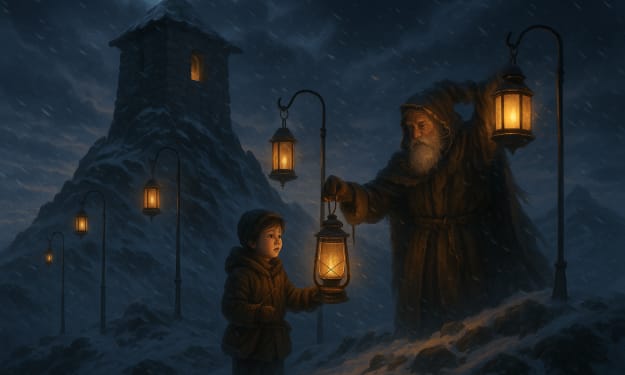
The Lantern Keeper. AI-Generated.
The villagers said no one could survive the storms up on Wyrm’s Peak. The winds tore roofs off houses, the snow fell sideways, and lightning danced like angry spirits. But at the very top, near the ruined watchtower, a single light always flickered through the worst nights.
By Muhammad yaseen6 months ago in Fiction
The Rain That Stayed Too Long. AI-Generated.
It began with a drizzle—innocent, almost welcome. The dusty leaves of the neem tree outside my window trembled as droplets danced upon them. The sky was painted in strokes of ash and pearl, and I remember thinking, Finally, the heat has surrendered.
By Muhammad yaseen7 months ago in Families
The Clockmaker's Promise. AI-Generated.
In the heart of a quiet town stood a shop that didn’t quite fit the modern world. Its sign was faded, its wooden door creaked, and the windows displayed clocks that had long fallen out of fashion. Some were grand and ornate with brass pendulums, others small and delicate, ticking in unison like a choir of memories.
By Muhammad yaseen7 months ago in Fiction
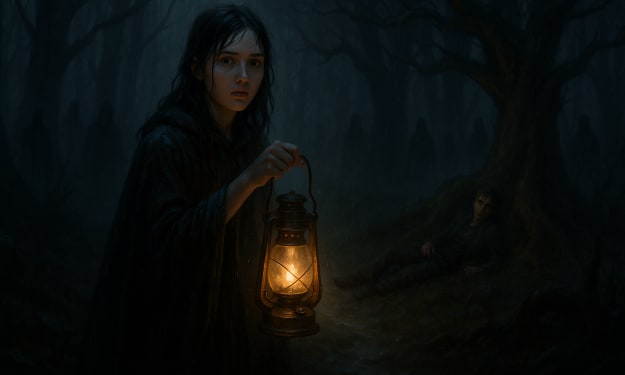
The Lantern in the Storm. AI-Generated.
The wind howled like a wounded animal through the dense pines of Darwain Forest. The clouds above pressed down like a lid on a boiling pot, heavy and brimming with rain. Beneath this stormy sky walked a lone girl, perhaps no older than sixteen, clutching an old brass lantern to her chest.
By Muhammad yaseen7 months ago in Fiction