Peter Ayolov
Bio
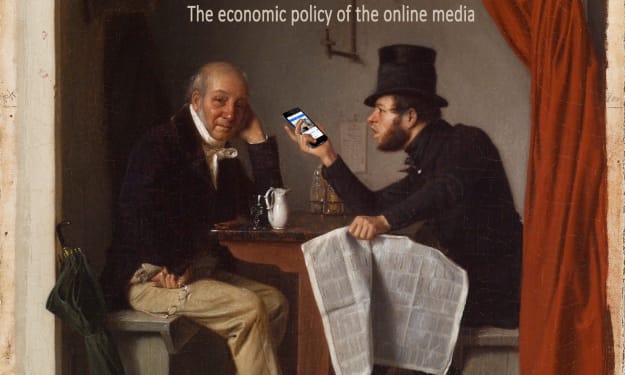
Peter Ayolov’s key contribution to media theory is the development of the "Propaganda 2.0" or the "manufacture of dissent" model, which he details in his 2024 book, The Economic Policy of Online Media: Manufacture of Dissent.
Stories (31)
Filter by community
Moral Outrage Networks, The Sociology of Digital Anger (2026)
Peter Ayolov, Moral Outrage Networks: The Sociology of Digital Anger (2026) Moral Outrage Networks: The Sociology of Digital Anger continues and deepens Peter Ayolov’s earlier work The Economic Policy of Online Media (2023), in which he developed the theory of the Manufacture of Dissent and outlined the Propaganda 2.1 Model as an update to classical propaganda theory under conditions of platform capitalism. While the earlier book focused on the political economy of digital media and the monetisation of dissent, this new volume turns decisively toward the emotional infrastructure that makes such systems viable. Ayolov now advances a more fundamental claim: moral anger is not merely exploited by digital media systems but constitutes one of the basic structural conditions of morality itself, and therefore of social life in networked societies.
By Peter Ayolov10 days ago in BookClub
The Economic Policy of Online Media: Manufacture of Dissent
Peter Ayolov’s The Economic Policy of Online Media: Manufacture of Dissent is best read as a political economy of attention written from inside the contemporary media machine: a study of how dissent is not simply reported, represented, or ‘allowed’, but produced as a monetisable output of platform capitalism. The book’s organising intuition is both simple and unsettling. In the online environment, conflict is not a malfunction of communication; it is a business model. What appears to users as spontaneous outrage, grassroots polarisation, or organic ‘culture war’ is, at scale, a routinised industrial process—engineered through incentives, metrics, and infrastructures that reward emotional volatility and punish slow, careful public reasoning.
By Peter Ayolov10 days ago in BookClub
Toward the Linguistic Apocalypse
Toward the Linguistic Apocalypse What stands before the present age is not a technological crisis but a linguistic one. Artificial intelligence does not announce the rise of a new sovereign intelligence; it announces the collapse of an old regime of words. Power is unraveling not because machines are becoming conscious, but because language is becoming uncontrollable. The monopoly over meaning, interpretation, memory, and narration is dissolving, and with it dissolves the architecture of authority that depended on silence, delay, and scarcity.
By Peter Ayolov14 days ago in Critique
Language After Power
Abstract This article examines recent warnings about artificial intelligence delivered at the World Economic Forum by Yuval Noah Harari, situating them within a broader political economy of language and power. While public discourse frames AI as an emerging autonomous intelligence threatening humanity, this paper proposes an alternative interpretation: the primary fear articulated by global elites is not independent artificial intelligence but the democratisation of advanced linguistic power. Drawing on theories of language, power visibility, and informational exposure, the article argues that large language models threaten existing systems of authority by enabling unprecedented access to linguistic production, interpretation, and disclosure. AI does not merely automate language; it accelerates what can be described as an informational apocalypse, understood in its original sense as revelation. The article concludes by suggesting that contemporary anxieties surrounding AI governance reflect elite concern over the loss of narrative control rather than genuine existential risk, signalling a possible reconfiguration of authority away from financial and institutional actors toward linguistic and philosophical power.
By Peter Ayolov14 days ago in Critique
The Unique Case of Alma Mater TV
(A Review of Charmaine Voigt's Dissertation on Practical Media Training) Abstract This review examines the Bulgarian case study of Alma Mater TV as discussed in Charmaine Voigt's doctoral dissertation College Television: Practical Media Training in US and German Higher Education. While Voigt's work focuses primarily on Anglo-American and German contexts, the Bulgarian example stands out as an exceptional and largely unmatched model of student television in Europe. Alma Mater TV, based at the Faculty of Journalism and Mass Communication at Sofia University 'St. Kliment Ohridski', functioned not merely as a training platform but as a fully operational public-facing television project. Students produced and aired original programmes on Bulgaria's largest national broadcasters without censorship or editorial interference, while simultaneously participating in the creation of a European student television network. This review argues that Alma Mater TV represented a globally unique pedagogical and institutional experiment whose decline resulted not from structural failure but from a lack of strategic vision at the university leadership level. Particular attention is paid to the decisive roles of Professor Svetla Bozhilova and Professor Peter Ayolov in establishing and sustaining this model.
By Peter Ayolov19 days ago in Education
Homo Narrans Vs. Phono Sapiens
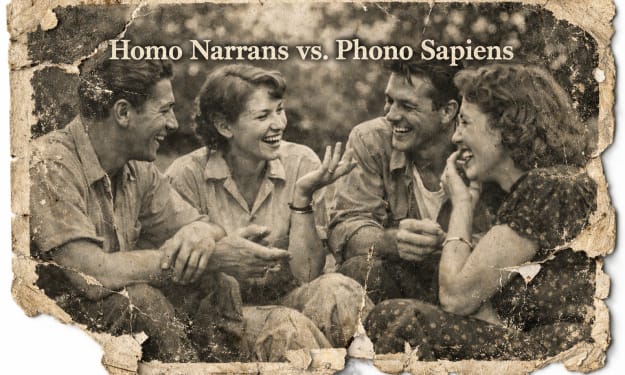
Peter Ayolov, Sofia University “St. Kliment Ohridski” Abstract This article examines the contemporary shift from storytelling as a shared, dialogical practice to storyselling as a performative, market-oriented mode of self-presentation. Drawing on Byung-Chul Han’s book The Crisis of Narration, the analysis argues that narration has lost its primary social function: the creation of a common symbolic world sustained through reciprocal exchange. Traditional storytelling depended on at least two participants and unfolded as a movement back and forth, producing memory, cohesion, and future-oriented meaning. In contrast, storyselling treats narrative as a one-directional instrument for selling identity, success, or visibility, reducing listeners to passive consumers. The article situates this shift within broader transformations of digital capitalism, self-optimisation culture, and communication coaching, showing how conversational depth is replaced by predictable, strategic self-branding. The loss of genuine conversation is presented not as a stylistic problem but as a structural erosion of social bonds and shared meaning.
By Peter Ayolov19 days ago in Critique
Lingua ex machina
Peter Ayolov, Sofia University "St. Kliment Ohridski" Abstract This article examines the claim that language is not merely a product of human nature and evolutionary adaptation, but a force that, once constituted, begins to shape humans in its own image. Drawing on Elan Barenholtz’s Substack essay ‘Syntax is Dead! Long Live Syntax!’ and the University of Toronto discussion ‘The (Terrifying) Theory That Your Thoughts Were Never Your Own’, the text argues that language initially emerged as an adaptive coordination system but gradually detached from its biological origins through external memory technologies such as writing, print, audio, and video. With the advent of large language models, this autonomy becomes visible for the first time. Syntax appears not as an innate causal engine but as an emergent statistical shadow of predictive systems. Language, understood as an autogenerative informational system, now operates as a cultural and cognitive environment that produces meaning, belief, identity, and even metaphysical concepts such as God. In this sense, language does not reflect reality so much as organise it, creating human subjects through symbolic structures that precede intention and awareness.
By Peter Ayolov20 days ago in Critique
Pax Imperialis
Every empire tells a story about itself. It claims to be a reluctant hegemon, a civilising force, a guardian of order in a chaotic world. Edward W. Said captured this imperial self-mythology with ruthless clarity when he wrote: ‘Every empire, however, tells itself and the world that it is unlike all other empires, that its mission is not to plunder and control but to educate and liberate.’ The promise is always peace, stability, progress. Yet behind this language of benevolence stands an apparatus of overwhelming violence. Empires do not rule through persuasion alone. They require an ultimate weapon, a technological embodiment of terror that transforms domination into inevitability and resistance into madness. From the atomic bomb to the Death Star, from clone armies to genetically engineered super-soldiers in The Mandalorian, the logic remains unchanged. Universal peace, or Pax, is purchased through the threat of total annihilation.
By Peter Ayolov20 days ago in Fiction
From Rome to Coruscant to Washington
George Lucas never treated Star Wars as mere fantasy. Beneath its lightsabres and starships lies a deeply historical meditation on how political systems decay. At the heart of his saga is a simple and disturbing proposition: republics are not overthrown, they are surrendered. In Lucas’s vision, the transition from freedom to tyranny is not dramatic or sudden but procedural, bureaucratic, applauded, and rationalised in the name of peace. The model for this story is not fictional at all. It is Rome.
By Peter Ayolov20 days ago in Fiction
Another New Hope, Nope
Abstract In the Star Wars saga the Old Republic maintained peace without strong centralised rule for thousands of years, yet ultimately collapsed not because of a lack of ideals but because of corruption, inflation and financial capture. Over the long arc of galactic history, whoever controls money controls the galaxy. A New Jedi Order that ignores the power of the Banking Clan is structurally doomed, regardless of its moral aspirations. This article argues that Rey’s project, as imagined in the 2026 narrative horizon, cannot survive as a purely compassionate, decentralised pedagogical movement. If the new Jedi are to build a durable peace, they will be forced into alliances that lead them towards the ‘grey’ side of the Force. Rey’s realistic options narrow to two archaic yet resilient traditions: the Mandalorian creed, embodied by Grogu, and the matriarchal religion of the Witches of Dathomir. In a parallel to the Bene Gesserit in Dune, the text explores the provocative thesis that Rey’s only viable solution is not the restoration of monastic celibacy, but the creation of a hereditary aristocracy of Force users. Blood, not intentions, has always structured power in the galaxy. Luke was the son of a queen; Rey is the heir of Palpatine. ‘New Hope’ thus ceases to mean moral rebirth and comes to signify newborns, bloodlines and dynasties. The ultimate irony is that the House of Palpatine–Skywalker may be the only institution capable of surviving a millennium. Palpatine may have lost the war, but his principle – that blood outlives ideals – may yet rule for eternity.
By Peter Ayolov20 days ago in Futurism
From Babel to Code
Abstract This article argues that the central intellectual provocation in Neal Stephenson’s *Snow Crash* is neither the Metaverse as a virtual geography nor the novel’s satirical political economy, but the idea of language as a virus: a transmissible code capable of poisoning cognition, reshaping bodily behaviour, and reorganising social order. Stephenson links this viral model to the Tower of Babel as a myth of linguistic fracture and control, then projects it into a modern world where computer languages become the operational substrate of intelligent machines. The contemporary paradox is that large language models, built on formal code and computational syntax, increasingly mediate everyday human expression. Rather than machines corrupting a pure natural language, the argument developed here proposes the reverse: natural human language is itself unstable, illogical, and socially dangerous, and humans increasingly require technological filters to write, speak, and reason coherently. In an emergent environment where utterances are recorded, searchable, and algorithmically judged, language becomes less disposable and more accountable. The article concludes by interpreting this ‘global library’ condition as a new stage of linguistic civilisation, in which the risk of viral speech persists, yet the possibility of responsible language use expands through machine-assisted memory, verification, and form.
By Peter Ayolov20 days ago in BookClub