Riham Rahman
Bio
Writer, History analyzer, South Asian geo-politics analyst, Bengali culture researcher
Aspiring writer and student with a deep curiosity for history, science, and South Asian geopolitics and Bengali culture.
Asp
Stories (23)
Filter by community
Wheels of Color: The Vibrant Tradition of Bangladesh’s Rickshaw Art
Bangladesh, a country rich in culture and creativity, is home to one of the most unique and colorful folk art traditions in South Asia—rickshaw art. Found on the three-wheeled cycle rickshaws that crowd the streets of Dhaka, Chattogram, and other cities, this mobile artwork transforms ordinary vehicles into vibrant canvases that tell stories, evoke emotions, and reflect the soul of the nation. Rickshaw art is not just a decorative form of expression; it is a cultural statement, a voice of the urban poor, and an emblem of the country’s creative resilience.
By Riham Rahman 9 months ago in Art
The Untold Sides of 'The Hobbit Trilogy'
Th The globally acclaimed fantasy saga The Lord of the Rings and The Hobbit are masterpieces by J.R.R. Tolkien. Brought to life on the silver screen by director Peter Jackson, The Lord of the Rings trilogy focused on Frodo Baggins of the Shire. A decade later came its prequel, The Hobbit Trilogy, with Frodo's uncle Bilbo Baggins taking center stage. Though it didn’t quite match The Lord of the Rings in success, The Hobbit Trilogy was fairly well-received. Today’s piece explores some lesser-known facts about The Hobbit Trilogy, which is set 77 years before The Lord of the Rings. 1. Tolkien started drafting The Hobbit around 1928. This means the story predates The Lord of the Rings and serves as its prequel. Interestingly, Tolkien had left the story half-finished. A student of his, Elaine Griffith, brought the unfinished manuscript to a publisher friend, who was highly impressed. Upon Griffith’s encouragement, Tolkien completed the tale. Hence, she played a crucial role in bringing Middle-earth’s enchanting fantasy to the world. 2. In 1994, director Peter Jackson wanted to adapt The Hobbit into a film after being inspired by the 1978 animated The Lord of the Rings. His original plan was to follow up with two Lord of the Rings films. However, due to creative differences with the production house Miramax, the project stalled. Eventually, New Line Cinema stepped in, helping bring both trilogies to the big screen.
By Riham Rahman 9 months ago in Journal
How to Rum cake recipe
Classic Caribbean Rum Cake Recipe Rum cake is a beloved dessert that blends the rich flavors of butter, vanilla, and rum into a moist and tender cake. Originating from the Caribbean, this cake is a staple during holidays and celebrations. The key to a good rum cake is its texture — dense yet soft — and the flavorful glaze that soaks through every bite.
By Riham Rahman 9 months ago in Lifehack
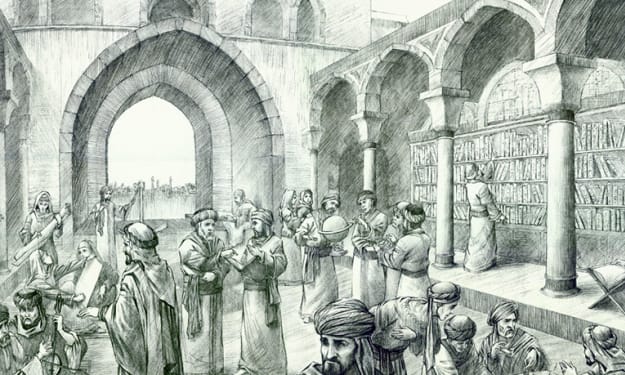
Bayt al-Hikmah: Where Stars of Knowledge Once Shone
During the Abbasid Caliphate, Baghdad emerged as a center of intellectual and economic excellence. One of the most iconic examples of their support for scientific advancement was the famous library of Baghdad, Bayt al-Hikmah—known in English as the House of Wisdom. From around the 5th to at least the 9th century, its collection was considered the largest in the world. The halls of this institution were always abuzz with the presence of prominent scholars of the time.
By Riham Rahman 9 months ago in Journal
The Untold Aspects of The Lord of the Rings Trilogy Pt.2
Last part 8. Avatar (2009) drew significant inspiration from The Lord of the Rings trilogy. How? Let’s explain. In 1994, James Cameron had already completed about 80% of the conceptual work for Avatar. However, due to the limitations of visual effects at the time, he didn’t feel confident enough to begin production. Lacking advanced CGI and VFX, he decided to wait patiently for technological advancements. In 2002, after witnessing the CGI and motion capture used for Gollum in The Two Towers, Cameron was blown away. He realized the time had finally come to bring his dream project to life. And so, he jumped in headfirst to make it happen.
By Riham Rahman 9 months ago in Journal
The Untold Aspects of The Lord of the Rings Trilogy Pt.1
Imagine a group of friends deep in discussion about the greatest fantasy franchises in the world. Naturally, names like Harry Potter, The Witcher, Game of Thrones, Star Wars, Narnia, Pirates of the Caribbean, and Marvel/DC Comics would come up. However, one name that must also be mentioned is J.R.R. Tolkien's immortal creation — The Lord of the Rings. Whether in books or on the silver screen, this franchise remains unforgettable. Formed with a unique blend of friendship, love, vengeance, lust for power, magic, and diverse races, the fantasy of this franchise can easily rival reality. In 2001, renowned director Peter Jackson brought this trilogy to the big screen with the first installment The Fellowship of the Ring. It garnered immense acclaim from critics and audiences alike, essentially immortalizing the franchise. This article dives into some lesser-known aspects of The Lord of the Rings trilogy. 1. The Production Struggle Initially, it was decided that the film would be produced under the Miramax production house, split into two parts. However, due to budget constraints, the studio informed Peter Jackson that the entire story must be condensed into a single film. Knowing this would result in a disaster due to the vast plot, Jackson stood firm. Eventually, New Line Cinema, under Warner Bros., came forward to realize the dream, greenlighting the full trilogy. 2. Casting Surprises Christopher Lee, who played Saruman, originally wanted to play the powerful wizard Gandalf. He was the only cast member who had read the entire book series multiple times—every year, in fact—and even memorized large portions. A true fan of the franchise, he was also the only cast member to have ever met J.R.R. Tolkien. Upon hearing that a film adaptation was in the works, he personally wrote to Peter Jackson requesting to play Gandalf. However, Jackson suggested he take the role of Saruman instead. Interestingly, Scottish actor Sean Connery was offered the role of Gandalf and even promised 15% of the total box office revenue. But he declined, saying he couldn't grasp the complexity of the character. Eventually, the role went to Sir Ian McKellen, who brought Gandalf to life brilliantly. For the role of Aragorn, actors like Nicolas Cage, Stuart Townsend, and Russell Crowe were approached but declined. Ultimately, it went to Viggo Mortensen. American actor Jake Gyllenhaal auditioned for Frodo, but Elijah Wood was chosen instead. 3. Helicopter Fear on Set Sean Bean, who played Boromir, had a severe fear of helicopters. The mountain scenes in the first film were shot in New Zealand, and most cast and crew were flown in by helicopter. But Bean refused to fly, so he would hike for nearly two hours to reach the shooting location. As a result, the entire crew had to wait for him every day on the mountain. 4. Differences Between the Book and the Film While four hobbits accompany Frodo in the films, there were five in the book. The missing one was Fredegar “Fatty” Bolger, who stayed behind in the Shire. He played a role in defending the Shire when Saruman attacked later. He briefly appears in the extended cut. Sauron is only shown as a giant eye atop a tower in the films, but in the book, he has a full physical description. His hunt for the One Ring was aimed at world domination. While the film shows Frodo setting out shortly after Bilbo gives him the ring, in the book, his journey begins 17 years later. Saruman’s death also differs. In the book, after the ring is destroyed in Mount Doom, the hobbits return to find that Saruman has taken over the Shire. They fight him, and eventually, Gríma Wormtongue kills Saruman by slitting his throat in a place called the Scouring of the Shire. 5. Epic Runtime Binge-watching this trilogy is no easy task. Each movie runs for nearly 3.75 hours on average. The original theatrical cuts total 9 hours and 18 minutes, while the extended editions stretch to an astounding 11 hours and 55 minutes — a record-setting runtime for a trilogy. 6. Groundbreaking Effects When the first film was released in 2001, CGI and VFX were just emerging technologies. Many new techniques debuted in this trilogy. To maintain realism, the director heavily used practical elements. Astonishingly, around 18,000 costumes were used, with 30–40 duplicates for each main character. There were also 2,000 unique weapons and about 10,000 arrows used, along with nearly 300 horses. The differences in character heights were achieved using clever camera angles and new visual effects. 7. Editing Nightmare The three films were released in 2001, 2002, and 2003, respectively. The editing team was pushed to their limits managing such large-scale productions. At one point, editing for The Fellowship of the Ring had just finished while The Two Towers was in production, and footage for The Return of the King was already being cut. Even after the theatrical release of the final movie, Peter Jackson shot additional scenes for the extended edition.
By Riham Rahman 9 months ago in Journal
Independence Movements in the Caribbean: Successes and Failures of the Colonial Powers
Independence Movements in the Caribbean: Successes and Failures of the Colonial Powers Before the Second World War, a large part of the world was under colonial rule, with European powers maintaining colonies across the globe. After the war, political awareness grew in these colonized countries, and independence movements gained momentum under various types of political leadership. Nationalism surged in many regions as a result of the war, and the number of independent nation-states began to increase rapidly. At the same time, global population grew, while the size of states decreased. Former colonies often fragmented into smaller states, and new states were created. In many cases, however, the attempt to build new states failed. The Caribbean region, too, holds stories of both success and failure in state-building. Independence of Caribbean Nations Antigua and Barbuda, known for its tourism, and the Bahamas, a popular tourist destination with over 700 islands (many uninhabited but rich in beaches, coral reefs, and natural beauty), are notable Caribbean countries. Barbados, famous for cricket, beaches, and rum, has an economy that relies heavily on tourism and international trade. Barbados gained independence peacefully in 1966 under the joint leadership of the Barbados Labour Party and the Democratic Labour Party. The most well-known Caribbean country for many readers is likely Cuba—the country of Fidel Castro. Along with communism, Cuba is known for its sugar, tobacco, and coffee exports, as well as its music, creative arts, and cigars. Cuba gained independence in 1959 by overthrowing a U.S.-backed government. The Cuban independence movement had begun as early as the 19th century and finally culminated under the leadership of Fidel Castro and Che Guevara, leading to the establishment of communism in the country. Dominica and the Dominican Republic are two other Caribbean nations. Both have agriculture-based economies and export bananas, sugar, and coffee. The Dominican Republic was a Spanish colony and saw violent independence movements in the 19th and 20th centuries. It gained independence in 1821 after three centuries of colonial rule, was then taken over by Haiti, from which it broke free in 1844. Spain reoccupied it in 1861, and later it came under U.S. rule in 1916. The Third Republic was established in 1924, and the Fourth Republic in 1966. The Dominican Republic, with a population of 11 million, now has a per capita income of over $10,000. Sharing the island of Hispaniola with the Dominican Republic is Haiti, known as the world’s first Black republic founded by former slaves. Grenada, famous for its spices, also has an agriculture- and tourism-dependent economy, like most Caribbean countries. Jamaica, one of the larger Caribbean nations, is known for its mountains, rainforests, and scenic beaches—and, of course, for cricket star Chris Gayle. Outside of tourism and agriculture, Jamaica has a growing manufacturing sector and a rich cultural heritage, especially in music. The Jamaican Labour Party and the People’s National Party led Jamaica's independence movement, and the country gained independence from Britain in 1962. Other Caribbean countries include Saint Kitts and Nevis, Saint Lucia, and Trinidad and Tobago. Nearly all these nations were once colonies of various European powers before World War II and have agriculture- and tourism-based economies. Trinidad and Tobago gained independence from Britain in August 1962 under the leadership of the People’s National Movement (PNM), which also ensured a peaceful transition of power. Why Were These Independence Movements Successful? After World War II, the number of independent nations rose rapidly, along with an increase in movements demanding independence. These movements were justified by two main theoretical frameworks: First, the Culturalist Theory suggests that nationalist movements arise from differences and inequalities in cultural identity. These identities may be based on language, ethnicity, or religion. Such identity-based independence movements often derive legitimacy from institutional and social inequalities, with civil society playing a key role in justifying these causes. Second, according to the Rationalist Theory, people make decisions based on the most advantageous outcome. A political force is more likely to join an independence movement if doing so promises political and economic benefits. In most states, there is a core-periphery divide. Groups in the core enjoy more political and economic advantages, while those in the periphery experience the opposite. Eventually, peripheral groups may pursue independence to assert their own political identity and cultural diversity. Third, human beings are inherently drawn to freedom. Most people do not accept colonial rule willingly. On the contrary, they repeatedly engage in political struggles to free themselves from it. Colonial rulers, however, are reluctant to relinquish control due to their economic and political interests. This often leads to conflict between colonizers and freedom-seekers. To suppress independence movements, colonizers typically maintain repressive state structures, which further incite resistance. Fourth, every nation develops its own core values and political philosophies. Although democratic governance is practiced in over 130 countries today, each country shapes its system in its own way. Differences in governance values often lead to conflict between colonizers and local populations. These conflicts may arise from language issues, demands for equitable resource distribution, or religious differences—all of which strengthen the case for independence. Fifth, the post-World War II global political landscape changed significantly. Foreign interference in domestic politics became more prevalent. Often, multiple global powers vied for influence in the same country, leading to clashes that sometimes resulted in independence. Regional political dynamics also played a role, as rival factions often saw the collapse of a colonial power or breakup of a larger state as an opportunity for political gain. Caribbean Territories That Have Not Gained Independence Despite many successes, at least 17 territories in the Caribbean remain under colonial rule. The countries that still hold territories in the Caribbean include the United Kingdom, the Netherlands, France, and the United States. The UK, once a dominant colonial power in the region, still governs several territories including Anguilla, Bermuda, the British Virgin Islands, Montserrat, the Cayman Islands, and the Turks and Caicos Islands. The Netherlands retains control over Bonaire, Curaçao, Saba, Sint Maarten, Sint Eustatius, and Aruba. France controls Guadeloupe, Martinique, Saint Barthélemy, and Saint Martin. The United States governs Puerto Rico. Many of these territories have small local populations, and some islands serve primarily military purposes. Global powers maintain a military presence in the Caribbean to preserve their geopolitical relevance and justify their continued control using various political arguments. These areas also lack a well-developed middle class—essential for a successful independence movement. Additionally, local elites often do not support independence, and the civil society lacks a principled ideological position. These are key reasons why these regions have not yet achieved independence.
By Riham Rahman 9 months ago in History
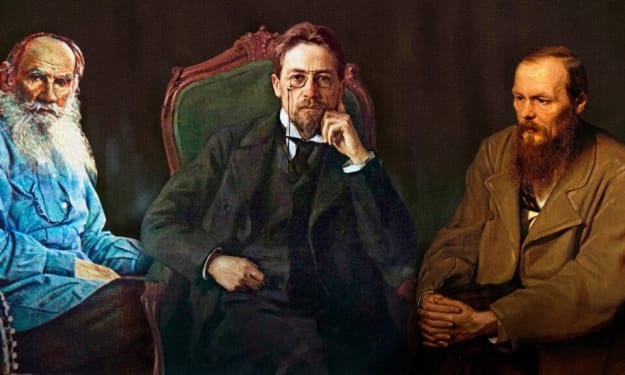
The top 5 great russian writers
Russian writers hold a special place in the world of literature. The influence of Russian literature extends beyond the realm of literary circles—it has impacted politics, economics, and society across the globe. Almost every writer and reader, big or small, holds Russian literature in high regard. There is hardly another example where the writers of a single country have had such a far-reaching influence. Russian literature reached its peak of richness in the 19th century. With a new language, fresh artistry, and modern ornamentation, it brought about a literary revolution that rippled beyond Russia and captivated the entire world. Even today, the world remains enchanted by the fragrance of the Golden Age of Russian literature. This Golden Age was glorified and enriched by several great writers. Today’s discussion is about five of them. Alexander Pushkin Alexander Sergeyevich Pushkin is often called the Shakespeare of Russian literature. The Golden Age of Russian literature began with Pushkin. Though he is regarded as the father of modern Russian poetry, he revived the entire landscape of Russian literature through his dramas, short stories, and novels. Born in 1799 and passing away in 1837, Pushkin was born into an aristocratic family in Tsarist Moscow. Despite his noble birth, he led a revolutionary and combative life. Although he is considered the father of Russian literature, he spent the first ten years of his life primarily speaking French. At just 15, he shocked everyone with his radically different poetry. His poems are largely romantic. Some of his famous works include Message of Europe, Ruslan and Ludmila, The Bronze Horseman, and Boris Godunov. His most beloved literary work is the verse novel Eugene Onegin, which took a lifetime to write. It is so complex that its English translation required two volumes for just 100 pages of the original. Pushkin was influenced by the liberal philosophies of Kant and Voltaire. He was a reformist and consistently wrote against monarchy. His revolutionary poetry frequently brought him into conflict with the authorities, resulting in years of exile. Pushkin was the first Russian writer whose works spread globally. Pushkin led a chaotic life—he was stubborn and short-tempered. He fought many duels. In one such duel by the Black River, he was shot. Two days later, the eccentric, debt-ridden Pushkin died at just 38. By then, he had already reshaped the map of Russian literature. Nikolai Gogol Pushkin’s friend Gogol was born ten years after Pushkin (in 1809) and died fifteen years later (in 1852), living a brief life of just 43 years. Gogol was born into a literary-minded family in Ukraine, then part of the Roman Empire. As a literary heir, he developed an early passion for poetry and drama. Gogol, like Pushkin, led a wild life. He self-published his first poetry book, and when no one bought a single copy, he burned all the remaining copies in a fit of rage. But he didn’t stop writing. He traveled extensively across the Soviet Union, Switzerland, Germany, Italy—even Palestine. He formed friendships with philosophers, writers, and spiritual figures throughout the Soviet region. He held multiple jobs, none of which satisfied him. Initially, Gogol wrote poetry and stories about Ukrainian village life. Over time, his writing style evolved. His friendship with Pushkin greatly enriched both their literary careers. Gogol’s works combined satire and realism, which distinguished him from others. It is believed he mocked Tsarism in his writings. His most famous works include the short story The Overcoat and the novel Dead Souls. It is largely due to Dead Souls that he is considered the pioneer of modern Russian novels. After Pushkin’s death in 1837, Gogol fell into despair and turned toward spirituality. He began to believe that the Devil was using him to write sinful material. As a result, he burned the second volume of Dead Souls. This act of destroying both his first and last books completed a symbolic cycle. After burning the final manuscript, Gogol became bedridden, stopped eating, and eventually died ten days later. Thus ended the life of one of modern Russian literature’s finest minds. Fyodor Dostoevsky The year was 1849. Under the Tsarist regime, a group of revolutionaries was taken before a firing squad for operating a secret progressive society. Just before execution, a last-minute order spared them. They were sent into exile. One of them, Fyodor Dostoevsky, was a novelist, short story writer, and philosopher—now one of the brightest names in world literature. Born in Moscow in 1821, Dostoevsky published his first novel Poor Folk at age 24, considered the first social novel in Russia. His four major novels are Crime and Punishment, The Idiot, The Demons, and The Brothers Karamazov. He became renowned for using the “stream of consciousness” technique, which was later popularized by James Joyce. His characters are complex and tormented, often exhausted and confused by moral dilemmas. Joyce described his novels as full of “violence.” Dostoevsky’s ideas and writing influenced countless writers and philosophers, including James Joyce, Albert Camus, Franz Kafka, Friedrich Nietzsche, Samuel Beckett, and even Albert Einstein. He suffered from epilepsy throughout his life and had a severe gambling addiction. A statue of him still stands at a casino in Germany. He lost his savings and even borrowed money meant for his ill wife's treatment, signing contracts under pressure to pay his debts. Despite this, he continued gambling. His first wife, with whom he had a rocky relationship, died of tuberculosis. Later, he fell in love with his 25-years-younger stenographer Anna and married her. Anna helped stabilize his life. Two months before his death in 1881 at age 59, Dostoevsky completed The Brothers Karamazov, which he dedicated to his beloved wife Anna. Leo Tolstoy Since 1901, the Nobel Prize has been awarded in literature, but the biggest controversy remains the committee’s failure to honor Leo Tolstoy. He died in 1910, and even by then, he was considered the greatest name in world literature. His novels War and Peace and Anna Karenina consistently rank at the top of the greatest literary works of all time. War and Peace took five years to write and spans over a thousand pages with more than 600 characters. It tells the story of Napoleon Bonaparte’s invasion of Russia and the rise and fall of aristocratic families. Anna Karenina, written over three years, explores Russian society and a complex romantic relationship. These two novels alone define Tolstoy’s literary legacy, although he also wrote Resurrection, an autobiography, and many timeless short stories. Born into an aristocratic family in 1828, Tolstoy lost both parents at a young age. He was exceptionally intelligent and hardworking. According to Maxim Gorky, Tolstoy was “a world unto himself.” He taught himself Latin, English, Arabic, Italian, and Hebrew—learning new languages just to read books in their original form. Early in life, Tolstoy was unsure whether to pursue literature, but under the influence of his friend and fellow writer Ivan Turgenev, he began writing. His first book Childhood was followed by two more autobiographical volumes. Most people write autobiographies later in life, but Tolstoy began his literary journey with one, as his life was already filled with remarkable events. After a failed stint managing his estate, he traveled across Europe and even fought in the Crimean War. These experiences enriched Tolstoy’s writing. His work extended beyond novels—his short stories are also invaluable. He was a philosopher, too. His teachings on nonviolence influenced Mahatma Gandhi. In his final years, Tolstoy turned toward spirituality, giving away nearly all his wealth. At age 82, he left home in poverty and died of pneumonia at a small train station in Russia—one of the brightest stars of world literature. Anton Chekhov Continuing the tradition of iconic Russian writers, Anton Chekhov also lived a short life—only 44 years. Born in 1860 and passing in 1904, Chekhov was the son of a serf-turned-merchant father and a Ukrainian mother. He grew up in a harsh family environment. In his words, “I have my mother’s heart and my father’s talent.” Chekhov was a doctor by profession, although he earned very little from it. He traveled across Russia, Ukraine, and even to prisoner camps in Japan, offering free medical help, building hospitals, and treating those suffering during a cholera outbreak. During this time, he wrote several letters considered among his finest works. He began writing to support his family financially after suddenly becoming the primary breadwinner. He submitted pieces to newspapers and gradually realized writing was his true calling. Even in his short life, his works gained immense recognition, both during and after his lifetime. He is regarded as one of the world’s greatest short story writers. His plays rank among the most frequently performed in history. His best-known plays include Three Sisters, The Seagull, and The Cherry Orchard. Though initially slow to gain popularity, his fame grew steadily. His most famous short stories include The Lady with the Dog, The Chameleon, The Black Monk, The Steppe, and A Dreary Story. His stories were often more blunt than traditional tales. Like Dostoevsky, Chekhov also gained fame for his use of stream of consciousness. Afraid of marriage, Chekhov married just three years before his death. He and his wife lived in separate cities. His death was also peculiar. After long suffering from tuberculosis, he one day sat up in bed and said in German—despite barely knowing the language—“I am dying.” He smiled, took a glass of champagne, drank it in one sip, and passed away in 1904. Thus ended the life of one of the greatest short story writers and playwrights in world literature.
By Riham Rahman 9 months ago in History
The Sundarbans: A Proud Heritage of Bengal
The sundarban is a her that fills the people of Bengal with pride. Nature has gifted us with forest paradise so magnificent that its stories can be told to the entire world. Recognized as a UNESCO World Heritage Site, the Sundarbans is the largest mangrove forest in the world, situated at the confluence of the Ganges and Brahmaputra rivers. What doesn’t this forest have? It is the home of the world-famous Royal Bengal Tiger. In addition, there are spotted deer, crocodiles, venomous snakes, turtles, and countless other species. The forest is also rich with diverse trees like Sundari, Garan, and Keora.
By Riham Rahman 9 months ago in History
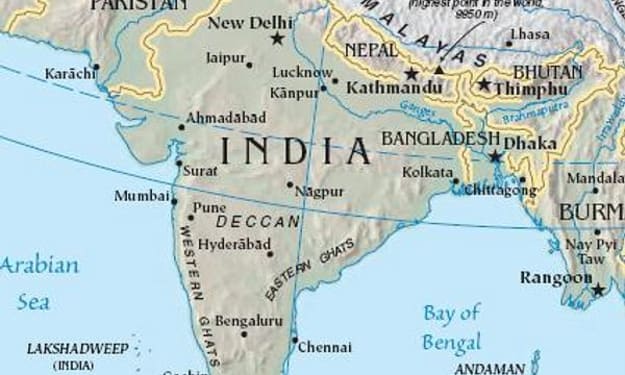
South Asian Geo-politics : current situation
I International politics is never static. A new geopolitical environment, based on a new balance of power is shaping up. Stresses have been building up in the so-called rule-based order, set up by the victors of the Second World War in 1945, for a considerable time since the Cold War ended. The disintegration of the Soviet Union, 9/11 terrorist attacks, the global financial crisis of 2008 –10, COVID-19, the invasion of Ukraine by Russiain 2014 and 2022, and the disintegration of Yugoslavia in which the West played a key role, were some of the notable seismic events that strained the older world order. The bipolar world order of the Cold War years gave way briefly to unipolarity and then multipolarity with the rise of new powers like China, India and others. The inherently undemocratic UN system of multilateralism has become increasingly dysfunctional. It failed to keep international peace and stability as multiple wars broke out with regular frequency in different parts of the world. The rise of new powers and new regional groupings has also challenged the UN system. Globalization that began in the 80s became hyper globalization of the late 20th and the 21st century. Globalization created a lot of wealth but also acute inequity. It failed the test of sabka saath, sabka vikas or inclusive growth. Production became decentralized leading to extended supply chains. The problem was that these supply chains were concentrated in a few countries and were highly vulnerable to geopolitical and natural disruptions. This was amply demonstrated during the Covid in 2020 when the global economy almost came to a halt as millions of lives were being lost and after the Russian invasion of Ukraine in 2022 when grain and energy markets were severely disrupted. The disturbances caused by geopolitics led to the disruptions of supply chains. The world is once again becoming fragmented and protectionist. The underlying principles of the old-world order, namely democracy, free markets, and the rule of law, are being challenged. The problem was that the markets were never fully free and the rule of law was only in name as the most powerful countries continued to call the shots. These deficits of the old order have now been exposed fully. Geopolitics is about the balance of power. Numerous factors shape the global balance of power. But, the relative distribution of power in the world leads to equilibrium or disequilibrium. Those who do not have power in the world are at a disadvantage. They tend to make up for the relative lack of power by aligning with one power or the other or forming groupings amongst themselves based on commonality of interests. We have seen the emergence of a large number of regional groupings, and multilateral arrangements in a variety of political economic and security geometries. Countries also come together in coalitions of the willing based on specific interests. Thus, the balance of power in the world today is highly complex and does not fit into bipolar, unipolar or any other precise frameworks. Multipolarity, a fashionable term, is a flexible term. What it means is that today there are many countries who may not have the overwhelming military power but still remain important in the overall balance of power. The world was multi-polar in the 19th century when several powers were important. The world is returning to multipolarity once again. But, multipolarity can be unstable. The global balance of power is complicated by factors such as climate change, demographic shifts, migrations and the crisis of the commons. New technologies which have brought down the constraints of boundaries have also impacted the notion of absolute sovereignty. Part of the reason why the crises are becoming unmanageable is because the older rules are not sufficient to regulate the powerful new technologies. It is becoming clear that new rules would be required but the world is so fragmented that it is almost impossible to generate consensus on how to agree on them. The international law evolves but slowly and is miles behind the evolution of new technologies. Artificial intelligence, bit coins, and quantum technologies are examples of technologies that cannot be governed so easily by the older rules. As the world fragments, the states are taking recourse to defining their interests narrowly and protecting them with whatever tools and instruments are available to them. The consensus amongst the big powers on larger global issues is also breaking down. Increasingly, the big power are defining their interests in civilizational terms. China, India and Russia are examples of this trend. They are using their civilizational attributes, long histories and rich heritage to come up with narratives that contextualize their rise, protect their interests, and strengthen engagements with like-minded countries. Francis Fukuyama had opined after the end of the Cold War that history had ended with the victory of Western liberal ideas. That was pure hubris. The new rising powers do not subscribe to the Fukuyama view of the end of history. They feel that their moment has come as the West declines. Factors like culture, civilization and religion have become important in the current geopolitics as identifiers. Making America Great Again (MAGA) emphasizes the ‘American identity’ which has been evolving since 1776 when America was formed. Countries like Russia, India, China and those in Europe are much older. They are also asserting their civilizational identities too. In the 1990s Samuel Huntington had predicted that leading civilizations and cultures would clash. This idea has been controversial but worth a critical examination. The rise of Trump in 2017 in American politics brought ‘Trumpism’ to the fore. Trumpism is based on the idea of America First and ‘Making America Great Again’ (MAGA). Such ideas, based on an acute form of American nationalism, are bound to impact America’s standing as a global power. It is also having a domestic repercussion. The American society is deeply divided along multiple axes. Trump’s return is an indication of that phenomenon. It is already leading to stresses and strains in the long-held notion of alliances and shared objectives. Trump has signalled that America will first look after its own interests. He will not allow others to take unfair advantage of America. The return of Trump in 2025 is creating a high degree of stress in the old world order. Trump has little respect for globalism or multilateralism. As a result, the old world is experiencing extraordinary turbulence. One can see that all major powers are today unabashedly nationalistic and are defining their interests and identities in narrow terms. Key Geopolitical Trends The global situation is moving rapidly. A few key trends can be identified as follows. • For the first time in post-Second world war history, the US and Europe seem to be on a collision course. • The US has broken rank with Europe on the Russia -Ukraine war and is dealing directly with Putin, pressuring Ukraine to do a deal with Putin. It has for the moment stopped all military aid to Ukraine and has refused to give security guarantees. • Trump’s policies have raised doubts among allies and friends about its reliability. • Trump has stopped most developmental and arms aid. This will have widespread impact on many developing countries and US strategic partners alike. • Trump has little regard for multilateral institutions. This is evident in the US withdrawal from WHO and the Paris Climate Agreement. • The US is weaponising trade and technology in its foreign policies. It seeks to retain and further its global primacy in trade and technology. Economic coercion is becoming increasingly common. • The US is a global power. Trump is redefining US global interests. The isolationist streak in US foreign policy is coming to the fore. Therefore, a shift in its policies will have a major regional impact. This is already visible: • US-Europe relations are in flux. The future of the transatlantic alliance is uncertain. • Europe is gearing up to spend more on defence and security. Militarization of Europe is on the cards. Europe has to identify Euro 800 billion for defence. A lot of it will be through enhanced debt limits. • The increased defence spending will lead to greater budget deficits and will have domestic consequences at a time when most European economies are under stress and right-wing, anti-immigration forces are raising their head. • In Latin America, the US has pressurized Mexico and Colombia on trade and drugs. The US is redefining its relationships in North and South America. • The US-Canada relations have come under great stress. Canada has been hit with the boycott of US relations. • Trade and technology are at the heart of US-China strategic competition, which is likely to strengthen. There could be a US-China deal involving economic and political issues. US commitment to secure Taiwan is in doubt. • By courting Russia, the US may seek to dent the Russia-China strategic partnership. Whether Trump will succeed in this is still unclear. • The US is desperately scouting for minerals. These are necessary for economic and technological imperatives. It wants to break the Chinese monopoly in this area. Minerals have become a key component of US policies. Africa and Central Asia, Where minerals are in abundance, might benefit from US investments. • In the West Asia/Middle East, Trump is standing solidly behind Israel in the fight against Hamas. Trump wants to turn Gaza into a “riviera” and wants the Gazans to go elsewhere. This kind of radical thinking, amounting to ethnic cleansing, will have a major impact on the balance of power in the region. • But Trump has a larger objective in the Middle East. The US is in support of IMEC, which it sees as a game changer. An alternative to BRI. The US will continue to work for Saudi-Israel rapprochement, but this is not going to be easy. Trump had withdrawn from the Joint Comprehensive Plan of Action (JCPOA) on trans nuclear program in his first term. But his position may be shifting. He now wants a nuclear deal. This is an exciting development. • In the Indo-Pacific, Trump’s position is still evolving. Does he want to free the US from its commitments in Europe and redirect to the Indo-Pacific. China remains a rival but a deal is possible. Commitments to defend Taiwan cannot be taken for granted. Japan will be asked to spend more on defence. It is already doing this. But it faces a very complex security environment. The steps it takes to enhance its deterrence need to be watched. • Trump may approach the North Korean leader and pick up from where he left earlier. South Asia • Let us look at South Asia and how it is going to be impacted by Trump’s policies. • South Asian nations will have to watch out for the unpredictability in Trump's polices on trade, aid, security, immigration, and technology. • It is not clear whether Trump will see South Asia through the lens of US-China rivalry or independently. • As Modi’s visit to Washington shows, Trump continues to regard India as a partner in the Indo-Pacific. Thus, there will be a lot of continuity but some reordering of trade and technology relations is on the card. The US and India are working on a bilateral trade agreement. India should be clear about what the US wants from India. • Myanmar is in the midst of a civil war, and remains mired in an economic crisis China’s influence in Myanmar is tangible. The more the US pressurises Myanmar, the more it helps China in Myanmar. • As in other places, Trump will be transactional in South Asia. it wants India to buy US defence equipment, energy, and open up its market. • The sudden stoppage of USAID will impact many South Asian countries that received large amounts of US aid. • The future of MCC in Nepal is uncertain. Trump cancelled $39 million USAID support for fiscal federalism ($20 million) and biodiversity conservation ($19 fund million). He also suspended for three months the $550 million MCC grant. Nepal has already spent about $190 million on land acquisition and compensation on the project, meant to build power stations, transmission lines and road upgradation. The future of MCC is uncertain. • It remains to be seen how US-Pakistan relations evolve. The two are discussing CT cooperation once again. Trump loves to sees himself in a peacemaker’s role. In his last term he had offered mediation on Kashmir. This may happen again. It is too early to anticipate his policies towards Pakistan. • Bangladesh is in turmoil. The US had a role in it in all likelihood. Bangladesh is highly vulnerable to shifts in US policies on trade, climate change, immigration, humanitarian aid etc. Bangladesh exported USD 10 billion of RMG (Ready Made Garments) to the US last year. It also gets a lot of developmental aid from the US. The closure of USAID will impact Bangladesh about $2.4 billion in humanitarian aid since the Rohingya crisis began in 2017. • At a time when Bangladesh's relations with India have deteriorated. Bangladesh's foreign policy must navigate the delicate balance between China's BRI and the US. On the one hand, China is Bangladesh's largest trading partner and a key investor in infrastructure projects under the BRI. On the other, the US remains crucial for exports, development aid, and global advocacy. The deep-sea exploration potential in Bangladesh's maritime zone adds another dimension to this balancing act. • Sri Lanka would also be watching Trump’s policies closely. The US role in the IMF and other global financial institutions is significant. Conclusion What should we expect in the future? How will geopolitics evolve? Undoubtedly, a new geopolitical environment is shaping up. This is a time of great flux in international relations. Uncertainty has deepened. The churn in international politics will produce unpredictable results. The post-Cold war years have been turbulent. None of the major events were predicted. Should we be prioritizing the ‘balance of interests’, as Russian Foreign Minister Mr Lavrov say? This is an open question. The best one can do it to look at the factors which will impact the future. Climate change, demography, technology, energy, food, water, migrations, minerals, health and skills will certainly impact the future. In all these areas, negative tendencies are palpable. Climate change is unrelenting; most parts of the world except Africa, are going to experience population decline by the end of the century; the environment is degrading rapidly as several planetary boundaries have been crossed or are on the verge of being crossed; food, water are likely to become scarce for large populations; social disruption due to technology is going to become common. These factors will impact future geopolitics or the balance of power. India will have to maintain a steady growth rate which also maintain internal social cohesion. The world desperately needs an infusion of ethics, morality, a sense of right and wrong; a sense of balance and proportion. There is massive wealth in the world but also massive inequality, unsustainable debts and extreme inequity. The new world order needs to be based on the common social ideas of caring and sharing, inclusivity, sustainability, respect for diversity, environmental consciences, peace and stability and not unabashed greed, razor-sharp identities and a sense of rights and entitlement without regard for duty and responsibility. Neither a doomsday scenario is inevitable nor can one be complacent that business as usual scenario will prevail. The older world order is shaping. The actions we take today will decide the future course.
By Riham Rahman 9 months ago in Journal
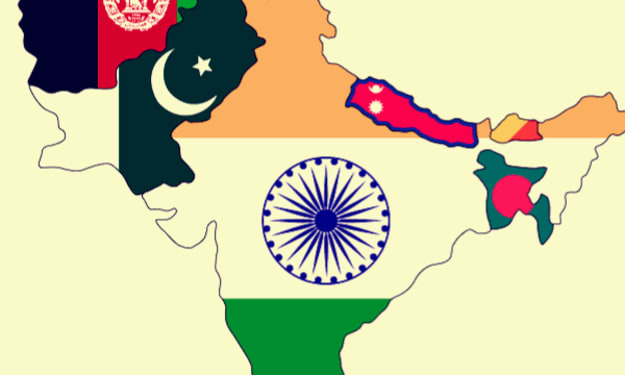
South Asian Geo-Political Shifts: Past and Present
I NBefore discussing the geo-political issues, for this paper, the South Asian (SA) concept needs to be clarified. Countries contiguous to the Indian Sub-continent and within the definition of ‘Indian Sub-Continent’ have been discussed. But countries of the Sub-Continent, mainly in the region between the Indian Ocean and the Bay of Bengal are within the realm of South
By Riham Rahman 9 months ago in Journal