
The Conspicuous Elite
How Authority Learned to Perform Itself

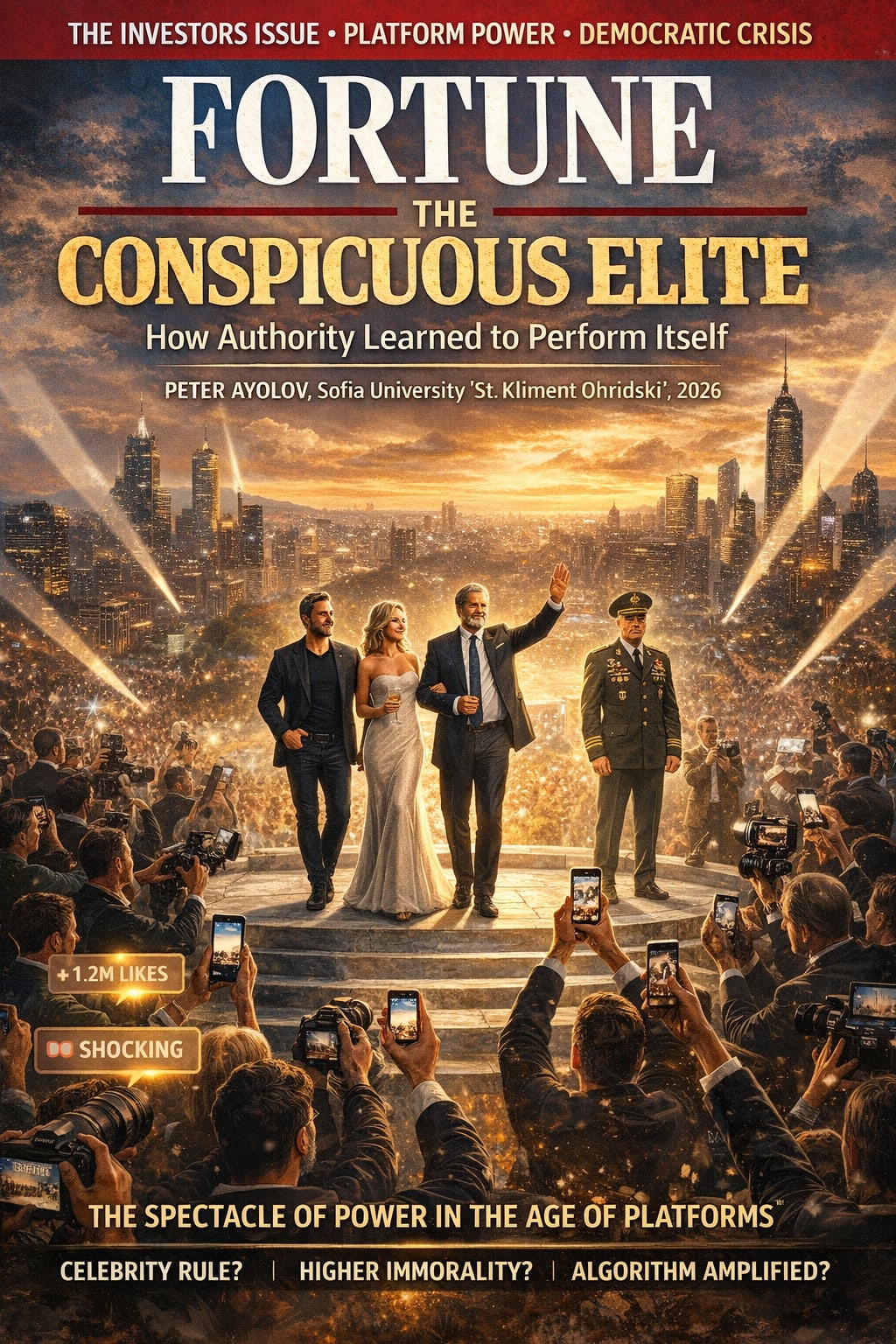
Peter Ayolov, Sofia University ‘St. Kliment Ohridski’, 2026
Abstract
By 2026, the institutional power elite described by C. Wright Mills has not dissolved but reappeared as a conspicuous platform elite, whose authority depends on continuous visibility, biographical myth, and algorithmic amplification. Power is exercised less through discrete command and deliberation than through spectacle, attention, and the conversion of domination into an aspirational life-model. Rereading The Power Elite from the standpoint of 2026, the article foregrounds Mills’s 1956 warning about ‘higher immorality’: a structural condition in which decision-makers at the summits of corporate, political, and military power are insulated from the moral consequences of their actions by distance, scale, bureaucracy, and abstraction. The article argues that higher immorality was never a period detail of mid-century America but an early diagnosis of a durable logic of modern power that has since intensified under platform capitalism. In the contemporary environment of celebrity governance, technical delegation, and algorithmic mediation, higher immorality operates less through secrecy and denial than through public performance and normalisation. In this sense, elite rule culminates in what this article calls ‘The Conspicuous Elite’ or ‘Platform Elite’, where authority is no longer concealed by institutions but performed openly through visibility, narrative, and attention.
Keywords
Higher immorality; C. Wright Mills; power elite; conspicuous elite; platform elite; sociological imagination; platform capitalism; authority and visibility; organised irresponsibility; democratic accountability.
Introduction: When Power Became a Life Model
Mills wrote The Power Elite against the reassuring myth that modern power was dispersed and democratically answerable. From 2026, his diagnosis looks less exaggerated than unfinished. The elites he mapped have not vanished; they have learned to present themselves as moral and cultural protagonists, converting authority into a continuous public narrative. In the platform era, elite biographies no longer sit behind offices and procedures but circulate as spectacle, offered as proof of competence, destiny, and superiority. Visibility becomes a mode of rule: power not only decides, but performs deciding, and the performance becomes part of its legitimacy.
From Institutional Authority to Conspicuous Rule
In Mills’s time, elite power was anchored in corporate, political, and military command posts, and prestige depended increasingly on ‘publicity machines’. By 2026, the image of rule has migrated from the command post to the feed. The elite does not merely inhabit institutions; it inhabits attention. Wealth, influence, and exemption are displayed rather than disguised, while responsibility is dispersed into procedure, expertise, and technical necessity. The decisive shift is not that structure has been replaced by image, but that institutional domination and media performance have fused, making rule appear as success and inequality as destiny.
The Warning of ‘Higher Immorality’
Mills’s concept of higher immorality names a form of organised irresponsibility produced by scale, distance, and bureaucratic insulation. In 2026, this condition is amplified by platform infrastructures that fragment publics, outsource judgment, and reframe power as optimisation. Moral language proliferates—security, resilience, innovation—while moral consequence becomes structurally irrelevant. The result is a political culture in which domination does not need to justify itself as right; it only needs to remain visible, admired, and narratively convincing.
Conclusion: When Power No Longer Needs to Hide
Reread from 2026, Mills’s work is less a Cold War artefact than a sociological warning that has matured into a new cultural form. Authority has learned to survive through conspicuousness: it presents itself as exemplary life while embedding responsibility in systems that diffuse accountability. The central democratic problem is no longer only hidden rule, but the seduction of rule in plain sight—power that is watched, followed, and internalised as aspiration. Mills’s warning about ‘higher immorality’ therefore returns as a present diagnosis: when elites are insulated from consequence, immorality stops appearing immoral and becomes normality, with decay recoded as disruption and antinomian exemption recoded as virtue. Smirnenski’s Stairs to Power remains the final image: ascent is purchased step by step through surrendered hearing, borrowed sight, and finally the loss of heart and memory—until the climber reaches the summit convinced that domination is destiny and the suffering below has, conveniently, ‘nothing to do with me’.
Bibliography
Mills, C.W. (1956) The Power Elite. New York: Oxford University Press.
Mills, C.W. (1959) The Sociological Imagination. New York: Oxford University Press.
Wolfe, A. (2020) ‘Afterword’. In: Mills, C.W. The Power Elite. New York: Oxford University Press.
About the Creator
Peter Ayolov
Peter Ayolov’s key contribution to media theory is the development of the "Propaganda 2.0" or the "manufacture of dissent" model, which he details in his 2024 book, The Economic Policy of Online Media: Manufacture of Dissent.
Keep reading
More stories from Peter Ayolov and writers in BookClub and other communities.
Book Review: Atmosphere by Taylor Jenkins Reid
I flipped the book over in my hands in the centre of the small airport book shop. Although I had heard promising reviews of Atmosphere by Taylor Jenkins Reid, I hesitated. The synopsis didn’t compel me - I wasn’t much of a space girly. In high school it made me cringe when my peers would talk about the stars.
By sleepy drafts3 days ago in BookClub
8 Great Books To Master Your Emotions And Inner Peace
In a world that constantly pulls at our attention, mastering our emotions and cultivating inner peace is no longer a luxury—it’s a survival skill. We juggle careers, relationships, financial pressure, and an endless stream of information, often leaving us emotionally overwhelmed and mentally exhausted. Below is a list of 8 great books to master your emotions and inner peace.
By Diana Meresc5 days ago in BookClub
Writing About Writing: The Rainbow Trap
The good thing about living in modern times is that LGBTQ representation in media is increasing. Not just in niche and Independant media, either, but also in mainstream media. Books, movies, TV shows, comics... they're finally catching on that LGBTQ+ people form a significant part of their audience, and deserve to see themselves on screen and in fiction, not just as victims in documentaries and true crime shows.
By Natasja Rose2 days ago in Writers




Comments
There are no comments for this story
Be the first to respond and start the conversation.