
The Long Walk - From Page to Screen
An Analytical Essay on the Adaptation of Stephen King´s Novel
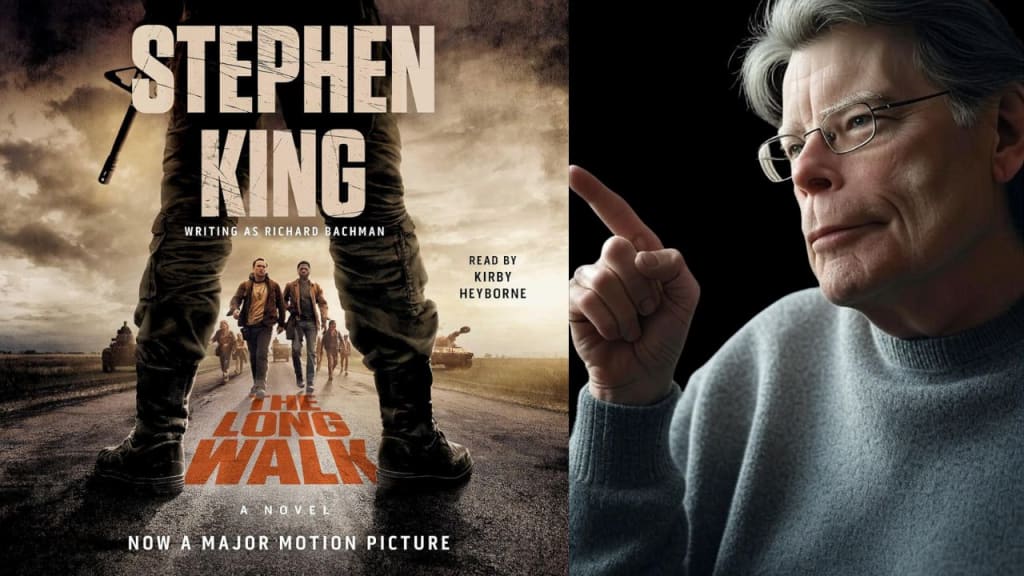
Spoiler Alert: The following article contains detailed spoilers for The Long Walk Movie/Book. If you haven't experienced it yet and want to avoid spoilers, proceed at your own risk!
Introduction: The Long Road from Nihilism to Revolution
Stephen King’s 1979 novel, The Long Walk, published under his Richard Bachman pseudonym, has endured for decades as a masterclass in brutal, minimalist dystopian fiction. Written when King was just a teenager, its simple, horrifying premise—a walking contest where the losers are executed—has haunted readers with its raw depiction of psychological collapse and its pointed critique of a society that consumes its young. The long-awaited 2025 film adaptation from director Francis Lawrence finally brings this grim spectacle to the screen, but in doing so, presents a significantly altered cinematic interpretation. While both works share a terrifying premise, the film deliberately transforms the novel's bleak, Vietnam-era allegory of individual psychological collapse into a modern parable of systemic defiance, achieved through fundamental changes to characterization, thematic focus, and a climactic ending that proved as ambitious as it was divisive among critics.
A Shared Foundation: The Brutal Premise of the Walk
To appreciate the depth of the film's reimagination, it is crucial to first understand the core concept it shares with the novel. Both versions are built upon the chillingly simple rules of "The Long Walk," an annual televised contest set in a totalitarian America. In this national sport, a group of young men must maintain a set walking speed without stopping. If they falter, they receive warnings; too many warnings, and they are summarily executed by soldiers. The last one left walking wins "the Prize," an ultimate reward for surviving an ordeal that guarantees the death of all other competitors. This shared, simple, yet horrifying concept serves as the narrative bedrock from which all thematic and character-based divergences spring.
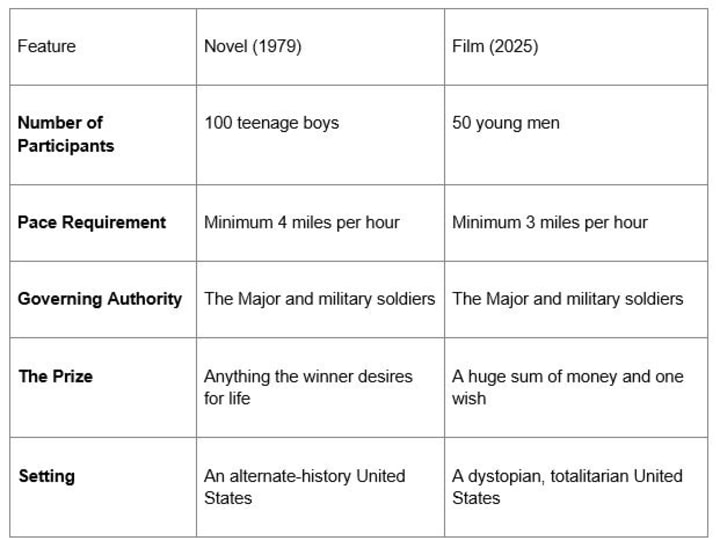
These foundational similarities provide a common ground of dread, but the distinct contextual frameworks of each work reveal their vastly different narrative purposes.
Context and Critique: Reinterpreting Dystopia for Different Eras
Understanding the historical context of each work is crucial to decoding its unique thematic messages about society, violence, and survival. While both the novel and the film use the Walk as a lens to critique a broken America, the specific targets of that critique are products of their respective times.
King’s novel, conceived in 1966 during the height of the Vietnam War, functions as a potent metaphor for that conflict. Critics have long identified its allegorical elements: the draft-like lottery that selects the boys, the jingoistic culture that celebrates the "game," the randomness of death on the road, and the profound psychological trauma inflicted on its young participants. Yet, as academic Fred Mason has argued, the novel's critique extends beyond a single war to encompass broader anxieties of its era. King's text scrutinizes the "hyper-mediation of sport" that exploded in the 1960s and 70s, the rise of so-called "trash sports" like roller derby, and a culture of on-field violence epitomized by teams like hockey's "Broad Street Bullies." In this light, the Walk becomes a grim projection of where sport as spectacle, stripped of playfulness and tethered to nationalist fervor, might ultimately lead.
The 2025 film, arriving in a different socio-political landscape, updates and broadens this critique. Director Francis Lawrence, known for his work on The Hunger Games franchise, shifts the focus from a specific war to a more generalized commentary on systemic oppression and political fascism. The film draws explicit parallels between the walkers' "voluntary" participation and the economic desperation that drives young people to join the military today, framing them as cannon fodder for a system that benefits only the elite. Furthermore, King's story is seen as presciently predicting the rise of reality television, a theme the film embraces by portraying the Walk as a national media spectacle designed to pacify and control the masses.
These overarching thematic shifts are most powerfully expressed through the specific, transformative changes made to the story's central characters.
The Evolution of the Walkers: Character as Thematic Vehicle
The most significant adaptations in the film are found in the characterizations of the protagonists, Ray Garraty, and his closest friend on the road, Peter McVries. These changes are not merely cosmetic; they are fundamental to shifting the story's core message from one of personal despair and psychological unraveling to one of communal hope and active resistance.
Ray Garraty: From Introspective Victim to Revolutionary Agent
In the novel, Ray Garraty's journey is almost entirely internal. His motivations for joining the Walk are subconscious and ill-defined, a tangled mix of rebellion against his parents, youthful naivete, and a grim curiosity. The narrative is a descent into his psyche as his body and mind break down under the relentless pressure. He is a victim of the system, and his story is about the struggle to simply survive it.
The film externalizes his conflict, transforming him into an active protagonist. Portrayed by Cooper Hoffman, this Garraty has a clear, "Hunger Games-esque mission." He enters the Walk not out of confusion but with a specific goal: to avenge his father, who was executed by the state, by winning the Prize and using his wish to assassinate the Major. This provides him with a tangible, revolutionary purpose, turning his personal struggle into a political one from the outset.
Peter McVries: From Damaged Nihilist to Moral Compass
The transformation of Peter McVries is perhaps the film's most radical and telling departure from the source material. The novel's McVries is a tragic figure with a "dark, troubling past." He is haunted by a violent incident with his ex-girlfriend, which left him with a prominent scar and an apparent "death wish." He is cynical, self-loathing, and on the Walk to die.
In stark contrast, the film’s McVries, played with charismatic warmth by David Jonsson, becomes the story's moral and emotional anchor. This version of the character is a kind, hopeful orphan who has spent his life finding the good in people despite immense personal tragedy. He actively builds camaraderie among the walkers, becoming a leader who preaches empathy over hate. Where the novel's McVries is a symbol of self-destruction, the film's version is a beacon of compassion and the embodiment of the story's newfound focus on human connection.
Streamlining the Narrative: Thematic Omissions and Their Impact
To sharpen its focus on political defiance and camaraderie, the film excises several complex thematic threads from King's novel. Gone is the adolescent fixation on sexuality, most notably Garraty’s girlfriend, Jan, whose memory serves as a key, if idealized, motivation for him in the book. Also removed is the subtext of Garraty's "queer struggle," which includes his repressed thoughts and confusing feelings toward both the Major and McVries. By removing these complicated, messy, and at times unsavory elements, the adaptation streamlines its narrative. The choice sacrifices some of the novel's raw psychological complexity but allows the film to concentrate more purely on the platonic, brotherly bond between the male walkers and their shared opposition to the regime.
This recalibration of the characters and their motivations sets the stage for the film’s most profound change: its radical alteration of the story's conclusion.
Two Endings, Two Messages: The Divergence of Despair and Defiance
The ending is the most profound point of departure between the two works, fundamentally defining the ultimate message of each version. In a Q interview, director Francis Lawrence made the fascinating claim that his team "tweaked the ending a little bit without really changing the spirit of the movie." This assertion, however, is a matter of intense critical debate, as the conclusion of each version presents two starkly different theses on the nature of survival, resistance, and hope in an oppressive world.
The Novel's Conclusion: The Inescapable Trauma of Survival
Stephen King's original ending is a masterpiece of ambiguity and nihilism. Ray Garraty is the last man standing after his final rival, Stebbins, simply collapses from exhaustion. However, there is no celebration. His victory is hollow, a prize for enduring unimaginable horror. In his delirium, Garraty experiences a complete psychological break. He hallucinates a "dark mysterious figure" up ahead, beckoning him to continue. As the Major approaches to congratulate him, Garraty ignores him and begins to run, still walking, still in the game. This conclusion reinforces the novel's central theme: in such a system, there are no true winners. The sole survivor is not saved but is instead "damaged beyond belief," trapped in a perpetual state of trauma from which there is no escape.
The Film's Reimagining: Sacrifice, Love, and Political Defiance
The film completely reworks this bleak finale, transforming it into an act of overt political rebellion. The climax unfolds in a dramatic sequence:
- The final two walkers are not Garraty and Stebbins, but the two friends at the heart of the story: Garraty and McVries.
- In a final testament to their bond, Garraty deliberately sacrifices himself. He stops walking so his friend can win, a decision driven by the realization that his own mother is waiting for him, while McVries, an orphan, has no one.
- As the winner, McVries is granted his Prize. He uses his one wish to request a carbine from the soldiers. He immediately turns the weapon on the Major and assassinates him on live television.
Critical reception to this new ending was sharply divided. Some, like Den of Geek, lauded it as a "startlingly transgressive" reimagining. This interpretation frames McVries's final action not as an act of hate, but as one of profound love for his fallen friend, a "symbolic act of defiance" offering a "flicker of... revolutionary desire." Screen Rant argues the action is psychologically earned, the culmination of "the emotional toll of watching his friends pushed to their limit and then butchered," with Ray's tragic death serving as the final straw that breaks him.
A dissenting view, however, comes from prominent critics who found the change unconvincing. David Rapp of Kirkus Reviews labeled the new ending "a misstep—a strange stumble at the finish line after a solid run." Similarly, People's World noted that "The ending, for many, will feel too ambiguous and muddled, especially as so much leading up to that moment is crisp and direct." For these critics, the film’s attempt to inject a clear political message sacrificed the horrifying ambiguity that made the novel a classic.
Conclusion: Fidelity, Reimagination, and the Legacy of the Walk
The 2025 film adaptation of The Long Walk is a deliberate and ambitious act of reimagination, not merely a direct translation of the source material. In moving from page to screen, the story undergoes a profound metamorphosis, shifting from a claustrophobic, Vietnam-era allegory of individual psychological horror into a modern, expansive critique of systemic oppression centered on camaraderie and defiance. While director Francis Lawrence believed he could preserve the novel’s "spirit" while altering its conclusion, the film's success in this endeavor remains a matter of vigorous critical debate. For some, the new ending provides a cathartic, subversive spark appropriate for a contemporary audience hungry for revolutionary hope. For others, like Kirkus's David Rapp, it represents a "strange stumble at the finish line," transforming King's ambiguous horror into something more conventional and less resonant. Ultimately, Lawrence’s adaptation sacrifices the novel’s raw, nihilistic power, but in its place, it creates a new, potent, if contentious, message: that even in the face of certain death, an act of love can become an act of revolution.
(Now you have the opportunity to listen to the audiobook for free by clicking HERE.)
About the Creator
Francisco Navarro
A passionate reader with a deep love for science and technology. I am captivated by the intricate mechanisms of the natural world and the endless possibilities that technological advancements offer.
Keep reading
More stories from Francisco Navarro and writers in BookClub and other communities.
Your Ears Are Your New Reading Superpower
Ever feel like you're constantly battling the clock, wishing you could devour more books but never quite finding the time? What if I told you that reading, as you know it, is evolving? Imagine a world where you can immerse yourself in captivating stories and absorb insightful information while simultaneously tackling your to-do list. It's here, and it's powered by your ears.
By Francisco Navarro6 months ago in BookClub
Rachel Reviews: Lunch Tales: Teagan by Lucille Guarino
Well, I did enjoy this! Sometimes, all you need is just great storytelling and this is what Lucille Guarino delivers here. There's no big message to this book; it's just about folks and families, living their lives and coping with everything that's being thrown at them and finding their way. But when it's done well, like it is here, then you have characters to whom you can relate, tension which leaves you rooting for a better outcome, attraction which has your heart racing and an urge, as a reader, to see the characters happy with the people with whom they belong.
By Rachel Deeming5 days ago in BookClub
The Conspicuous Elite
Peter Ayolov, Sofia University ‘St. Kliment Ohridski’, 2026 Abstract By 2026, the institutional power elite described by C. Wright Mills has not dissolved but reappeared as a conspicuous platform elite, whose authority depends on continuous visibility, biographical myth, and algorithmic amplification. Power is exercised less through discrete command and deliberation than through spectacle, attention, and the conversion of domination into an aspirational life-model. Rereading The Power Elite from the standpoint of 2026, the article foregrounds Mills’s 1956 warning about ‘higher immorality’: a structural condition in which decision-makers at the summits of corporate, political, and military power are insulated from the moral consequences of their actions by distance, scale, bureaucracy, and abstraction. The article argues that higher immorality was never a period detail of mid-century America but an early diagnosis of a durable logic of modern power that has since intensified under platform capitalism. In the contemporary environment of celebrity governance, technical delegation, and algorithmic mediation, higher immorality operates less through secrecy and denial than through public performance and normalisation. In this sense, elite rule culminates in what this article calls ‘The Conspicuous Elite’ or ‘Platform Elite’, where authority is no longer concealed by institutions but performed openly through visibility, narrative, and attention.
By Peter Ayolov6 days ago in BookClub




Comments
There are no comments for this story
Be the first to respond and start the conversation.