Top Stories
Stories in BookClub that you’ll love, handpicked by our team.
Little Ghost Laban
I like to dig into other cultures and languages, particularly when it comes to horror, folklore, and storytelling. There's so much out there that isn't readily available in English. It's the same with your native language, whatever that might be. The world is connected now in a way it never has been, and newer technology allows me to explore it using translation tools. We take these tools for granted today, but they are recent inventions.
By J.A. Hernandez2 years ago in BookClub
Vocal Book Club: Trust by Hernan Diaz
In Yuval Noah Harari’s Sapiens (published in English in 2014) we are reminded of how much fiction underpins our lives. Fiction, Harari argues, is one of the great engines of culture. Religion is a story many choose, collectively, to believe: it is the story that creates culture and cohesion. He uses the example of a brand — Peugeot — to enquire how we imbue fictions with significance. What connection can anyone now make between a company founded in the early 19th century with the car manufacturer of today? What does the “Peugeot” symbol on the front of an automobile signify? There’s one answer: a story. Perhaps you buy the car because, at some level, you believe the story.
By Erica Wagner2 years ago in BookClub
They're Challenging Reading Challenges?
In 1961 the town of Tarzana, California pulled a book off of the city library shelves as it was deemed unsuitable for children. The offense was clear: the story, one of a group of adventures, featured a couple clearly living in sin: Tarzan and Jane.
By Judey Kalchik 2 years ago in BookClub
Vocal Book Club: Tom Lake by Ann Patchett
Tom Lake is not your ordinary pandemic novel, though it begins in that strange — and awful — spring of 2020. It is set in northern Michigan, on the cherry orchard belonging to the Nelson family. It interrogates the family’s life and the memories of Lara Nelson, once an actress, as she talks with her three grown daughters. They are Emily, who in time will settle on the farm; Maisie who’s at veterinary school; and Nell who hopes to follow in her mother’s thespian footsteps.
By Erica Wagner2 years ago in BookClub
William Shakespeare's Coriolanus
Written around 1608, Coriolanus was possibly William Shakespeare’s last tragedy. He wrote four such plays set in Ancient Rome, and coincidentally his first tragedy, Titus Andronicus, is also one of these. However, while Titus is not very accurate historically, for Coriolanus (as well as Julius Caesar and Antony and Cleopatra) Shakespeare made extensive use of Plutarch’s Lives of the Most Noble Grecians and Romans which had been translated into English by Thomas North in 1579. Coriolanus does not appear to have seen print in Shakespeare’s lifetime, and the earliest text is from the posthumously-published First Folio of 1623.
By Doc Sherwood2 years ago in BookClub
Book Review: Clytemnestra’s Bind by Susan C Wilson
The House of Atreus is spiralling into self-destruction—a woman must find a way to break the family curse. Queen Clytemnestra's world shatters when Agamemnon, a rival to the throne of Mycenae, storms her palace, destroys her family and claims not only the throne but Clytemnestra herself. Tormented by her loss, she vows to do all she can to protect the children born from her unhappy marriage to Agamemnon. But when her husband casts his ruthless gaze towards the wealthy citadel of Troy, his ambitions threaten, once more, to destroy the family Clytemnestra loves. From one of Greek mythology's most reviled characters—a woman who challenged the absolute power of men—comes this fiery tale of power, family rivalry and a mother's burning love. Placing motherhood at the heart of the story, Clytemnestra’s voice is heard in a new way. It also explores society's obligation to conform to stereotypical gender expectations and shows the explosive powerplay between men and women in a patriarchal society.
By Marie Sinadjan2 years ago in BookClub
Knowing the Enemy: The Last Tribes of Britannia by Lea Moran
I love stories about ancient Britain and Lea Moran does an excellent job of creating a tale set in those times, which draws on the uncertainty between tribes and the fight for dominance as well as the fear of invasion from outsiders.
By Rachel Deeming2 years ago in BookClub
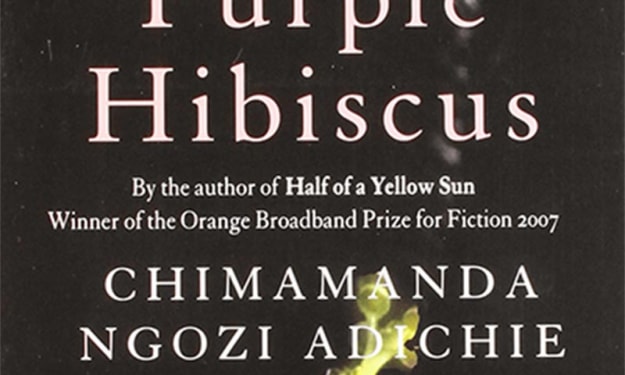
PURPLE HIBISCUS
I had always wanted to read Chimamanda’s books. To be honest, it’s because everyone was reading “Americanah” and because of FOMO I wanted to join the bandwagon. I then realized that she had more books and they were all super hyped. After watching her TED talk “We should all be feminists” I thought she was amazing. When I got “Purple Hibiscus” I understood the hype because the book was captivating.
By Catherine Nyomenda2 years ago in BookClub
Pencil Lines and Plotlines
This year, I dove into a few graphic novels - I wanted to mix things up since I have been reading an average of over 60 books a year. I thought it would be nice to expand my literary horizons and slip back to a genre that I was comfortable with from the beginning.
By Xine Segalas2 years ago in BookClub
Vocal Book Club: Tomorrow, and Tomorrow, and Tomorrow by Gabrielle Zevin
Sadie, Sam and Marx are the central characters of Gabrielle Zevin’s remarkable 10th novel, Tomorrow, and Tomorrow, and Tomorrow. Sam and Sadie meet when they are 11 years old, in the games room of a Los Angeles hospital. Sam — fervently playing Super Mario Bros — is chronically ill; Sadie’s older sister is dying of cancer. Eventually Sam and Sadie will become game designers of the highest order, their friend Marx a kind of abiding spirit who keeps them together and lifts them to greater heights — even as tragedy strikes.
By Erica Wagner2 years ago in BookClub