
When Empires Ruled the World
The Rise and Fall of Civilizations That Shaped Humanity
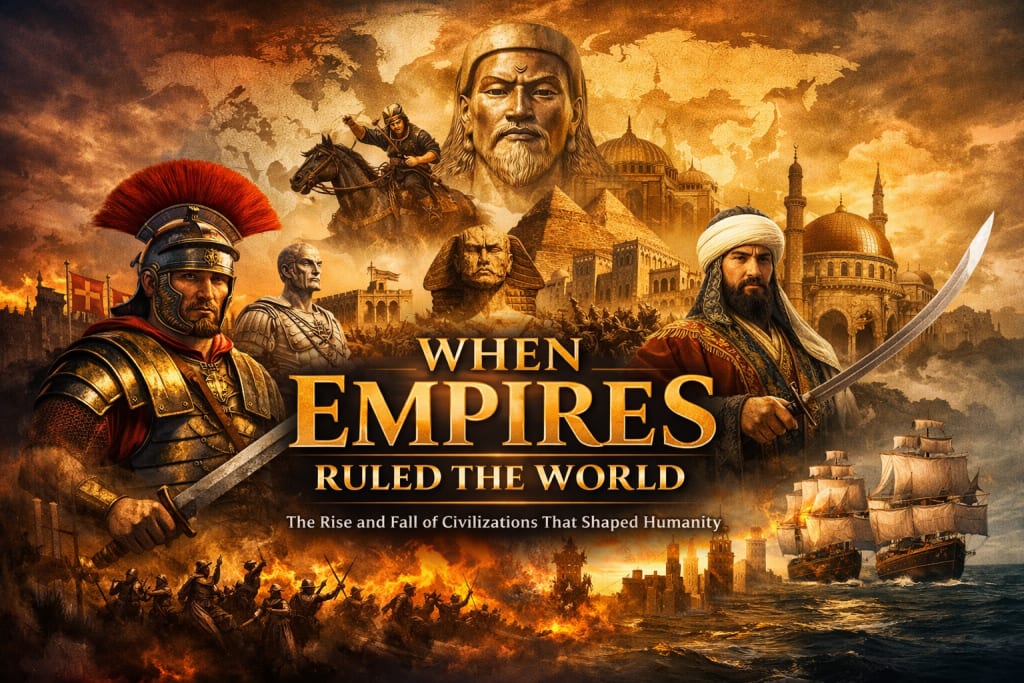
History is, in many ways, the story of empires — vast political and cultural systems that stretched across continents, united diverse peoples, and reshaped the destiny of humanity. For thousands of years, empires ruled the world, rising from humble beginnings to dominate trade, warfare, culture, and innovation. Yet, no matter how powerful, every empire eventually faced decline. Their legacies, however, still echo in our laws, languages, borders, and beliefs.
This is the story of when empires ruled the world — how they rose, how they governed, and why they fell.
The Birth of Empire
Empires did not begin as empires. Most started as small kingdoms, city-states, or tribal territories seeking survival and security. Expansion often began with the need for resources — fertile land, water, trade routes, or minerals. As military strength grew, so did ambition.
One of the earliest known empires was the Akkadian Empire (c. 2334–2154 BCE) in Mesopotamia. Founded by Sargon of Akkad, it united multiple city-states under one rule for the first time in recorded history. This model — centralized authority ruling diverse regions — became the blueprint for future empires.
Empires offered advantages: larger armies, shared economies, cultural exchange, and administrative systems. But they also required strong leadership, organization, and control.
The Persian Empire: Masters of Administration
The Achaemenid Persian Empire (c. 550–330 BCE) became one of the largest empires the world had seen, stretching from Egypt to India.
Founded by Cyrus the Great, Persia thrived not just through conquest but through governance. The Persians introduced:
Provincial administration (satrapies)
Standardized taxation
Royal road networks for communication
Religious tolerance policies
Their approach allowed diverse cultures to coexist under imperial rule — a strategy many later empires adopted.
Yet, even Persia fell, conquered by Alexander the Great in 330 BCE — proof that military brilliance could topple even the most organized systems.
The Roman Empire: Engineering Power and Law
Few empires shaped the modern world like Rome. From a small republic in Italy, Rome expanded across Europe, North Africa, and the Middle East.
Rome’s power rested on multiple pillars:
1. Military dominance – Highly trained legions secured and expanded territory.
2. Infrastructure – Roads, aqueducts, and cities unified the empire.
3. Law and governance – Roman law still influences modern legal systems.
4. Cultural integration – Conquered peoples were often granted citizenship.
At its height (2nd century CE), Rome governed over 60 million people.
But internal corruption, economic troubles, political instability, and external invasions weakened Rome. In 476 CE, the Western Roman Empire fell — marking the symbolic end of ancient imperial dominance in Europe.
The Han Dynasty: China’s Imperial Foundation
While Rome ruled the West, the Han Dynasty (206 BCE–220 CE) consolidated imperial power in East Asia.
The Han era established systems that defined Chinese governance for centuries:
Civil service examinations
Confucian state philosophy
Silk Road trade expansion
Advances in papermaking, metallurgy, and astronomy
The Silk Road connected China to Rome, Persia, and India — proving empires were not isolated giants but interconnected worlds.
Like others, the Han fell due to court corruption, peasant rebellions, and regional warlords.
The Islamic Caliphates: Faith and Empire
Beginning in the 7th century, Islamic empires expanded with extraordinary speed. Within a century of Prophet Muhammad’s death, the Umayyad and later Abbasid Caliphates ruled from Spain to Central Asia.
Their influence extended beyond conquest:
Preservation and translation of Greek knowledge
Advances in medicine, algebra, astronomy
Architectural achievements
Global trade networks
Baghdad’s House of Wisdom became a center of learning during Europe’s early medieval period.
Fragmentation, internal rivalries, and invasions — including the Mongols — led to decline, but their intellectual legacy fueled later global progress.
The Mongol Empire: Conquest Without Precedent
No empire expanded faster than the Mongol Empire under Genghis Khan and his successors in the 13th century.
At its peak, it stretched from Eastern Europe to East Asia — the largest contiguous land empire in history.
The Mongols were feared for their brutality but also facilitated:
Safer Silk Road trade (Pax Mongolica)
Cultural and technological exchange
Diplomatic connectivity between East and West
However, governing such vast territory proved difficult. The empire fragmented into khanates, gradually losing unity and power.
European Colonial Empires: Global Domination
From the 15th to 20th centuries, European powers built overseas empires that reshaped the globe.
Major colonial empires included:
British Empire – “The empire on which the sun never set”
Spanish Empire – Dominant in the Americas
French Empire – Africa and Southeast Asia
Portuguese Empire – Brazil, Africa, Asia
Colonial empires were driven by:
Trade and resource extraction
Maritime technology
Missionary expansion
Strategic dominance
They spread languages, religions, and governance systems worldwide — but also caused exploitation, slavery, and cultural destruction.
By the mid-20th century, independence movements dismantled most colonial empires.
How Empires Governed Diverse Peoples
Ruling vast populations required innovation. Successful empires often shared governing strategies:
1. Infrastructure – Roads, ports, communication networks
2. Tax systems – Funding armies and administration
3. Cultural tolerance (selective) – Reducing rebellion
4. Military presence – Deterring uprisings
5. Bureaucracy – Managing records, laws, census data
Empires that balanced control with inclusion lasted longer.
Why Empires Fell
Despite their might, no empire proved permanent. Common causes of decline included:
1. Overexpansion
Large territories strained military and administrative capacity.
2. Economic instability
War costs, inflation, and taxation weakened economies.
3. Political corruption
Power struggles eroded governance.
4. Rebellions
Conquered peoples resisted imperial rule.
5. External invasions
Rival empires and nomadic forces exploited weaknesses.
6. Cultural fragmentation
Diverse populations sometimes lacked shared identity.
Decline was often gradual — a slow erosion rather than sudden collapse.
Cultural Legacies of Empires
Even after their fall, empires left enduring marks:
Languages – English, Spanish, Arabic spread globally
Religion – Christianity, Islam, Buddhism expanded through empires
Law – Roman law influenced modern justice systems
Trade routes – Foundations of globalization
Architecture – Roads, monuments, cities
Modern borders, conflicts, and alliances often trace back to imperial decisions.
Empires in Historical Memory
How we remember empires is complex.
Some view them as engines of progress — spreading technology, governance, and culture.
Others see oppression — exploitation, slavery, cultural erasure.
Both perspectives hold truth. Empires built and destroyed, unified and divided, advanced and exploited.
History demands we examine both sides.
From Empires to Nation-States
By the 20th century, the imperial model weakened. Nationalism, democracy, and self-determination reshaped global politics.
World Wars drained imperial powers. Colonies demanded independence. International law challenged conquest.
The age when empires ruled the world gave way to sovereign nations — though echoes of empire remain in geopolitics and global inequality.
Conclusion: The Echoes of Imperial Power
When empires ruled the world, they defined humanity’s trajectory. They connected continents, built trade networks, spread ideas, and forged civilizations.
But power carried costs — conquest, suffering, and resistance.
Their rise teaches us about ambition, innovation, and governance. Their fall warns of overreach, inequality, and fragility.
Today’s superpowers operate differently, yet imperial lessons remain relevant: no dominance is permanent, and legitimacy matters as much as strength.
Empires may have faded, but their shadows shape our present — in borders we cross, languages we speak, and systems we live under
History’s imperial age reminds us of a timeless truth:
Power can rule the world — but it can never rule forever.
About the Creator
Keep reading
More stories from Aiman Shahid and writers in Confessions and other communities.
The Loneliness of Being “The Strong One”
In every group, workplace, or family, there’s often one person who everyone relies on — the one who seems unshakable, calm under pressure, and capable of handling anything life throws their way. This person is often called “the strong one.” On the outside, being strong is admirable. People trust you, seek your advice, and lean on your support. But beneath the surface, there’s a hidden cost. Being the strong one can be lonely, exhausting, and isolating. While others see resilience, the reality often includes quiet struggle, emotional suppression, and a longing for someone to lean on in return.
By Aiman Shahida day ago in Confessions
Lately, I'm empty
Lately, I feel an emptiness inside of me that doesn’t make any sense. I was fine a week ago and now I’m numb to the pain that I’ve been carrying around. Numb to the idea of me existing. I wish I could go to a place where I can hear happy positive thoughts and surround myself with joy. The medication I’m on doesn’t seem to work anymore. I still feel pain from existing, why am I here anyways? Merely to exist. I don’t feel like I’m making any differences being here.
By Cerina Galvan5 days ago in Confessions
How University Students Experience Love While Balancing Studies
University represents a significant change in the aspects of personal freedom, responsibility, and awareness of emotions, so the importance of love seems exciting and overwhelming. When students join campuses, they are usually excited to get meaningful relationships as they adjust to the new academic demands. Romantic relationships grow fast within the same environment such as libraries, hostels and classrooms where emotional attachment is built through shared emanation and aspiration. Love gets mixed with the everyday life, as late-night chats are mixed with studying exams. This proximity may exaggerate emotions, relationships feel very intimate and emotionally intense at an already changing stage of life.
By Grace Smitha day ago in Confessions




Comments
There are no comments for this story
Be the first to respond and start the conversation.