how to
How Tos for lawful misconduct; explore forensic analysis, legal proceedings, police investigations and beyond.
Pros & Cons of Representing Yourself Vs Having a Criminal Defense Lawyer
Representing yourself in a criminal case, also known as self representation can be a daunting task fraught with challenges. On the other hand, hiring a criminal defense lawyer offers several advantages. To understand the pros and cons of each option, let's dive into the details:
By Marder and Seidler3 years ago in Criminal
The Perfect Crime
Introduction: Andhra Pradesh, a land of rich culture and tradition, is now shrouded in darkness as a heinous crime grips the coastal town of Vizag. In this gripping crime story, we delve into the heart of the investigation, uncovering the twisted truths and unmasking the perpetrators behind the veil of shadows.
By Renuga kannan3 years ago in Criminal
The Slippery Brains
The Slippery Brains The Heist The moon cast a ghostly shine on the abandoned roads as dimness wrapped the city. The famous crook engineer known as "The Shadow" had carefully arranged his most recent heist. His objective: the National Bank of Verdon, supposed to hold a fortune in extremely valuable relics.
By George Michael3 years ago in Criminal
Negotiating Fair Settlements: How a Hamilton Car Accident Lawyer Fights for Your Compensation
Car accidents can be traumatic, and the aftermath of an accident can be stressful and overwhelming. It is essential to have a car accident lawyer on your side who can help you navigate through the legal process and ensure that you receive fair compensation for your injuries. A skilled lawyer can negotiate with insurance companies on your behalf, ensuring that you receive maximum compensation for medical bills, lost wages, pain and suffering.
By Rohit Kumar3 years ago in Criminal
The Trio
Tyler Granum, 18, turned himself in to the Miami-Dade Police Department on Monday and was charged with armed robbery, an arrest report said. Two other suspects, 21-year-old Kaya Burgos and 18-year-old Jayden Sanders, were arrested last week in connection with the same crime. The report did not specify what led to the arrests or what the suspects allegedly stole.
By Ebem Charles 3 years ago in Criminal
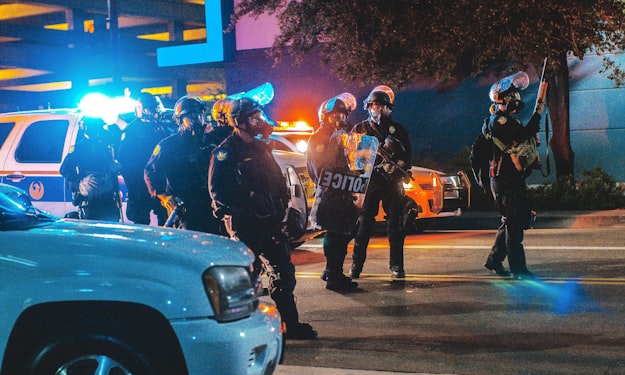
The Unfolding of a Police Story: Exploring the Challenges, Responsibilities, and Evolving Role of Law Enforcement . Content Warning.
Police stories have captivated audiences for decades, shedding light on the intricacies of law enforcement, the courage of those who serve, and the complexities they face in maintaining peace and order. In this essay, we delve into the world of policing, exploring the challenges, responsibilities, and the evolving role of law enforcement in society.
By Peter Kaan3 years ago in Criminal
Booked One Night Hotel And Didn't Pay his $70,000 Bill
The man, identified as a 44-year-old from the United Arab Emirates, was arrested after trying to leave a five-star hotel in Mumbai without paying his Rs 5 million ($70,000) bill for 603 days of stay. The accused had checked into the hotel on December 1 last year and did not check out till August 13 this year.
By Ebem Charles 3 years ago in Criminal
Do gun buybacks work?
This is a list of countries with the most guns per person. Leading the list is the US, the only place in the world where guns outnumber people. Yemen is second with 53 guns per 100 people. This is primarily because Yemen has been fighting a civil war for a decade. Tied in third place is Serbia. No other country in Europe has more firearms per capita than Serbia. This is also a legacy of conflict, most recently in the former Yugoslavia throughout the nineties. But Serbia is trying to get off the list. To do that, they're trying something big. They're asking Serbians to surrender their guns. And they're not the first to try it. From the end of the Yugoslav wars in 2001 until 2023, there were five mass shootings in Serbia. But then in May of 2023, there were two, just one day apart. First, a seventh grader opened fire at a school and killed eight students and a security guard. The very next day, another mass shooter killed eight people and wounded 15 a few miles away. In response, Serbia's president vowed to disarm the country. His plan included a monthlong program that would allow Serbians to surrender illegal guns, called a "weapons amnesty." These are also sometimes called "gun buybacks." It's not Serbia's first amnesty, but it's been the most successful in the country's history. More than 26,000 weapons, 1.3 million rounds of ammunition and 6000 explosives were surrendered. But will removing all these weapons work? And how do we know? One place to look for answers is a country that's tried something similar: Australia. On April 28th, 1996, a young man drove to the tourist town of Port Arthur, Tasmania, and opened fire with a semi-automatic rifle, killing 35 people and wounding 18. As Australia prepares to mourn the victims, there have been urgent calls for tough new gun laws. Just 12 days later, Australia adopted a national firearms agreement. It centered around ten core measures, including registration, licensing and safety training. But the number one priority was a ban on automatic and semi-automatic weapons, the most dangerous in mass shootings. To retrieve these newly banned weapons already in circulation, the agreement also included a yearlong gun amnesty. Asking Australians to give up their weapons wouldn't be easy. "Are you going to surrender your arms?" But it turns out, the conditions were just right. And looking at the features of Australia's program can help us understand why it worked. First, gun reform in Australia had overwhelming public support. After Port Arthur, thousands took to the streets to demand change. And polls showed that about 90% of Australians backed them up. Second, Australia's weapon amnesty program was national, not just in certain parts of the country. And the government paid fair prices for every item surrendered. Businesses impacted even got government assistance. The amnesty was anonymous, with no consequences. But it was also mandatory, with serious penalties for noncompliance. To facilitate compliance, buyback centers where Australians could drop off their weapons were set up across the country. Finally, once the weapons were collected, they had to be destroyed. That typically meant crushed and then melted. And all of this had to be implemented alongside new firearm restrictions to keep illegal weapons out of the public's hands after the amnesty was over. Australia's 1996 buyback removed more than 640,000 guns from circulation. By some estimates, that was about 20% of all weapons in Australia. So did it make a difference? First we can look at the frequency of mass shootings. From 1980 to 1996, Australia experienced 14 mass shootings, but in the 18 years since Port Arthur there were none. But that was also probably a result of Australia's broader gun reforms. Looking specifically at the gun buyback program, the big impact we find is on suicides. A study found that the states where more firearms were turned in had greater reductions in suicides. Since 1990, all these countries have had weapons collection programs in which at least 10,000 firearms were destroyed. But they haven't all been as successful as Australia's. In the US, it's estimated that since the 80s, more than 500 gun buybacks have been held in 37 states. But in the US buybacks are small locally run programs. They're voluntary, aren't typically accompanied by new firearm restrictions, and while the majority support voluntary buybacks, they have yet to amass overwhelming public support. Nationally, both mass shootings and overall gun deaths continue to rise. Now let's look at Serbia. Serbia's recent weapon amnesty isn't mandatory and doesn't include compensation, but it does have one thing that separates it from Serbia's earlier gun amnesties: the level of public support, and the calls to look beyond policy and examine the culture that got them here in the first place. Most gun amnesties are temporary, and maintaining their effectiveness takes work and consistency. Even in Australia, an increasingly powerful gun lobby is chipping away at gun laws. Still, Australia's world-leading response to gun violence is instructive for other countries on the list. It might be impossible to replicate Australia's exact conditions and apply every single lesson. But if Australia is any indication of what's possible, Serbia could go from topping the list of countries with the most guns per person, to one that is off the list. And if Serbia can do it, maybe other countries that suffer from gun violence can do it too.
By george Gars3 years ago in Criminal