Nonfiction
"Apple Intelligence Is A Failure"
Apple | Intelligence is like any other distributed computer system, layered within Von Neumann dervied binary summing algorithms and the OSI Layer Stack. Private Cloud Computing is sophisticated and currently the best implementation for safe delivery of AI moderated query and it is far from a failure.
By Scott Cathery7 months ago in Critique
"Don't give your kids a phone or a tablet, it's bad for them"
I've recently begun self paced study in Peterson Academy. Part of the interest has swung me over to some of the other resources that Jordan moderates or contributes to. This are my recent post comments to Dr Jordan B Peterson "Daily Wire +" segment regarding the advice to "don't give your kids devices" || (responding to) this is a massive decision | had to move to the computer for the edits. Two thumbs can be a challenge on the input.
By Scott Cathery7 months ago in Critique
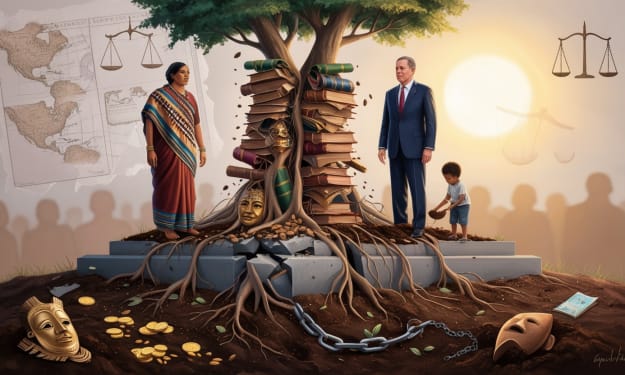
God of the Conqueror: How Religion Was Weaponized Against the Colonized
The history of empire is not just a story of land and gold. It is also a story of God. From the Spanish missions of Latin America to the Anglican schools of Southern Africa, religious institutions were often the first tools of empire. Churches arrived before flags. Bibles before bullets. Priests before governors. And with them came the most dangerous lie ever sold: that submission to foreign rule was not only political, but divine.
By David Thusi7 months ago in Critique
July 1, 1964
July 1 is Canada Day sort of Canada's Independence Day, I believe, but actually July 1, 1964, is my birthday. This is the month of the dog days of summer as well as our Independence Day. Believe it or not I chose the image of the flag and soldiers for I was born the month that Americans started to be sent to the Vietnam War and all those issues Vietnam caused. Canada Day is Canada's day of freedom and for those who need to make some serious choices in their lives. Thank you soldiers for protecting the baby I was.
By Mark Graham8 months ago in Critique
Sociological Imagination
This place is odd. I am at a café in Allentown. I like the loft area. I am Phantom of the Opera here. Hiding in the shadows of a dead and vacant café. There are no people here; just as there were none on the street. The things around me that feel most alive are, ironically, the things that are most dead. To my left is some sort of wooden crank machine. To my right, an old, ornate full-size mirror. Up here, closer to the ceiling, one is better able to appreciate the ghosts of this building. Often the ceiling is the last thing to change through all the iterations of businesses and residences. These things feel more alive than the phone by my side, the clothes that are on me, the bag that I carry, but not the books that are within that bag. Marcel Duchamp coined the term the “infrathin” to give a word to the phenomenon of the residue left by humans on objects. It is the marks left behind, such as the warmth on a seat after someone has left, or the smell of tobacco in a room. These objects around me relate, but they are a more permanent version. They have taken in the marks of history and the dead. There is a possession to them. The phone, my clothes, my bag have touched no one but me. Save for the passing brush or the hug of family and partner. But this is not imprintation. Some of my books have not known the touch of another reader, but not most. I love used books. This possession of books is intensified by the marks of prior human contact. It is a connection with a separate mind that is thinking and interpreting the same words as you. In a way, this is a comradery. It cuts through the loneliness of thought. It adds life to thinking with the dead. Roland Barthes discusses in his essay “The Death of the Author” that the author should be one that disappears into the work. Ultimately, the reader becomes the author. It is the reader that is the end interpreter of the work, and it is the reader that gives meaning to the work. Without the reader, there is no author, and there is no author if they are not themselves a reader. Even without used books, there is an aliveness that comes from books that is ultimately unalive. It is this uncanny paradox that makes books the quintessential source of intelligence. Freud discussed this element in his essay on the uncanny by stating that the uncanny arose from “doubts whether an apparently animate being is really alive; or conversely, whether a lifeless object might not be in fact animate”. In this understanding, it can be argued that books generally hold this uncanny quality. They are both alive and dead and also neither. However, it should be accepted that the uncanny stems more from the doubt than the paradox. This aliveness is the continuation of life through ideas. Discussing, and somewhat opposing, Michel Foucault and Roland Barthes, Kate Zambreno, in her To Write as if Already Dead, speaks of the desire to write with the solitude and peace of someone dead, and yet to place oneself within the work in order to be seen, respected, acknowledged. Although the reader may give the ultimate meaning to the work, the words themselves are a certain continuation of the self. The words matter, but maybe so also the importance of its generality, which Hamlet may well have implied with his epizeuxis, Words, words, words. More than the café in which I now sit, with its wooden crank machine, ornate mirror, and historical ceiling, books contain the history and space in which one can think.
By Daniel J. Guercio8 months ago in Critique
History, Identity, and Power: Who Gets to Write the Truth?
History is not merely a record of what happened. It is a powerful tool, shaped by those who write it, often reflecting the agendas, traumas, and aspirations of nations. In our post-colonial world, history is contested terrain. Nowhere is this more evident than in the ongoing debate over the origins of the Jewish people, the identity of modern Israelis, and the broader question of who has the right to claim historical legitimacy.
By David Thusi8 months ago in Critique
Selah and the Spades: How the Series Would've Benefited Young Adult Media
The world was introduced to Selah Summers and Haldwell Academy in April 2020. Selah is the titular character of Selah and the Spades, an independent Young Adult drama that tells the story of how Selah walks a fine line between being feared and being loved. Months before the film’s release, Variety released an article stating that Amazon Studios had bought the rights to the film and planned to develop a series based on the movie. According to the article, the show was supposed to expound on the world of Haldwell Academy, possibly after Selah graduated. Unfortunately, we learned a few years back from Tayarisha Poe (the writer and director) on Twitter that the series isn’t happening. Looking at the current state of Young Adult Entertainment, Amazon should've developed the series. Teen media today lacks authentic minority representation, original content, and has alienated teen audiences. If the Selah and the Spades series existed, there would be more minority representation in teen media, an original show amongst the sea of remakes and reboots, and a show that doesn't alienate teen audiences.
By Tallulah Chanel8 months ago in Critique
‘Very big force’: Will the news media be attacked for not showing Trump’s military parade?
The question is absolutely appropriate. Ask the folks at the Associated Press what happened for refusing to use the name Gulf of America in every instance without qualification.
By Lenny Cohen8 months ago in Critique
Israel Attacks Iran
Israel Attacks Iran – June 2025 Overview In the early morning hours of June 13, 2025, Israel launched a massive, coordinated military operation—codenamed Operation Rising Lion—targeting Iran’s nuclear facilities, military leadership, and strategic infrastructure. The assault marks the largest Israeli attack on Iran since the Iran–Iraq War and represents a dramatic escalation in Middle East tensions, with the world now bracing for further retaliation and regional instability.
By M Irfan Zafar8 months ago in Critique
The Collapse of a Climate Mascot:
Let’s not act like this came out of nowhere. Greta Thunberg was always a symbol first. The world put a teenager on the global stage and decided she was the solution to a crisis rooted in decades of corporate corruption, policy decay, and public inertia.
By Dr. Mozelle Martin8 months ago in Critique
What Comes After Exposure? Reclaiming Memory and Repair
It starts with a spark—a documentary, a conversation, a sudden reckoning. Maybe someone posts about stolen African artifacts sitting in European museums, or you read that the wealth of a global power was built on slave labor. At first, it feels like outrage. But soon, a deeper question emerges:
By David Thusi8 months ago in Critique
MAGA Fatigue
The 2024 U.S. presidential election has led to increasing disappointment among Americans who backed Donald Trump because they expected his promises of economic growth and law enforcement and American greatness. The base of Trump supporters now experiences deep regret about their support because his administration's policies have produced results that cannot be denied. The initial enthusiasm for Trump has transformed into deep frustration and anger and feelings of betrayal because his second term has exceeded all expectations of chaos and division and damage.
By Melvin Savage8 months ago in Critique