


Killdeer used to nest along our long gravel driveway to the farmhouse. Coming home from school in the afternoon, I would see the Killdeer, with their scurrying steps and bobbing heads, darting here and there in front of me as I walked in from the road. In spring, at nesting season, these birds would put on a clever display. As you approached, if there were a nest nearby, the parent Killdeer would hurry in front of you then fake an injury like a World Cup footballer trying to get a penalty kick.
The seemingly injured bird would begin hobbling tragically, dragging its wing as if disabled (but always keeping a step or two ahead of you as you walked) and then as soon as it judged you were far enough away from its hidden nest, it would burst into flight with a loud call of glee, “Kill-DEE-DEE!” The clever bird thrilled at having lured another potential danger away from the nest.

I’d had a good walk, there was still some decent light on this overcast evening, and so I sat down by a pond to see what might show up. As I waited, the ducks swam over to see if I was the kind of human that threw birdseed (I don’t) then went about their business. Soon they became alarmed by something a distance down the shore and, quacking loudly, swam over in a group to some tangled bushes. I’d seen what was in those bushes - a flash of light brown fur and a fluid movement through the rocks.
From where I was sitting on a low wall with standing driftwood between us breaking up my outline, and with the wind coming from across the pond taking my scent away, I could see the mink hadn’t noticed me. It drew quite close along the rocky shore, being harried by the ducks the whole time (“Egg-stealer! Nest-raider!” they quacked in warning) and I got some good opportunities for photos. Then, when the mink finally did notice me sitting there, now about ten feet away, it gave a startled jump and scampered away between the rocks.
“Taking an image, freezing a moment, reveals how rich reality truly is.” — Anonymous
A few days ago I was down by the lakeshore, watching the waves break over the rocks that were awash in the lake in front of me and seeing the rivulets that surged through the gaps between the boulders I was sitting on. I was thinking about Leonardo, and how he must have struggled to arrive at his sketches of the ever-changing and yet consistent behaviour of water. I saw the patterns in the rushing rivulets that the remarkable Renaissance artist/scientist captured so well in his sketchbooks. What an eye to see and record all of this without the tool of photography to stop time and motion!
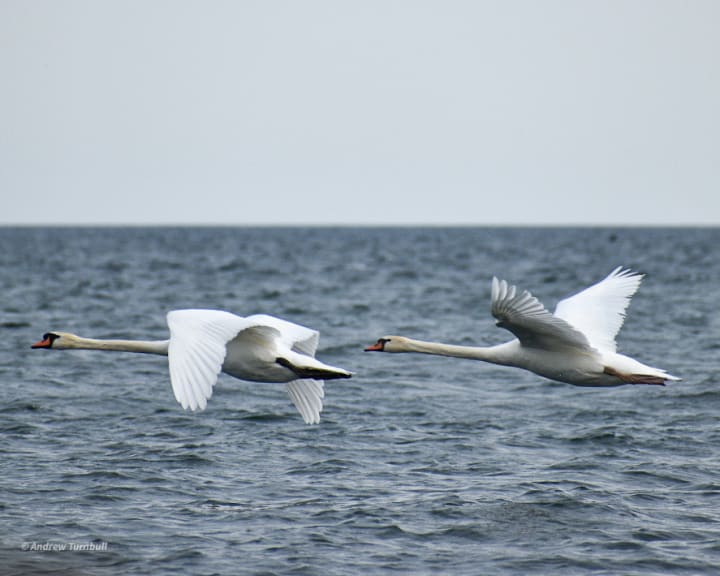
I was sitting there thinking these fairly obvious thoughts, marvelling at Da Vinci (as people have done for at least five hundred years) when, across the bay, I spotted two mute swans flying low over the water toward me. I picked up my camera and waited for them to draw close enough to photograph in flight, hoping they wouldn’t veer off to fly away out over the lake. Luckily they did stick close to shore and here is what the camera captured.
About the Creator
Andrew Turnbull
I take out my camera, screw on the telephoto lens, and start walking.
Letting go of thoughts or worries, I silently ask, “What is beautiful and interesting today?”
The answer to that question is what I photograph and write about here.
Keep reading
More stories from Andrew Turnbull and writers in Earth and other communities.
Nature Diary
Northern Oriole Northern Orioles (also known as Baltimore Orioles) had been sighted in parks around the city for a week or so and I had seen several. They are easily recognized orange-coloured black birds that whistle pure notes from the treetops. I had been trying for days to get a clear photo of one but, shooting at a distance from the ground up to their high perches, all of the photos taken had turned out blurry.
By Andrew Turnbull5 years ago in Earth
Super Bowl LX Recap: A Team Called Hawks
Sixty. The Super Bowl turned 60! Still amazes me that this was the sixtieth Super Bowl played in NFL history. It seems like yesterday that I watched Super Bowl XXVII, the first SB I ever watched. The QB who won Super Bowl XXVII has since called a few SBs, and will call next year's game, but that's another story. Super Bowl LX took place at Levi's Stadium in Santa Clara, California, the home stadium of the San Francisco 49ers. However, it was one of their division foes who represented the NFC, as the Seattle Seahawks faced off against the New England Patriots.
By Clyde E. Dawkins2 days ago in Unbalanced


Comments
There are no comments for this story
Be the first to respond and start the conversation.