Climate
Climate change will prolong tough times for allergy sufferers
Climate change, which is caused by increasing greenhouse gas emissions, will result in an extended allergy season, according to researchers at the University of Michigan. Pollen from grasses, flowers, and trees will also become much more intense, according to the study. The new findings were published in the journal Nature Communications.
By winter oliver lachlan4 years ago in Earth
Are We Prepared for an Extreme Solar Storm?
It’s clear that there are various preparations in place to protect us from the fallout of an extreme solar storm — known as a coronial mass ejecton (CME). But there’s still much we need to learn about CMEs in order to boost our preparedness.
By Shane Peter Conroy4 years ago in Earth
Is a Single Line Electricity (SLE) System Key in Kicking our Unsustainable Energy Habit?
With global warming accelerating at an alarming rate, the adoption of renewable energy technologies by the global community is going to be essential if we are to avoid climate catastrophe. And beyond our natural environment, unsustainable or inefficient energy practices also have direct adverse side effects on humanity.
By Jacob Gitman4 years ago in Earth
The Five Seasons Of Weather. Top Story - May 2022.
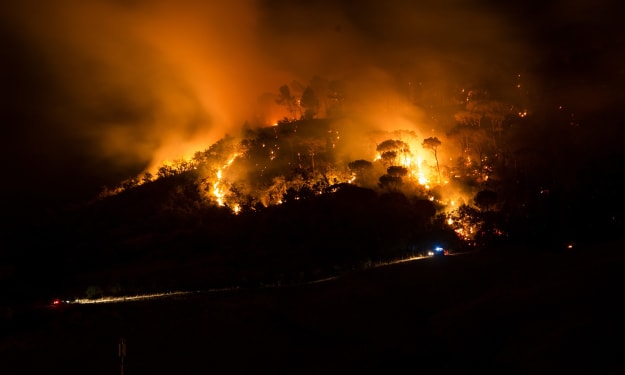
Wildfire Season Is Upon Us It's early in the season, and so far, the number of acres burned across the United States is nearly 78% above the 10-year average. Much of the West, Plains, and Texas remain in the middle of a historic drought as they suffer from above-average temperatures and below-normal precipitation. The current conditions are a perfect storm that could bring larger and even more dangerous wildfires this year.
By Jason Ray Morton 4 years ago in Earth
What Would Happen if a Solar Storm Hit Earth?. Top Story - May 2022.
An extreme solar storm — known as a coronal mass ejection (CME) — can eject as much as one billion tons of plasma from the sun’s surface at speeds up to 1.6 million kilometres per hour. Fortunately, the 2012 CME narrowly missed our blue planet. But it was too close for comfort, and it got scientists thinking about what would have happened if it had impacted Earth.
By Shane Peter Conroy4 years ago in Earth
The Earth is facing serious climate issues
The International Panel on Climate Change has released its latest report. It says it straight: global warming has extremely negative consequences for our environment and even for human physical and mental health. The data is frightening.
By MCCORMACK KENNETH ANDREW4 years ago in Earth
What is the current status of Climate change?
CO2 Atmospheric carbon dioxide levels reached an all-time high in 2020, reaching 417 parts per million in May. The last time carbon dioxide levels exceeded 400 ppm was about 4 million years ago, during the Pliocene epoch, when global temperatures rose by 2-4°C, and sea levels were 10-25 meters (33-82 feet) higher than before.
By valuedPost 4 years ago in Earth
What's next for climate change solutions?
The climate change problem is getting worse. We have finally started to see some solutions on a large scale, but many of us still don't feel like we're doing enough. Our governments and companies also aren't doing enough. So where are we headed? This blog will look at the future of climate change solutions and the different options that we have.
By Satish Kumar4 years ago in Earth
The Waning Crescent
I trace the outline of the circle of the moon in my head as I stare into the ocean sky. Soon, we will be in the new world greeted by the new moon which symbolizes new beginnings. The ocean waves are slightly swaying the boat and I feel a cold but welcoming breeze. I take a deep breath in and gracefully exhale the salty promise of the future.
By Erin Kenny4 years ago in Earth
The Science of Climate Change Explained: Facts, Evidence and Proof
The science of climate change is more solid and widely agreed upon than you might think. But the scope of the topic, as well as rampant disinformation, can make it hard to separate fact from fiction. Here, we’ve done our best to present you with not only the most accurate scientific information, but also an explanation of how we know it.
By Matei Bobu4 years ago in Earth