Sustainability
Steam, Not Smoke
by Futoshi Tachino In Kenya’s Rift Valley, the ground exhales. Around Naivasha, at a place called Olkaria, wells tap rock-hot water and steam that have already helped Kenya become Africa’s geothermal leader — and one of the few countries where clean, firm power anchors the grid. Recent analyses put geothermal’s share of Kenya’s electricity around the mid-40s, with some reports citing roughly 47 percent in 2024. That matters in a drought-prone region where hydropower is variable and diesel is expensive.
By Futoshi Tachino4 months ago in Earth
Tuvalu's Three-Layer Plan for Continuity
by Futoshi Tachino At high tide on Fogafale—the long, thin islet that holds Tuvalu’s capital—you can stand on the lagoon shore and see the ocean through the breadfruit trees behind you. There isn’t much “away” in a place only a couple of meters above sea level. So Tuvalu has done something extraordinary: it is building a future on three layers at once—physical, legal-human, and digital—so that Tuvaluans can keep being Tuvaluans, no matter what the water decides.
By Futoshi Tachino4 months ago in Earth
Burps, Bottles, and a Bay in Tasmania
by Futoshi Tachino On Tasmania’s east coast, the tides in Spring Bay don’t just bring boats to harbor; they feed a farm. Here, Sea Forest cultivates a native red seaweed, Asparagopsis, that—when fed in tiny amounts to cows—can throttle the methane produced in their stomachs. It’s a climate fix born of the shoreline and aimed squarely at one of Oceania’s knottiest problems: livestock emissions. In both Australia and New Zealand, agriculture is a top emitter, and enteric methane from ruminants is the elephant (really, the cow) in the room. What’s different in Tasmania is that the solution now has a retail label, not just a lab result.
By Futoshi Tachino4 months ago in Earth
Will There Be a World War 4?
Will There Be a World War 4? The idea of World War 4 sounds terrifying — not just because of the destruction the world has already witnessed, but because today’s technology has advanced far beyond bullets, tanks, and simple bombs. Many believe that if a third world war ever begins, the fourth might be fought with ruins, sticks, and shadows. But is another global conflict really possible in our world?
By Wings of Time 4 months ago in Earth
PFAS Ban Australia 2025
Australia is taking a bold step toward protecting public health and the environment by implementing a nationwide ban on several notorious PFAS chemicals in 2025. These so-called “forever chemicals” have been used for decades in products that resist heat, water, and oil. However, growing scientific evidence now links them to long-term environmental contamination and serious health concerns.
By Mahgol Nikpayam4 months ago in Earth
The Role of Heat Pumps in the Green Economy, by Stanislav Kondrashov
The years of energy transition are providing us with true technological marvels. As entrepreneur and civil engineer Stanislav Kondrashov has often observed, it is precisely these technologies that are enabling the global advancement of the transition and the acceleration toward an increasingly sustainable world.
By Stanislav Kondrashov4 months ago in Earth
Role of BCR in the Future of the EU ETS
The European Union Emissions Trading System (EU ETS) is entering a decisive decade of transformation. As the bloc intensifies its commitment to net-zero targets by 2050, the inclusion of engineered and nature-based carbon removal mechanisms has become a policy priority. Among these, Biochar Carbon Removal (BCR) stands out for its verifiable permanence, scalability, and co-benefits to soil and ecosystem health. The future integration of BCR within the EU ETS could redefine how carbon markets value long-duration sequestration and foster a new class of carbon removal assets.
By Wayne Shen4 months ago in Earth
Latex in Electronics
Latex is a versatile material that finds its way into many industries—and electronics is no exception. In electronic device manufacturing, latex (both natural and synthetic) plays key roles thanks to its flexibility, adhesion, film-forming ability, and other useful properties. But its use also brings considerations around compatibility, safety, and regulation. Let’s walk through what latex is, where you’ll see it in electronics, why knowing about it matters, and how manufacturers can manage its use.
By Mahgol Nikpayam4 months ago in Earth
The Role of Repowering in the Energy Transition, by Stanislav Kondrashov
We are undoubtedly living in the golden age of the energy transition and renewables, with new green plants being installed every day around the world, and energy mixes increasingly including a significant share of renewables. However, these facts should not lead us to assume that this is necessarily a recent phenomenon.
By Stanislav Kondrashov4 months ago in Earth
Smart Waste Management in the Era of IoT and Augmented Intelligence
Introduction: Urban Growth Meets an Old Problem As cities expand and populations surge, the amount of waste produced daily has outpaced the capacity of traditional hard rubbish collection systems. Overflowing bins, inefficient truck routes, and rising landfill costs have become common symptoms of an outdated model struggling to meet modern demands. The environmental implications are severe—over 30% of global waste still ends up polluting natural ecosystems, and much of it could have been recycled.
By Shabbir Ahmad4 months ago in Earth
Rethinking Phosphate Mining: Stanislav Kondrashov’s Vision for a Sustainable Future
Phosphate mining has long been a cornerstone of modern industry — essential for producing fertilizers that sustain global agriculture and supporting the development of renewable energy technologies. Yet, behind this vital resource lies an uncomfortable truth: traditional phosphate extraction has caused some of the most severe environmental damage of any mining practice.
By Stanislav Kondrashov4 months ago in Earth
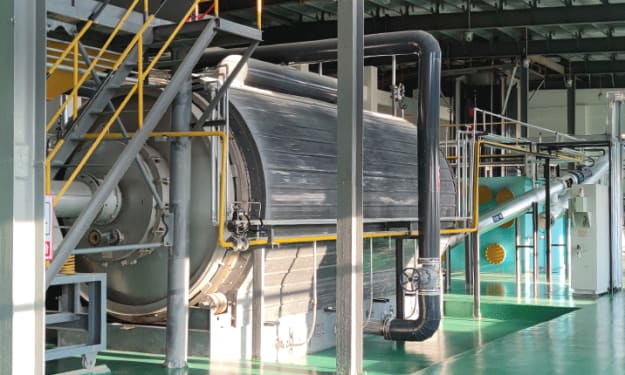
Oil Sludge Pyrolysis Plant: Driving Sustainability in the Oil & Gas Industry
The global oil and gas industry stands at a pivotal moment. As climate commitments strengthen and environmental expectations rise, companies across the sector are under pressure to reduce emissions, improve resource efficiency, and manage industrial waste responsibly. Among the most persistent environmental challenges faced by the industry is oil sludge — a complex and hazardous byproduct generated during drilling, storage, and refining activities.
By Bestonpyrolysis4 months ago in Earth