
How to Thrive in Remote Jobs
The Discipline, Systems, and Mindset Required to Succeed Outside the Office
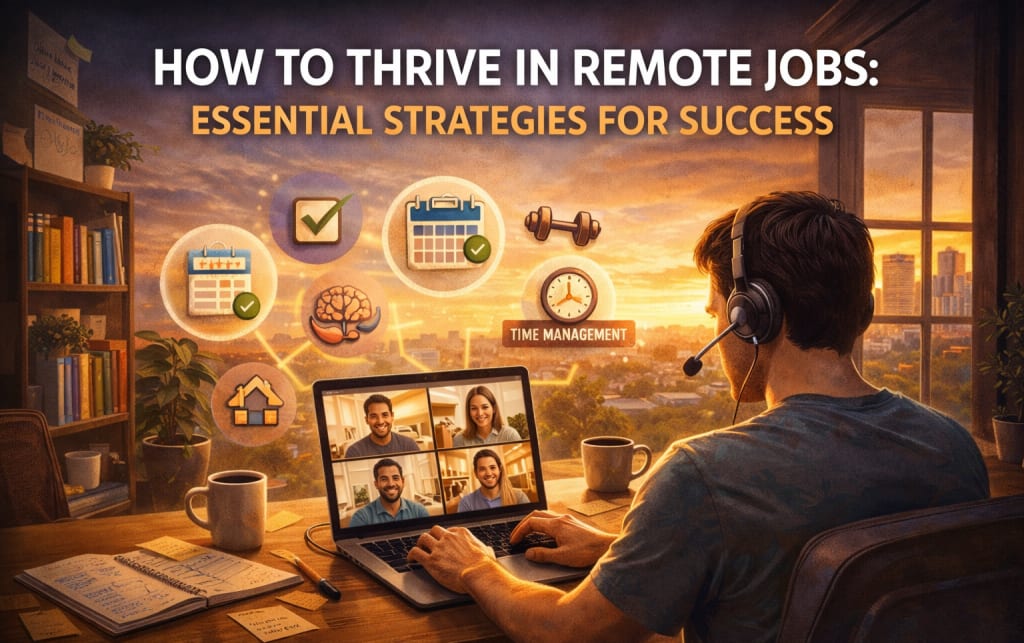
Remote work looks easy from the outside.
No commute.
Flexible schedule.
Work from home.
Freedom.
But what most people don’t realize is this:
Remote work doesn’t remove pressure.
It transfers responsibility.
In a traditional office, structure is built around you.
Your environment enforces focus.
Your manager sees your activity.
Your schedule is externally shaped.
In remote work, none of that exists unless you create it.
And that’s where most people fail.
They confuse freedom with looseness.
To thrive remotely, you must become self-directed, self-managed, and self-disciplined — without supervision.
Let’s break down what that actually requires.
1. Structure Is Not Optional — It’s Survival
When you work remotely, time can dissolve.
Without a commute or fixed office hours, the day becomes fluid. And fluid days often turn into unproductive days.
Thriving remote professionals build structure intentionally.
That means:
Defined start time
Defined deep work blocks
Clear shutdown time
Planned breaks
Not “I’ll work when I feel like it.”
Remote work rewards consistency, not flexibility without boundaries.
Your calendar is your manager.
If you don’t control your time, distractions will.
And at home, distractions are endless.
2. Visibility Replaces Presence
In an office, being seen equals perceived productivity.
In remote work, results replace presence.
No one sees when you log in.
No one sees when you leave.
What they see:
Deadlines met or missed
Communication clear or unclear
Output strong or weak
Thriving remotely means becoming excellent at visible contribution.
That includes:
Over-communicating progress
Giving regular updates
Clarifying expectations early
Delivering before deadlines
Silence in remote work creates doubt.
Clarity builds trust.
And trust builds long-term opportunity.
3. Communication Becomes a Core Skill
Remote work is communication-heavy.
You are not just doing your job.
You are explaining your job.
Misunderstandings cost more remotely because quick clarifications don’t happen naturally.
Strong remote professionals:
Write clearly
Respond promptly
Ask precise questions
Confirm expectations
If you struggle with written communication, remote work will expose that weakness quickly.
Improve it.
Your career depends on it.
4. Environment Impacts Output
Working from your bed is not remote freedom.
It’s productivity erosion.
Your environment signals to your brain what mode you’re in.
If your workspace blends with your relaxation space, your focus weakens.
Thriving remote workers create separation:
A dedicated desk
Clean workspace
Minimal distractions
Reliable internet
Professional setup for calls
It doesn’t need to be expensive.
It needs to be intentional.
Your setup reflects your seriousness.
5. Discipline Beats Motivation
Motivation fluctuates.
Discipline sustains.
Remote work gives you the illusion that you can rely on how you feel.
That is a mistake.
The professionals who grow in remote roles are not the most motivated.
They are the most consistent.
They show up even when:
Energy is low
No one is checking
Distractions are present
Because they understand something critical:
Remote work is a privilege tied to performance.
If performance drops, flexibility disappears.
6. Growth Requires Initiative
In an office, growth opportunities sometimes come to you.
In remote work, you must signal ambition.
That means:
Asking for bigger responsibilities
Volunteering for projects
Suggesting improvements
Tracking your own results
Remote environments reward proactive professionals.
If you only complete assigned tasks and stay silent, you remain invisible.
And invisible professionals rarely advance.
7. Mental Boundaries Protect Sustainability
One hidden risk of remote work is overworking.
When your office is your home, work never feels fully “off.”
Thriving remotely requires defined mental boundaries.
Close the laptop.
Shut down notifications.
End the workday intentionally.
Burnout happens faster when there’s no physical separation.
Balance is not automatic in remote work.
It is engineered.
The Reality Most People Ignore
Remote work is not easier than office work.
It is more self-dependent.
You must become:
Your own time manager
Your own accountability system
Your own performance monitor
If you master that, remote work becomes powerful.
If you don’t, it becomes chaotic.
The freedom remote work offers is directly proportional to your ability to manage yourself.
No structure?
Low growth.
Strong structure?
High leverage.
Final Shift
If you want to thrive remotely, stop asking:
“How can I enjoy the flexibility?”
Start asking:
“How can I operate like a high-level professional without supervision?”
Because that is the real standard.
Remote work rewards adults who act like owners.
It exposes those who rely on external control.
Build discipline.
Improve communication.
Increase visibility.
Protect your focus.
Do that consistently — and remote work becomes more than a job.
It becomes leverage.
About the Creator
Keep reading
More stories from Bahati Mulishi and writers in Education and other communities.
Creating Measurable Community Progress Through Results-Driven Philanthropic Leadership
Results-driven philanthropic leadership is essential for building strong, self-sustaining communities. It transforms charitable intent into structured initiatives that prioritize measurable outcomes and long-term development. Leaders who focus on results understand that sustainable impact requires planning, accountability, and coordinated collaboration.
By John Olin Killgore4 days ago in Education
Nancy Guthrie: Is a miracle still possible after close to two weeks?
Close to two weeks since Nancy Guthrie's abduction As of February 12, 2026, Nancy Guthrie remains classified as missing for 12 days, but there is no official confirmation that she is deceased. Blood matching Guthrie’s DNA was found on her front porch, indicating she likely suffered an injury during the abduction.
By Cheryl E Preston7 days ago in Geeks




Comments
There are no comments for this story
Be the first to respond and start the conversation.